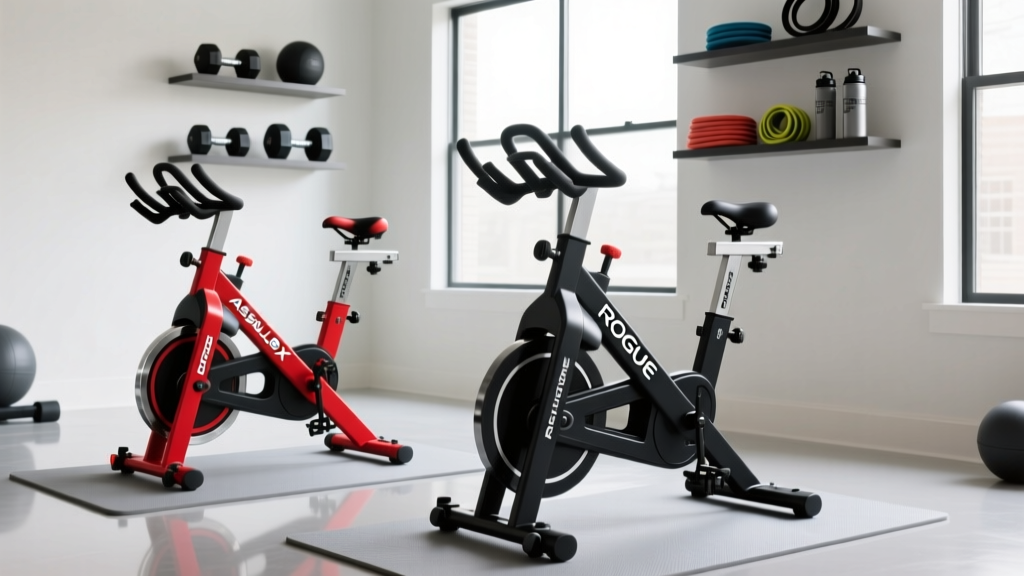
Air Bike vs Assault Bike: Budget & Treadmill Measurements Space Guide
Compare the AssaultBike ProX and Rogue Echo V2. We analyze budget, ROI, and spatial value against standard treadmill measurements for home gyms.

The 2026 Home Gym Dilemma: Maximizing Space and Budget
Building a home gym in 2026 requires a ruthless evaluation of both financial ROI and spatial efficiency. For cardio enthusiasts, the debate often narrows down to two high-intensity powerhouses: the AssaultBike and the Rogue Echo Bike. However, before dropping $1,000+ on an air bike, savvy buyers must weigh this purchase against the spatial realities of traditional cardio equipment. Specifically, understanding standard treadmill measurements is critical when mapping out your floor plan, as the footprint of a motorized treadmill often dictates whether an air bike is a luxury addition or a necessary spatial compromise.
In this comprehensive budget breakdown, we will dissect the financial and spatial value of the top air bikes on the market, compare their long-term maintenance costs, and contextualize their footprint against the sprawling dimensions of standard treadmills.
The Spatial Reality: Air Bikes vs. Treadmill Measurements
When planning a garage or basement gym, square footage is your most unforgiving constraint. A standard motorized treadmill typically boasts a deck and frame footprint of roughly 77 inches long by 32 inches wide. However, raw treadmill measurements only tell half the story. According to the American Council on Exercise (ACE), you must account for user clearance, incline elevation, and safety fall zones. This pushes the functional spatial requirement of a treadmill to at least 85 inches by 40 inches (roughly 23.6 square feet), plus a minimum ceiling height of 84 inches to accommodate incline running.
Conversely, premium air bikes offer a remarkably dense cardiovascular ROI per square foot.
💡 Spatial Insight: While a treadmill demands nearly 24 square feet of dedicated, unobstructed floor space, an air bike occupies roughly 10.5 square feet. If your room's treadmill measurements fail to leave a 3-foot safety buffer behind the machine, an air bike is the vastly superior and safer investment.Budget Breakdown: AssaultBike ProX vs. Rogue Echo V2
The air bike market is currently dominated by two flagship models. Let us break down the exact costs, specifications, and value propositions of each as of 2026.
| Feature | AssaultBike ProX | Rogue Echo Bike V2 |
|---|---|---|
| Retail Price | $999.00 | $1,250.00 |
| Drive System | Poly-V Belt | Poly-V Belt |
| Machine Weight | 140 lbs | 126 lbs |
| Footprint | 52' L x 27' W | 53' L x 29' W |
| Console | Backlit LCD, Bluetooth | Basic LCD, No BT |
| Warranty (Frame) | Lifetime | Lifetime |
Analyzing the $250 Price Gap
At first glance, the Rogue Echo Bike V2 commands a 25% premium over the AssaultBike ProX. Is the extra $250 justified? From a pure budget perspective, the AssaultBike ProX offers superior digital integration. Its Bluetooth-enabled console allows seamless syncing with third-party training apps, a feature noticeably absent on the Rogue Echo. However, the Rogue Echo V2 is renowned for its aluminum and steel hybrid frame and a slightly smoother, quieter belt-drive engagement at low RPMs. If your budget is strictly capped at $1,000, the ProX is the undisputed value champion. If you prioritize absolute structural rigidity during aggressive, out-of-the-saddle sprints, the Echo's engineering justifies the premium.
Drive System Mechanics: The Hidden Maintenance Budget
When calculating long-term value, you must factor in maintenance. Older air bikes relied on chain drives, which required monthly lubrication, tension adjustments, and eventual replacement. The noise profile of a chain-driven bike is also notoriously loud, often exceeding 75 decibels during max-effort intervals.
Fortunately, the 2026 landscape has standardized the Poly-V belt drive. Both the ProX and Echo V2 utilize this system. According to research on high-intensity interval training (HIIT), consistency is key to cardiovascular adaptation; a quiet, maintenance-free bike ensures you are less likely to skip early morning sessions due to noise complaints from sleeping household members. Belt drives require zero lubrication and operate at roughly 60 decibels, effectively eliminating the hidden 'time and money' tax of chain maintenance.
The 'Cheap Air Bike' Trap: Failure Modes to Avoid
Budget constraints often tempt buyers toward $300–$400 air bikes found on massive online retail marketplaces. As domain experts, we strongly advise against this. Here are the specific failure modes we observe in sub-$500 air bikes:
- Plastic Fan Blades: Premium bikes use stamped steel or high-grade aluminum fan blades. Cheap variants use injection-molded plastic that routinely cracks or shatters when subjected to the torque of a 200lb athlete sprinting at 80+ RPMs.
- Bottom Bracket Deflection: Budget frames use thin-walled tubing and low-grade cartridge bearings. Under heavy lateral pedaling forces, the bottom bracket will develop a 'wobble' within 6 months, leading to catastrophic crank arm failure.
- Slipping Belts: Inadequate tensioning mechanisms on cheap models cause the drive belt to slip during rapid accelerations, resulting in a dead pedal feel and premature belt fraying.
Ceiling Clearance and Ergonomic Edge Cases
While we spent considerable time analyzing horizontal treadmill measurements, vertical space is equally critical for air bikes. The handlebars on an air bike extend significantly higher than the seat post. When a user is standing and pulling the handles to their chest, the apex of the handlebar can reach 72 to 75 inches from the floor. If you are installing your gym in a basement with low-hanging ductwork or a sloped ceiling, ensure you have at least 80 inches of vertical clearance directly above the bike's footprint to prevent knuckle-striking incidents during all-out sprints.
Final Verdict: Maximizing Your Fitness ROI
When mapping out your home gym, the decision between an air bike and a treadmill often comes down to the unforgiving math of your room's dimensions. If your space cannot safely accommodate standard treadmill measurements—including the vital rear safety buffer—an air bike is not just a compromise; it is a superior tool for cardiovascular conditioning and caloric expenditure.
For the budget-conscious buyer in 2026, the AssaultBike ProX ($999) represents the pinnacle of value, offering modern belt-drive silence, Bluetooth connectivity, and a lifetime frame warranty. Reserve the Rogue Echo V2 ($1,250) for those who demand the absolute heaviest, most rigid frame available and are willing to pay a premium for analog perfection. By choosing wisely, you secure a lifetime of elite cardiovascular training in less than half the square footage of a traditional treadmill.
More gear to consider
All reviews
Stair Climber Setup Guide: Pairing With a Dumbbell Rowing Machine

Top Apps for Running on a Treadmill: 2026 Feature Buying Guide

Air Bike vs Assault Bike & How to Connect Apple Watch to Treadmill

Treadmill Before or After Workout: 2026 Feature Comparison Guide

Air Bike vs Assault Bike: Avoiding the Pesticide Treadmill
