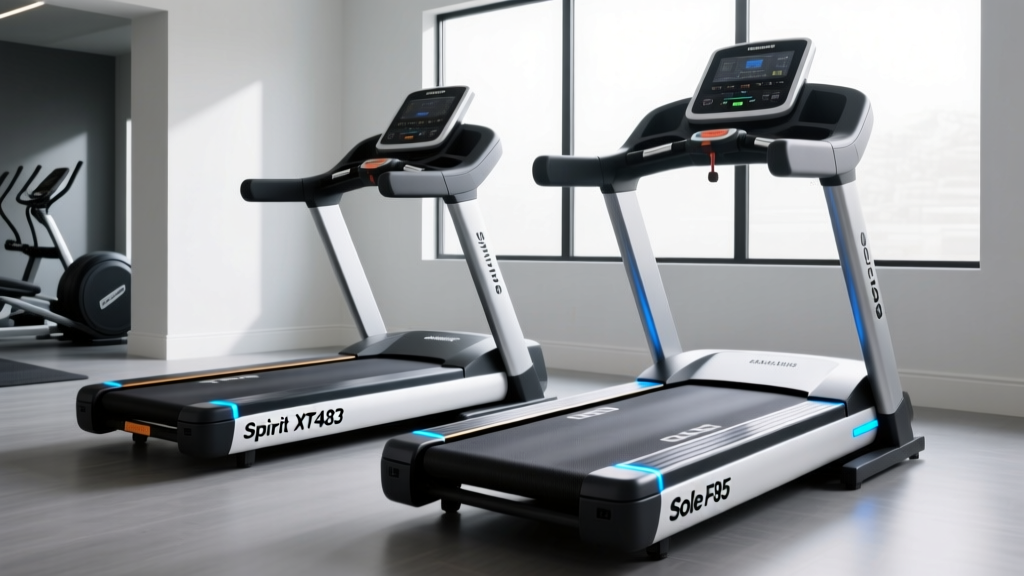
Elliptical vs Treadmill: Budget Value of a Pink Treadmill Setup
We break down the elliptical vs treadmill debate, analyzing the true budget value, ROI, and hidden costs of buying a trendy pink treadmill for home cardio.

The Aesthetic Premium: Why the 'Pink Treadmill' Trend is Disrupting Home Gyms
In 2026, home gym design is as much about interior aesthetics and social media presence as it is about VO2 max and cardiovascular health. The viral rise of the aesthetic 'pink treadmill'—often manifesting as rose-gold walking pads or pastel-colored compact treadmills—has created a massive niche market. Brands like UREVO and Sunny Health & Fitness have capitalized on this, offering blush-pink and rose-tinted machines that fit seamlessly into modern apartment decor. But when you strip away the Instagrammable veneer, how does a budget-friendly pink treadmill actually compare to a similarly priced, utilitarian elliptical machine?
For buyers caught in the crossfire of the elliptical vs treadmill debate, the decision is rarely just about calorie burn. It is a complex budget breakdown involving upfront costs, spatial footprints, maintenance liabilities, and long-term depreciation. In this comprehensive value analysis, we pit the trendy pink compact treadmill against the traditional magnetic elliptical to determine which machine delivers the superior return on investment (ROI) for your home cardio setup.
Head-to-Head Budget Matrix: Aesthetic Treadmill vs. Magnetic Elliptical
To conduct a fair value analysis, we must compare machines in the exact same price bracket. For this breakdown, we are looking at the Sunny Health & Fitness SF-T723016 Smart Treadmill (Pink Edition), which retails for approximately $279, and the Sunny Health SF-E3912 Magnetic Elliptical, which retails for roughly $249. Both represent the entry-level budget tier of home cardio, but their engineering philosophies are vastly different.
| Feature & Metric | Pink Treadmill (SF-T723016) | Magnetic Elliptical (SF-E3912) | Value Winner |
|---|---|---|---|
| Upfront Cost | $279.00 | $249.00 | Elliptical |
| Motor / Resistance | 2.0 HP Peak (approx. 1.0 CHP) | 11 lb Flywheel / Magnetic | Elliptical (No motor burnout) |
| Max User Weight | 220 lbs | 220 lbs | Tie |
| Footprint (Stored) | 4.5 sq ft (Foldable under bed) | 12.5 sq ft (Fixed footprint) | Treadmill (Space ROI) |
| Electricity Cost | ~$4.50 / month (Daily use) | $0.00 (Self-powered) | Elliptical |
| Estimated 3-Year Lifespan Cost | $441 (Including power & lube) | $249 (Zero ongoing costs) | Elliptical |
While the pink treadmill wins decisively on spatial efficiency—sliding neatly under a sofa or bed when not in use—the elliptical dominates the pure financial ROI. The absence of an electric motor on the magnetic elliptical eliminates monthly energy draw and removes the single most common point of mechanical failure found in budget treadmills.
Biomechanical ROI: Calorie Burn and Joint Stress Analysis
When evaluating the 'value' of a cardio machine, we must measure the physiological return on your time and physical effort. According to Mayo Clinic's fitness experts, both machines can provide excellent aerobic workouts, but the biomechanical loading is drastically different.
The Treadmill Calorie Ceiling
The primary limitation of the budget pink treadmill is its motor. A 2.0 Peak HP motor (which translates to roughly 1.0 to 1.25 Continuous Horsepower) is designed strictly for walking and very light jogging, capping out around 7.6 MPH. If you attempt high-intensity interval training (HIIT) or sustained running, the motor will overheat, and the belt will stutter. Therefore, your calorie burn is capped at roughly 250-350 calories per hour of brisk walking or incline hiking.
The Elliptical Full-Body Advantage
Conversely, the elliptical engages both the upper and lower body simultaneously. By utilizing the push-pull arm levers, you activate the latissimus dorsi, triceps, and chest, alongside the glutes and quadriceps. Research highlighted by the Cleveland Clinic notes that because the elliptical distributes the workload across more muscle groups, users often perceive a lower rate of perceived exertion (RPE) while burning an equivalent or higher amount of calories compared to walking on a treadmill. Furthermore, the elliptical offers zero-impact gliding, making it the superior choice for preserving knee and hip cartilage over a multi-year fitness journey.
Expert Insight: The Impact Multiplier
Every time your foot strikes a treadmill belt, your joints absorb a force equal to 1.5 to 2 times your body weight. On a budget treadmill with thinner shock-absorption decking (common in sub-$300 models), this impact is magnified. The elliptical completely eliminates this ground-reaction force, offering a vastly superior 'joint-health ROI' for aging athletes or those recovering from injuries.
Hidden Costs: Maintenance, Depreciation, and Failure Modes
The true cost of home gym equipment is rarely just the sticker price. Budget cardio machines are notorious for specific failure modes that can turn a great deal into an expensive clothes rack.
Belt Lubrication vs. Rail Greasing
Owning the pink treadmill requires a strict maintenance schedule. The friction between the PVC belt and the wooden/MDF deck generates immense heat. You must apply 100% silicone treadmill lubricant every 40 to 60 hours of use. Failure to do so will cause the motor to draw excess amperage to overcome the friction, eventually tripping the internal thermal breaker or frying the motor control board. Replacement belts cost $40-$60, and a control board replacement often exceeds the original cost of the machine.
The elliptical, by contrast, relies on a magnetic braking system and a simple track-and-roller mechanism. Maintenance is limited to wiping down the rails and applying a dab of white lithium grease to the pedal arm pivot points once a year. There is no belt to stretch, no motor to burn out, and no electronic console required to generate resistance.
'In the sub-$500 fitness equipment market, you are almost always better off buying mechanical resistance over motorized resistance. A $250 magnetic elliptical will easily outlast a $250 motorized treadmill by a factor of three.' — Home Gym Equipment Repair Technician, 2025 Industry Report
The Verdict: Which Machine Fits Your Budget and Lifestyle?
The choice between an elliptical and a trendy pink treadmill ultimately comes down to how you define 'value.' Is value measured purely in physiological output and mechanical longevity, or does spatial efficiency and aesthetic motivation hold tangible worth?
Buy the Pink Treadmill If:
- Space is your primary constraint: You live in a studio or small apartment and need a machine that can slide under a bed or stand upright in a closet.
- Aesthetics drive your consistency: You are a content creator, or you know that having a visually pleasing, Instagram-ready workout space is the psychological trigger you need to maintain a daily walking habit.
- Your fitness goal is strictly low-intensity steady state (LISS): You only want to hit 8,000 to 10,000 steps a day while watching TV or working at a standing desk.
Buy the Magnetic Elliptical If:
- You want maximum calorie burn per dollar: You need full-body engagement and higher intensity intervals without the limitations of a weak treadmill motor.
- Joint preservation is a priority: You have a history of shin splints, runner's knee, or lower back pain and require a zero-impact cardio modality.
- You hate maintenance: You want a 'buy it and forget it' machine that requires zero electricity, no belt lubrication, and no software updates.
In the final analysis, while the pink treadmill offers undeniable lifestyle and spatial benefits that justify its $279 price tag for a specific demographic, the magnetic elliptical remains the undisputed champion of raw budget value, mechanical longevity, and full-body cardiovascular ROI.
More gear to consider
All reviews
Navigating the Horizon T101 Treadmill Recall Rumors: Setup Walkthrough & Feature Comparison

ProForm 755 Crosstrainer Treadmill & Curved vs Motorized Setup

Home Stair Climber Guide: Matching Treadmill Speeds to MPH
Elliptical vs Treadmill: Space & NordicTrack Treadmill Problems
Treadmill Belt Care & Ladder Treadmill Machine Space Layouts