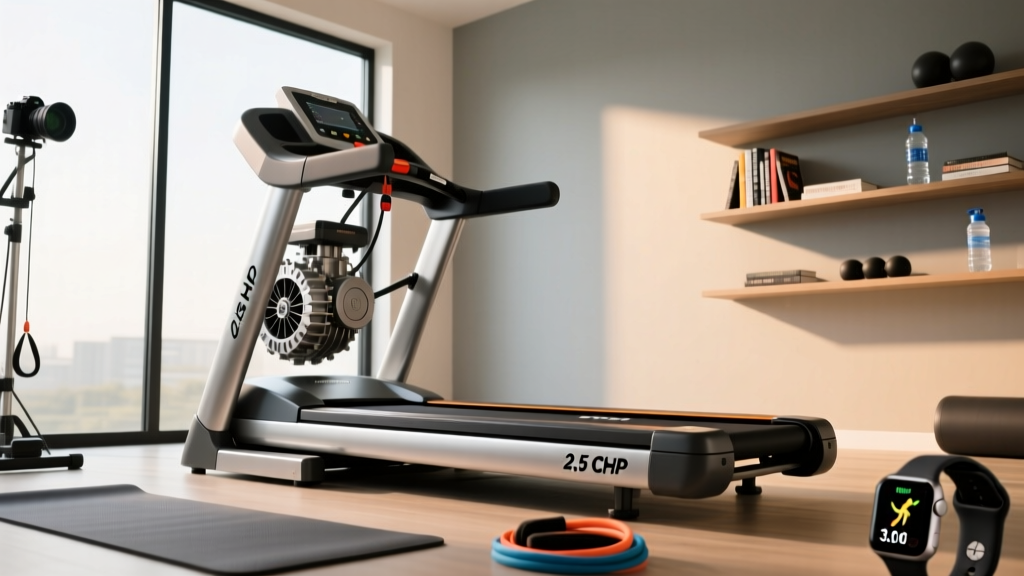
Running 400 m on a Treadmill: Motor Size & Horsepower Guide
Learn how to run 400 m on a treadmill safely. This beginner guide breaks down the exact motor size, CHP, and horsepower you need for sprint intervals.

The Hidden Danger of Sprint Intervals on Home Treadmills
Deciding to run 400 m on a treadmill is one of the most effective ways to build cardiovascular endurance and speed. The 400-meter sprint—exactly one lap around a standard outdoor track—translates to roughly 0.25 miles on a treadmill belt. It is a high-intensity burst that demands rapid acceleration, sustained top-end speed, and immense physical output. But while your lungs and legs might be ready for the challenge, your treadmill’s motor might not be.
Many beginners purchase an entry-level treadmill, attempt high-speed 400 m intervals, and experience a terrifying phenomenon: the belt stutters, slows down, or completely shuts off mid-sprint. This is not just an inconvenience; it is a severe fall hazard. To execute track-style intervals safely, you must understand the intricate relationship between sprint mechanics and treadmill motor size. This step-by-step guide will walk you through exactly how to choose the right horsepower, identify marketing traps, and safely execute 400 m repeats on your machine.
⚠️ SAFETY WARNING: Never attempt to jump onto a moving treadmill belt traveling over 8 mph. High-speed 400 m intervals require a specific straddle-and-ramp technique to protect both your Achilles tendons and the treadmill's motor controller from sudden amperage spikes.Step 1: Decoding Motor Size and the 'Peak HP' Trap
When shopping for a treadmill capable of handling the intense torque required for sprint intervals, you will immediately encounter two metrics: Peak Horsepower (HP) and Continuous Duty Horsepower (CHP). Understanding the difference is the most critical step in your buying journey.
The Marketing Illusion of Peak HP
Peak HP measures the absolute maximum power the motor can generate for a few seconds before it overheats or fails. Budget brands often advertise '3.5 Peak HP' to make their machines sound robust. In reality, a 3.5 Peak HP motor might only sustain 2.0 CHP. When you demand a 12 mph sprint for a 400 m dash, a motor running beyond its continuous duty limit will draw excessive amperage, overheat, and trigger a thermal shutdown.
The Reality of Continuous Duty Horsepower (CHP)
CHP measures the power the motor can sustain indefinitely during a normal workout without overheating. For running 400 m on a treadmill, CHP is the only metric that matters. According to biomechanics research highlighted by the Mayo Clinic, high-intensity interval training places exponential stress on both the human body and the equipment. The repetitive, high-impact footstrikes of a sprint require a motor that can instantly recover from micro-decelerations without bogging down.
| Motor Size (CHP) | Best Use Case | Suitability for 400m Sprints | Expected Price Range (2026) |
|---|---|---|---|
| 2.0 - 2.5 CHP | Walking, light jogging | Fail / Hazardous (Belt slip & thermal shutoff) | $400 - $700 |
| 3.0 - 3.25 CHP | Steady-state running | Poor (Only for users under 150 lbs) | $800 - $1,100 |
| 3.5 - 4.0 CHP | Sprinting, HIIT, heavy users | Excellent (Smooth acceleration, high torque) | $1,200 - $2,500 |
| 4.5+ CHP | Commercial gym, elite athletes | Overkill but Ideal (Zero lag, max durability) | $3,000 - $6,000+ |
Step 2: Matching Your Body Weight to the Motor
Horsepower does not exist in a vacuum. The strain placed on a treadmill motor is a direct calculation of belt friction, speed, and user weight. When your foot strikes the deck at 10 mph, your body weight momentarily halts the belt's forward momentum. The motor must instantly draw extra current to pull the belt back up to speed.
A study on exercise equipment durability notes that a 200 lb runner generates roughly 30% more amperage draw than a 150 lb runner at the exact same speed. Therefore, your body weight dictates your minimum CHP requirement for 400 m intervals:
- Under 150 lbs: Minimum 3.0 CHP (3.5 CHP preferred for longevity).
- 150 lbs to 200 lbs: Minimum 3.5 CHP.
- 200 lbs to 250 lbs: Minimum 4.0 CHP.
- Over 250 lbs: Minimum 4.5 CHP (or consider a commercial-grade model like the Precor TRM 731).
The Unsung Hero: Flywheel Weight
While CHP gets all the marketing glory, the flywheel is what actually smooths out your 400 m sprint. The flywheel is the heavy metal disc attached to the front roller that the motor turns. A heavier flywheel (18 lbs or more) carries kinetic momentum. When your foot strikes the belt, the momentum of the heavy flywheel helps pull the belt through the impact zone, reducing the electrical spike demanded from the motor. Always check the spec sheet for flywheel weight; if it is under 15 lbs, avoid it for sprint intervals.
Step 3: Top Treadmill Models for 400m Intervals
If you are serious about running 400 m on a treadmill, you need a machine engineered for high-torque output. Here are three highly rated models that meet the rigorous demands of track-style interval training:
- Horizon 7.8 (3.5 CHP)
- Price: ~$1,299
- Why it works: Features a heavy-duty 18 lb flywheel and a 350 lb weight capacity. The 3.5 CHP motor is perfectly calibrated for users under 200 lbs looking to do 90-second 400 m repeats without thermal lag.
- Sole F85 (4.0 CHP)
- Price: ~$1,499
- Why it works: The gold standard for home sprinting. The 4.0 CHP motor is paired with a massive 22" x 60" belt, giving you the physical space required for the long, aggressive strides of a 400 m dash. Sole's maintenance guidelines emphasize that their high-torque motors require regular silicone lubrication to maintain peak amperage efficiency.
- NordicTrack Commercial 1750 (4.0 CHP)
- Price: ~$1,999
- Why it works: Offers rapid incline/decline adjustments alongside a robust 4.0 CHP motor. The advanced motor controller board handles the rapid speed fluctuations of HIIT workouts exceptionally well, preventing the 'stutter' effect common in cheaper models.
Step 4: How to Execute 400 m on a Treadmill Safely
A 400-meter sprint is roughly 0.25 miles. If you are running at a 6:00 per mile pace (10 mph), the sprint will take exactly 90 seconds. Because treadmills take 5 to 12 seconds to ramp up from a walking pace to 10 mph, you cannot simply press 'start' and expect an accurate 400 m time. Follow this step-by-step execution protocol to protect your joints and your machine.
The Straddle-and-Ramp Protocol
- Warm-up: Jog at 5.0 mph for 5 minutes to increase blood flow and warm up the treadmill belt lubricant.
- Straddle the Deck: Increase the speed to your target sprint speed (e.g., 10 mph). Do NOT stand on the belt. Stand on the plastic side rails, holding the handrails securely.
- The Mount: Grip the handrails, step onto the moving belt with your dominant foot, match the belt speed for two steps, and then release the rails into a full sprint. (This prevents the motor from having to accelerate your dead body weight from 0 to 10 mph, which is the #1 cause of motor controller burnout).
- The Sprint (90 Seconds): Maintain your 10 mph pace. Focus on high knee drive and quick ground contact time, as noted in Harvard Health's research on interval biomechanics.
- The Dismount: At the 0.25-mile mark, grab the handrails, lift your body weight, and step back onto the side rails. Let the belt continue running to keep the motor cool.
- Active Recovery: Lower the speed to 3.0 mph, step back on, and walk for 2 to 3 minutes before your next 400 m rep.
"High-intensity intervals on a treadmill require a symbiotic relationship between the runner's biomechanics and the machine's torque curve. Mounting a belt already at speed preserves the motor's lifespan and mimics the flywheel effect of outdoor track running."
Step 5: Maintenance for High-Speed Interval Training
Running 400 m sprints generates immense friction and heat. If you do not maintain your machine, even a 4.5 CHP motor will eventually fail. To ensure your treadmill survives your interval blocks, adhere to this strict maintenance schedule:
- 100% Silicone Lubrication: Apply exactly 1 oz of 100% pure silicone treadmill lubricant under the belt every 150 miles. A dry belt can increase motor amperage draw by up to 40%, triggering false thermal shutdowns.
- Belt Tension Check: Every 3 months, check the belt tension. You should be able to lift the belt about 2 to 3 inches off the deck in the center. If it is too tight, it will choke the motor during heavy footstrikes.
- Motor Hood Vacuuming: Every 6 months, unplug the machine, remove the plastic motor hood, and use a vacuum hose to remove dust from the motor fan and controller board. Dust acts as an insulator, trapping heat and causing premature component failure.
Frequently Asked Questions
Q: Can I use a walking pad or under-desk treadmill for 400 m sprints?
A: Absolutely not. Walking pads typically feature 1.5 to 2.0 Peak HP motors (often less than 1.0 CHP) and lack the structural rigidity, side rails, and heavy flywheels required for running. Attempting to sprint on a walking pad will likely destroy the motor controller and void your warranty, while posing a massive injury risk.
Q: Does the treadmill incline affect the motor during 400 m repeats?
A: Yes. Running at a 1% to 2% incline actually reduces the impact shock on your joints and more accurately simulates outdoor wind resistance. However, running at a steep incline (10%+) while sprinting places maximum torque load on the motor gearbox. For 400 m track simulations, keep the incline between 0.5% and 2.0%.
Q: Why does my treadmill belt jerk when my foot lands during a sprint?
A: This 'belt slip' occurs when the tension between the drive roller and the walking belt is too loose, or when the motor lacks the CHP to instantly recover from your footstrike impact. First, tighten the rear roller bolts by a quarter-turn. If the jerk persists, your treadmill's motor is simply undersized for your weight and speed, and you need to upgrade to a 4.0 CHP model.
More gear to consider
All reviews
2026 Cardio Trends: Elliptical vs Treadmill Running Workout Data

Folding Treadmill for Small Spaces: Child Treadmill Care Guide

Treadmill Running vs Outdoor Running: Noise Troubleshooting

Stair Climber vs Treadmill: A Good Treadmill Workout Alternative?

NordicTrack FlexSelect Treadmill: Small Space Review & Care Guide
