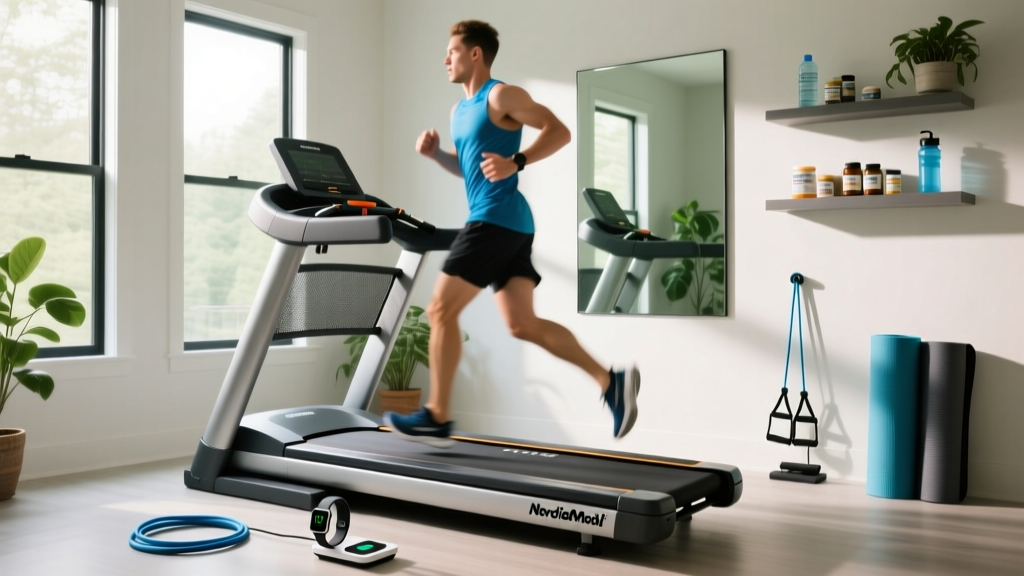
Curved vs Motorized: NordicTrack T7 Si Treadmill Review
We compare curved manual treadmills against motorized models in our NordicTrack T7 Si treadmill review. Find out which drive system fits your 2026 goals.

The Biomechanical Divide: Manual vs. Motorized
When outfitting a home gym in 2026, the debate between self-propelled curved manual treadmills and traditional motorized decks remains one of the most polarizing discussions in fitness equipment. On one side, you have the sleek, gravity-driven mechanics of curved runners; on the other, the accessible, feature-rich world of motorized belts. To ground this theoretical debate in hard data, we are anchoring the motorized side of this head-to-head product comparison with a staple of the budget-friendly market. In this comprehensive NordicTrack T7 Si treadmill review, we will pit this popular motorized entry-level model directly against the biomechanical realities of premium curved manual treadmills like the TrueForm Runner and AssaultRunner Pro.
Understanding the fundamental physics of these two drive systems is critical before dropping thousands of dollars. Motorized treadmills rely on a continuous-loop belt driven by an electric motor, meaning the machine dictates your pace. Curved manual treadmills, featuring a slatted belt on a 15-degree concave track, are entirely human-powered. Your foot strike pulls the belt down and back, translating your kinetic energy into belt rotation. This distinction fundamentally alters muscle recruitment, caloric expenditure, and long-term maintenance requirements.
Head-to-Head Benchmark: TrueForm Runner vs. NordicTrack T7 Si
To visualize the stark differences in engineering, pricing, and intended use cases, we have mapped out the core specifications of a premium curved manual treadmill against our motorized benchmark.
| Specification | TrueForm Runner (Curved Manual) | NordicTrack T7 Si (Motorized) |
|---|---|---|
| Drive System | Self-propelled, gravity & friction | 2.6 CHP Electric Motor |
| Running Surface | 62' x 17' (UHMWPE Slat Belt) | 55' x 20' (Continuous Rubber) |
| Max Speed | Unlimited (User-dependent) | 10 MPH |
| Incline/Decline | Fixed 15-degree curve | 0% to 10% Motorized Incline |
| Caloric Expenditure | +20% to 30% vs. flat running | Standard baseline (0% grade) |
| Footprint & Weight | 70' x 33' (345 lbs) | 68' x 28' (130 lbs) |
| 2026 Market Price | $3,499 | $599 - $749 |
Quick Verdict: The Pace vs. Price Trade-off
The NordicTrack T7 Si offers digital connectivity and motorized incline at a fraction of the cost, making it ideal for walkers and light joggers. However, the TrueForm Runner provides an elite, joint-friendly biomechanical stride with zero motor-failure risks, justifying its premium price tag for serious athletes and HIIT enthusiasts.
NordicTrack T7 Si Treadmill Review: The Motorized Experience
The NordicTrack T7 Si (often grouped with the T7.5S series depending on the retail channel) has long served as the gateway treadmill for home fitness enthusiasts. At its core, it utilizes a 2.6 Continuous Horsepower (CHP) motor. In 2026, a 2.6 CHP motor is considered the absolute minimum threshold for a full-sized treadmill. It handles walking at 3.5 MPH and light jogging at 6.0 MPH with relative ease, maintaining a smooth belt rotation without noticeable stuttering.
The Belt and Stride Reality
Where the T7 Si reveals its budget constraints is the running surface. The 55-inch length by 20-inch width belt is adequate for users under 5'10' walking or jogging. However, for runners taller than 6'0' attempting an 8-minute mile pace, the 55-inch belt creates a 'stride cutoff' effect. You are forced to subconsciously shorten your natural gait to avoid stepping off the rear roller, which can lead to altered biomechanics and eventual shin splints or knee strain over long training blocks.
Pros and Cons of the T7 Si
- Pros: Highly accessible price point; compact folding mechanism; integrated device shelf for tablet-based iFIT streaming; 10% motorized incline adds necessary resistance for walking workouts.
- Pros: Quiet operation at low speeds, making it viable for apartment living or early morning use.
- Cons: The 2.6 CHP motor struggles with thermal management during heavy-user sprint intervals.
- Cons: Deck flex is minimal; the MDF-based deck lacks the commercial-grade cushioning found in higher-tier models, transferring more impact to the calcaneus (heel bone) during heel-strike.
The Curved Alternative: Biomechanics and Energy Expenditure
Transitioning from a flat motorized deck to a curved manual treadmill like the AssaultRunner Pro or TrueForm Runner is a shock to the cardiovascular system. Because there is no motor pulling the belt beneath you, your hamstrings and glutes must actively pull the heavy rubber slat belt backward. According to physiological studies on non-motorized curved treadmills, this self-propelled mechanic increases heart rate, oxygen uptake (VO2), and perceived exertion significantly compared to motorized running at the exact same speed.
Research published in peer-reviewed sports science journals indicates that running on a curved manual treadmill can increase caloric expenditure by up to 30% compared to a standard motorized treadmill. This makes curved treadmills exceptionally efficient for time-crunched professionals looking to maximize their American Heart Association recommended weekly cardio minutes in shorter, more intense intervals.
'The concave shape of a curved treadmill naturally encourages a forefoot or midfoot strike, which reduces the braking forces associated with heel-striking on flat, motorized belts. This can lead to a reduction in patellofemoral joint stress over time.' — Biomechanics Analysis of Non-Motorized Locomotion.
Maintenance, Failure Modes, and Longevity
One of the most critical, yet overlooked, aspects of buying a treadmill is understanding how it will fail. The maintenance profiles of motorized versus curved treadmills are entirely different.
Motorized Failure Modes (NordicTrack T7 Si)
The primary failure point for entry-level motorized treadmills like the T7 Si is the motor controller board and belt friction. If the continuous rubber belt is not lubricated with 100% silicone treadmill lubricant every 150 miles (or roughly every three months), friction builds up between the belt and the MDF deck. This friction forces the 2.6 CHP motor to draw excess amperage to maintain speed. Eventually, this excess heat degrades the motor windings or blows the controller board's capacitor. Furthermore, users over 220 lbs attempting repeated sprint intervals at a 10% incline will frequently trigger the T7 Si's thermal shutoff safety feature, halting the workout mid-stride.
Curved Manual Failure Modes (TrueForm / Assault)
Curved treadmills eliminate the motor, controller board, and power cord, removing the most common points of electrical failure. However, they introduce mechanical wear. The UHMWPE (Ultra-High-Molecular-Weight Polyethylene) plastic guide rails that the slat belt glides upon will slowly wear down. After roughly 1,500 to 2,000 miles of heavy use, you may notice the belt tracking slightly to the left or right. While curved treadmills never require silicone lubrication, they do require periodic tension adjustments via the rear axle bolts and eventual replacement of the plastic guide rails every 4 to 6 years depending on usage volume.
Final Verdict: Which Drive System Fits Your Training?
Choosing between a curved manual treadmill and a motorized model ultimately comes down to your budget, biomechanics, and training goals.
Choose the NordicTrack T7 Si (Motorized) if: You are primarily a walker or light jogger, have a strict budget under $800, require a folding mechanism to save space, and prefer guided, instructor-led programming where the machine automatically adjusts your speed and incline. It is an excellent tool for achieving baseline CDC physical activity guidelines through steady-state low-intensity steady-state (LISS) cardio.
Choose a Curved Manual Treadmill if: You are a runner focused on HIIT, sprint intervals, or athletic conditioning. If you have a budget exceeding $3,000, want a machine that will last a decade with zero electrical maintenance, and need a biomechanically superior surface that promotes a natural midfoot strike and higher caloric burn, the curved manual treadmill is the undisputed champion of the home gym.
More gear to consider
All reviews
Assault Air Bike vs Treadmill Exercise for Weight Loss 2026

Air Bike vs Assault Bike: Do Advantages of Treadmill Walking Win?

Elliptical vs Treadmill: Stress Test Speed & Incline Home Cardio Value
Under Desk Treadmill Office Review & How to Turn On Precor Treadmill

30 Day Treadmill Challenge Setup: Cardio Machine Noise Guide
