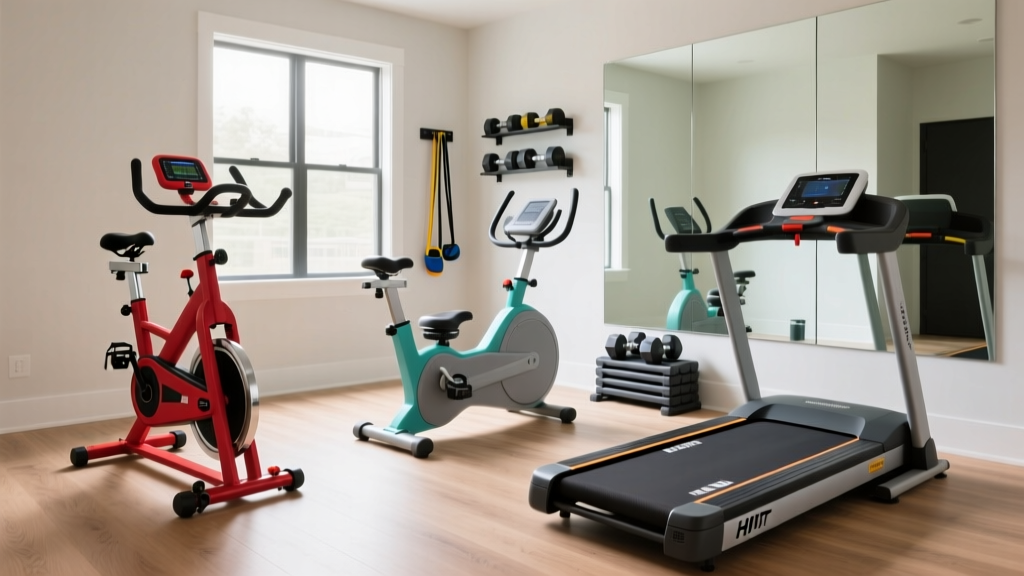
Space Layout: Stationary Bikes vs HIIT Treadmill Workout Walking
Compare upright, recumbent, and spin bike footprints. Learn space-saving layout tips to fit your gear alongside a HIIT treadmill workout walking zone.

The 2026 Home Gym Space Dilemma: Cycles vs. Walking Treadmills
As home fitness spaces evolve in 2026, enthusiasts are increasingly trying to balance two distinct cardio modalities in limited square footage: the low-impact, high-resistance burn of stationary cycling, and the viral HIIT treadmill workout walking routines (like incline sprint-walk intervals) that dominate social media. When designing your home gym layout, you must weigh the spatial demands of stationary bike types—upright, recumbent, and spin—against the clearance required for a walking treadmill.
While a walking pad or compact treadmill folds away neatly, the biomechanics of cycling require different ergonomic clearances. According to the American Council on Exercise (ACE), improper equipment spacing is a leading cause of home gym abandonment and minor injuries. This guide breaks down the exact footprints, layout strategies, and structural considerations for integrating stationary bikes into a space optimized for both cycling and walking intervals.
Footprint Matrix: Stationary Bike Types vs. Walking Treadmills
Before drawing up your floor plan, you need hard data. The table below compares the physical footprint and required operational clearance of popular 2026 cardio machines. Note that 'Operational Clearance' includes the space needed for mounting, dismounting, and emergency stops.
| Equipment Type | Top 2026 Model Example | Machine Footprint (L x W) | Total Operational Zone | Avg. Price Range |
|---|---|---|---|---|
| Spin Bike (Indoor Cycle) | Schwinn IC4 / Bowflex C6 | 48.7' x 21.2' (7.2 sq ft) | 6' x 4' (24 sq ft) | $900 - $1,100 |
| Upright Bike | Sole B94 | 41' x 23' (6.5 sq ft) | 5.5' x 4' (22 sq ft) | $1,100 - $1,300 |
| Recumbent Bike | Schwinn 270 | 64.5' x 27' (12.1 sq ft) | 8' x 4.5' (36 sq ft) | $650 - $800 |
| Walking Treadmill (Foldable) | WalkingPad X21 | 56.5' x 22.5' (8.8 sq ft) | 7' x 4' (28 sq ft) | $500 - $700 |
Deep Dive: Stationary Bike Types for Space-Constrained Layouts
Choosing the right stationary bike type depends heavily on your room's geometry. Here is how upright, recumbent, and spin bikes perform in tight spaces.
1. Spin Bikes (Indoor Cycles)
Spin bikes mimic the geometry of a road bike, leaning the rider forward. Because the handlebars and seat are positioned over a compact flywheel base, they offer the smallest visual and physical footprint of the three types. Models like the Schwinn IC4 feature a narrow 21-inch width, making them ideal for sliding into tight alcoves or placing parallel to a wall.
- Space Pros: Narrowest profile; easily tucked into corners; handles don't extend past the base.
- Space Cons: Requires lateral sway room (at least 18 inches on each side) for out-of-the-saddle climbing during intense intervals.
- Best Layout Placement: Perpendicular to a window or tucked into a 3x6 foot corner nook.
2. Upright Bikes
Upright bikes position the rider in a more vertical, traditional seated posture. The frame is often slightly shorter in length but taller than a spin bike. High-end models like the Sole B94 include larger console screens and wider stabilizer bars for added durability, which slightly increases the floor footprint.
- Space Pros: Shorter wheelbase means they fit well in rooms with low ceiling clearance or sloped attic roofs.
- Space Cons: Wider rear stabilizer bars can trip up users if placed in high-traffic walkways.
- Best Layout Placement: Facing a wall-mounted TV or mirror, centered in a dedicated 4x6 foot zone.
3. Recumbent Bikes
Recumbent bikes are the undisputed space hogs. The extended frame required to support the rider's back and legs horizontally means they demand significant linear floor space. However, their low-to-the-ground profile makes them uniquely suited for specific architectural quirks.
- Space Pros: Extremely low vertical profile (usually under 45 inches high), allowing them to slide under low-hanging shelves, window sills, or slanted ceilings.
- Space Cons: Massive length (often over 5.5 feet) makes them impossible to tuck into standard corners.
- Best Layout Placement: Long, narrow hallways, or placed parallel against a long, blank wall where linear space is abundant but depth is limited.
Designing the Dual-Zone Layout for Hybrid Cardio
If your goal is to alternate between heavy resistance cycling and a HIIT treadmill workout walking routine, you need a dual-zone layout that prevents the two machines from interfering with each other. Consumer Reports notes that multi-equipment home gyms fail when users neglect the 'transition zone'—the space required to safely move between sweaty, high-heart-rate activities.
Vertical Clearance and Structural Considerations
Space optimization is not just about square footage; it is about cubic volume and structural load. When planning a room for both cycling and a HIIT treadmill workout walking routine, you must account for user height and vibration transfer.
The Ceiling Height Trap
A standard walking pad adds only 4 to 6 inches to your standing height. However, spin bikes require significant vertical clearance for out-of-the-saddle riding. If you are 6 feet tall and riding a spin bike with a high handlebar stack, your head can easily reach 7.5 feet. Never place a spin bike directly under a ceiling fan or low-hanging pendant light.
Flooring and Vibration Dampening
Walking treadmills generate rhythmic, vertical impact forces, especially during the sprint intervals of a HIIT walking routine. Spin bikes, conversely, generate lateral (side-to-side) torque.
'If you place a spin bike and a walking treadmill on the same floating laminate floor without a unified high-density rubber mat, the lateral sway of the bike can slowly 'walk' the machine across the floor during climbs, potentially colliding with the treadmill base,' warns home gym interior specialists.
To solve this, invest in a custom-cut, 3/8-inch thick vulcanized rubber mat that spans the entire dual-zone layout. This unifies the floor, dampens the acoustic impact of the walking treadmill, and prevents the bike stabilizers from creeping during high-wattage efforts.
Final Layout Verdict
Optimizing your home gym for both cycling and walking intervals requires treating your floor plan as a dynamic ecosystem rather than a static storage room. If your primary focus is maximizing floor space for a sprawling HIIT treadmill workout walking zone, a compact spin bike is your best secondary addition due to its narrow width and corner-friendly geometry. If you require back support and have a long, narrow room, a recumbent bike utilizes otherwise dead linear space effectively. By respecting operational clearances, utilizing the T-shape layout, and unifying your flooring, you can build a highly efficient, multi-discipline cardio sanctuary in 2026 and beyond.
More gear to consider
All reviews
NordicTrack Dual Shox Cushioning Treadmill: Belt Maintenance Guide

Treadmill Motor Size Guide: Achieving Maximum Treadmill Speed
Setup Guide: Curved vs Motorized for Brisk Walking on Treadmill

Are Curved Treadmills Better? Flat vs. Curved Buying Guide

OK Go Treadmill Music Video: Compact Portable Cardio Layouts
