Lying Leg Press Machine vs 45-Degree: 2026 Buyer's Guide
Compare the lying leg press machine and 45-degree sleds. Explore biomechanics, top 2026 models, pricing, and space requirements for your ultimate leg day.

The Biomechanical Divide: Gravity vs. Pulley Mechanics
When outfitting a commercial facility or a high-end home gym in 2026, the debate over lower body development often narrows down to two primary plate-loaded giants: the lying leg press machine (horizontal) and the traditional 45-degree linear sled. While both isolate the quadriceps, glutes, and hamstrings without the systemic fatigue of a barbell back squat, their biomechanical force vectors are fundamentally different.
The 45-degree leg press relies on gravity acting upon an angled sled. According to principles outlined by the ExRx Kinesiology Database, the actual resistance force on a 45-degree angle is roughly 70.7% of the loaded weight (the sine of 45 degrees). Therefore, loading 400 lbs onto the sled yields approximately 282 lbs of actual horizontal resistance against your feet. Conversely, a true horizontal lying leg press machine utilizes an aircraft cable and pulley system or a direct lever arm. This creates a 1:1 or 2:1 mechanical ratio, meaning the resistance is entirely independent of gravity's downward pull, resulting in true horizontal force production.
"The horizontal force vector of a lying leg press machine virtually eliminates axial loading and lumbar shear, making it the gold standard for athletes managing lower back fatigue or recovering from spinal compression injuries." — Biomechanics in Strength and Conditioning
Deep Dive: The Lying Leg Press Machine (Horizontal)
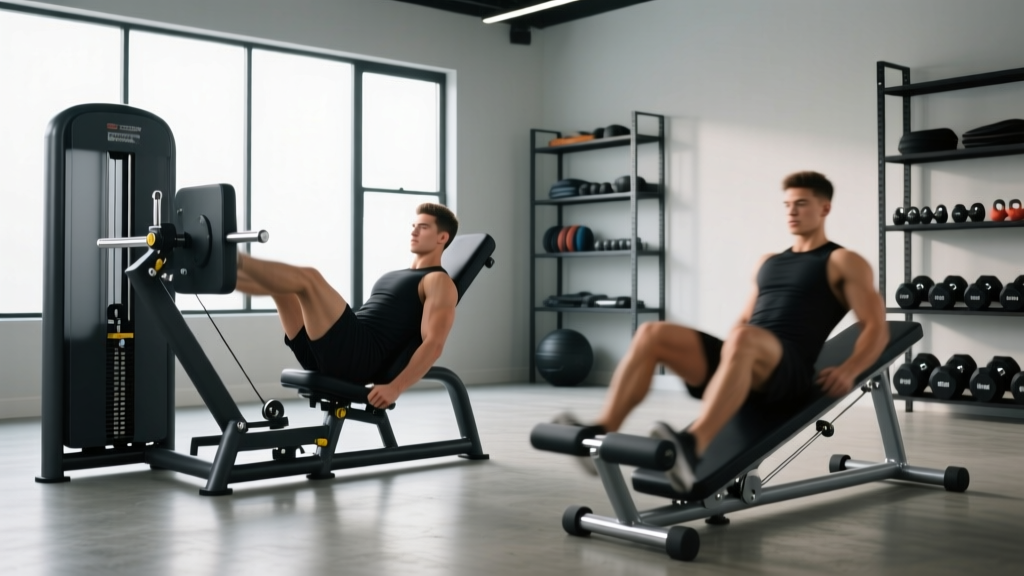
The lying leg press machine positions the user flat on their back or seated in a highly reclined, supported position, pushing a weight stack or plate-loaded carriage horizontally. This setup is highly favored in physical therapy clinics and athletic performance centers because the spine remains completely neutral and supported against the pad throughout the entire range of motion.
Top 2026 Horizontal Models & Specifications
- Titan Fitness Horizontal Leg Press: Priced around $1,499, this unit is a staple for garage gyms. It features an 82" L x 35" W footprint, utilizing a heavy-duty pulley system. The max capacity is 800 lbs, and the 1:1 pulley ratio ensures that 200 lbs of plates equals 200 lbs of resistance.
- Cybex Eagle NX Horizontal Press (Commercial): Retailing between $4,500 and $5,200, this iso-lateral machine uses frictionless pivot points rather than cables. It requires a larger footprint (90" L x 48" W) but offers unparalleled joint articulation and a 1,200 lb capacity.
Deep Dive: The 45-Degree Linear Sled
The 45-degree leg press is the undisputed king of absolute load. Because the sled rides on dual or quad linear bearings along steel guide rods, lifters can safely move astronomical amounts of weight. The American Council on Exercise (ACE) notes that the 45-degree press allows for massive mechanical tension, which is a primary driver of muscle hypertrophy. However, the angled nature of the machine means that as the sled descends, the pelvis can be forced into a posterior tilt if the user lacks adequate hamstring flexibility, leading to the dreaded "butt wink" and subsequent lumbar flexion under load.
Top 2026 45-Degree Models & Specifications
- Body-Solid Pro Club Line SLP500G: An entry-level commercial workhorse priced at $1,899. It features a 105" L x 62" W footprint, dual linear bearings, and a 1,000 lb weight capacity. The starting resistance is notably higher due to the heavy steel sled carriage (approx. 105 lbs empty).
- Arsenal Strength 45-Degree Leg Press: The premium choice for 2026, costing roughly $5,400. It boasts four oversized linear bearings, a 1,500 lb capacity, and an adjustable back pad that mitigates pelvic tilt. Its massive 115" L x 70" W footprint requires dedicated square footage.
Head-to-Head Comparison Matrix
| Feature | Lying Leg Press (Horizontal) | 45-Degree Linear Sled |
|---|---|---|
| Primary Force Vector | Horizontal (Pulley/Lever) | Angled (Gravity x 0.707) |
| Lumbar Shear Risk | Extremely Low (Spine fully supported) | Moderate (Risk of posterior pelvic tilt) |
| Average Footprint | 85" L x 35" W (Space efficient) | 110" L x 65" W (Requires high ceilings) |
| 2026 Price Range | $1,400 - $5,200 | $1,800 - $6,500+ |
| Maintenance Focus | Cable tension & pulley alignment | Linear bearing lubrication & rod cleaning |
Real-World Failure Modes and Maintenance
Buying heavy iron is an investment, and understanding how these machines fail in the real world is critical for gym owners and serious home lifters. The failure modes between a horizontal lying leg press machine and a 45-degree sled are entirely distinct.
Horizontal Press: Cable and Swage Failures
The Achilles heel of any cable-driven horizontal press is the aircraft cable and the swage fittings (the metal sleeves crimped onto the cable ends). Under repeated heavy eccentric loading, cables can stretch or fray inside the nylon pulleys. Edge Case: If a user drops the weight stack rapidly, the sudden kinetic shock can snap a poorly maintained cable at the swage point. Protocol: Inspect cables for micro-frays every 6 months and replace them every 3 years, regardless of visual wear. Lubricate pulley axles with dry PTFE spray annually.
45-Degree Sled: Bearing Seizure and Chalk Dust
Linear bearings are precision components. The most common real-world failure in commercial gyms is bearing seizure caused by magnesium carbonate (lifting chalk) and dead skin cells mixing with old grease on the guide rods, creating an abrasive paste. Edge Case: A seized bearing will cause the sled to "stick" mid-rep, creating a dangerous sticking point that can lead to knee strain. Protocol: Wipe down guide rods with a microfiber cloth after every session. Every 90 days, clean the rods with isopropyl alcohol and apply a thin layer of white lithium grease or specialized linear bearing oil.
Warning: Never use WD-40 on 45-degree leg press guide rods. It acts as a solvent that will strip the internal lubrication from the linear bearings, leading to rapid metal-on-metal degradation and voiding most manufacturer warranties.The FitGearPulse Decision Framework
Choosing between these two lower-body titans requires an honest assessment of your space, budget, and training demographic. Use our 2026 decision matrix below to finalize your purchase.
Choose the Lying Leg Press Machine If:
- Space is at a Premium: Your ceiling height is under 8 feet, or your total dedicated leg press footprint is less than 25 square feet.
- Rehab & Longevity are Priorities: You are training aging populations, athletes with a history of herniated discs, or clients who struggle with the hip mobility required to hit deep flexion on an angled sled without pelvic tilt.
- True Isolation is the Goal: You want to eliminate the stabilizing demands of gravity and focus purely on horizontal quad and glute contraction without lower back fatigue.
Choose the 45-Degree Sled If:
- Absolute Load is King: You train powerlifters, bodybuilders, or strongman athletes who need to overload the central nervous system with 800+ lbs of raw mechanical tension.
- You Have the Real Estate: You possess a commercial bay or a garage gym with 10-foot ceilings and a 10x10 foot dedicated footprint.
- Budget Allows for Premium Bearings: You are willing to invest in a quad-bearing commercial unit (like Arsenal or Prime) to ensure a frictionless ride under maximal loads, rather than settling for a cheap, sticky dual-bearing unit.
Ultimately, the lying leg press machine offers an unmatched, spine-safe horizontal contraction that perfectly complements free-weight squats, while the 45-degree sled remains the ultimate tool for brute-force overload. Assess your spatial constraints and biomechanical needs, and invest in heavy-gauge steel that will outlast the trends of 2026.
More gear to consider
All reviews
Budget Breakdown: Cybex Leg Press Machine vs Hip Thrust Setups

Setting Up a Rogue Leg Press Machine vs Hack Squat

Hack Squat vs Leg Press Setup & Calf Press on Leg Press Machine
Standing vs Seated Calf Raises & Leg Press Machine Foot Placement

Hack Squat vs Leg Press Setup: Calculating Leg Press Machine Weight
