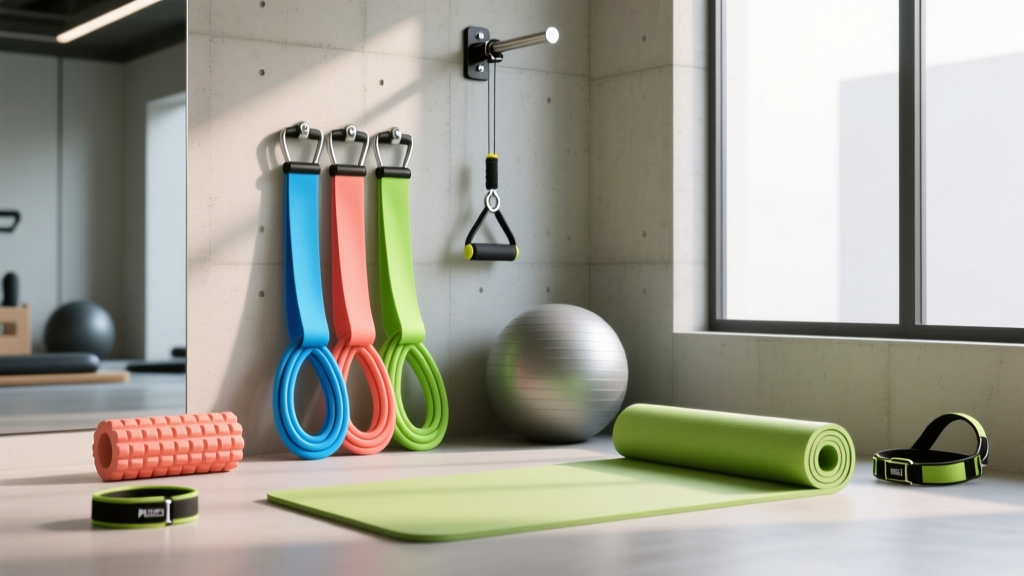
Small Space Pilates Accessories & Resistance Bands Workout Equipment
Maximize your home studio with our space-saving Pilates equipment accessories guide, layout designs, and resistance bands workout equipment integration.

The Micro-Studio Blueprint: Calculating Your Pilates Footprint
As urban living spaces shrink and home fitness evolves in 2026, dedicating an entire room to a traditional Pilates studio is a luxury few possess. According to the American College of Sports Medicine, functional movement requires specific spatial clearances to prevent joint strain and equipment damage. A standard Pilates mat measures 24 by 68 inches. However, to execute lateral arm sweeps and full leg circles without striking a wall, you must add a minimum of 24 inches of clearance on the left, right, and top of the mat. This brings your absolute minimum functional footprint to 6 feet wide by 8 feet long (48 square feet).
Space Optimization Callout: Never measure your room based on the equipment's resting dimensions. Always map the 'active envelope'—the maximum three-dimensional space your body and the accessory occupy at peak extension.Core Pilates Equipment Accessories for Tight Layouts
When curating a compact studio, every accessory must serve a dual purpose or offer rapid stowability. The era of leaving a massive wooden reformer in the center of the living room is over. Modern space optimization relies on modular, collapsible, and multi-vector gear.
1. The Foldable Reformer & Wall-Mounted Towers
For those who need spring-based carriage work, the AeroPilates Premier Studio Edition Reformer (retailing around $499-$549 in 2026) is a masterclass in spatial efficiency. When collapsed, it measures just 22' W x 18' H x 48' L, allowing it to slide under a standard bed or stand upright in a closet. Pair this with a wall-mounted half-cadillac tower, which utilizes vertical real estate rather than floor space, providing spring-loaded arm and leg work without the 8-foot horizontal footprint of a traditional full Cadillac.
2. The 14-Inch Magic Circle & Toe Correctors
The Balanced Body Pilates Ring ($28) features a flexible fiberglass core encased in foam. At 14 inches in diameter and less than 2 inches thick, it slips into a drawer or hangs on a wall peg. It provides essential isometric adduction resistance for inner thighs and chest presses. Similarly, the classical Toe Corrector ($45-$60), originally designed by Joseph Pilates, utilizes a small wooden base and heavy-duty springs to articulate the metatarsals. It takes up less than 6 square inches of shelf space but delivers unparalleled foot and ankle rehabilitation.
Equipment Footprint & Cost Matrix
| Accessory | Active Footprint | Stored Dimensions | 2026 Est. Cost |
|---|---|---|---|
| AeroPilates Premier Reformer | 86' x 24' | 48' x 22' x 18' | $499 - $549 |
| Balanced Body Pilates Ring | 14' Diameter | 14' x 14' x 2' | $28 |
| Merrithew Flex-Band (Set) | Variable | 6' x 4' x 2' (Pouch) | $16 - $22 |
| Classical Toe Corrector | 6' x 4' | 6' x 4' x 3' | $45 - $60 |
Integrating Resistance Bands Workout Equipment into Pilates
While springs offer linear tension, integrating high-quality resistance bands workout equipment introduces variable, multi-planar resistance that mimics the reformer's footbar and strap systems at a fraction of the spatial cost. The IDEA Health & Fitness Association frequently highlights elastic resistance for its ability to improve proprioception and joint stabilization in rehab and Pilates settings.
Tension Mapping: Matching Springs to Bands
To effectively replace reformer springs with elastic bands, you must understand tension mapping. A standard reformer red spring provides roughly 25 lbs of resistance at full extension, while a green spring offers about 15 lbs.
- Red Spring Equivalent (25 lbs): Use a heavy-duty latex tubular band with carabiners. Anchor it to a heavy door hinge or a wall-mounted D-ring installed at baseboard height for foot-straps, or eye-level for arm work.
- Green Spring Equivalent (15 lbs): The Merrithew Flex-Band ($16) is a flat, TPE-based band with ergonomic handles. It is ideal for seated rowing and supine arm presses where grip fatigue is a limiting factor.
- Blue Spring Equivalent (35+ lbs): For heavy leg presses, loop a continuous 41-inch fabric or heavy latex power band around a structural pillar or heavy furniture leg. Fabric bands prevent the rolling and snapping associated with cheap TPE loop bands.
'The beauty of modern elastic resistance is the ascending tension curve. Unlike a dead weight, the band forces the muscle to accelerate through the concentric phase of a Pilates teaser or leg circle, demanding deeper core engagement,' notes the Pilates Method Alliance in their continuing education guidelines on contemporary apparatus modifications.
Biomechanics of Band Anchoring
When anchoring bands for Pilates arm series (like the supine tricep press or seated rowing), the angle of the anchor point dictates the vector of resistance. A wall anchor placed at 45 degrees will engage the latissimus dorsi differently than a floor-level anchor. For small spaces, install a multi-point wall anchor track (similar to a TRX mount but rated for lateral sheer force) at 12-inch, 36-inch, and 60-inch heights. This allows you to replicate the exact biomechanical angles of a reformer's adjustable spring bar without moving heavy furniture.
3 Small-Space Layout Configurations
How you arrange your gear dictates the flow of your practice. Here are three optimized layouts for restricted square footage:
- The 5x5 Corner Anchor: Ideal for apartments. Place a thick, high-density EVA foam mat in a 5x5 corner. Install a heavy-duty door anchor on the adjacent door and a wall-mounted band anchor at 12 inches and 60 inches. This allows you to transition from standing Pilates to mat work without moving your anchor points.
- The Closet Conversion: Remove the lower shelves of a standard 6-foot closet. Store your folded reformer vertically against the back wall. Use the inside of the closet door to hang a pegboard system for your Magic Circle, Flex-Bands, and toe correctors. Pull the mat out onto the bedroom floor only during your 45-minute session.
- The Under-Bed Slide: Utilize the 6-to-8-inch clearance beneath a standard bed frame. Store flat accessories (rings, mats, loop bands) in a rolling canvas organizer. Keep your tubular resistance bands workout equipment in a dedicated UV-blocking bin to prevent material degradation.
Material Science: Preserving Your Gear in Compact Storage
Space optimization often means storing gear in suboptimal environments, like damp basements or sunlit window seats. Natural latex and Thermoplastic Elastomer (TPE) are highly susceptible to UV degradation and ozone exposure. According to material durability studies, continuous UV exposure can reduce the tensile strength of a latex resistance band by up to 40% within six months, leading to catastrophic snapping during high-tension Pilates movements.
Preservation Protocol: Always store your resistance bands workout equipment in opaque, airtight containers with silica gel packets to control humidity. Keep them away from direct HVAC vents, as extreme temperature fluctuations accelerate polymer breakdown. Wipe down foam accessories like the Magic Circle with a mild, non-alcohol-based antibacterial wipe to prevent the foam from drying out and cracking.
Frequently Asked Questions
Can I use resistance bands instead of a Pilates reformer?
Yes, but with caveats. While resistance bands workout equipment can mimic the ascending tension curve of reformer springs, they lack the gliding carriage that challenges your stabilizing muscles during eccentric movements. Use bands to supplement mat Pilates, focusing on the arm and leg spring-work sequences.
What flooring is best for a compact Pilates layout?
Avoid carpet, which creates friction burns during rolling exercises. Opt for interlocking high-density EVA foam tiles (at least 12mm thick) or a dedicated 6mm TPE Pilates mat placed over hard wood or laminate. This provides the necessary grip for standing band work and cushioning for spinal articulation.
How often should I replace my elastic bands?
For daily practitioners, replace latex and TPE bands every 6 to 8 months. Inspect the anchor points and carabiner clips for micro-tears or metal burrs before every session to ensure safety. If a band shows any white stress marks near the carabiner attachment, retire it immediately.
More gear to consider
All reviews
Battle Rope Guide & Yoga Mat Thickness for Beginners: 2026 Layouts
Foam Roller Density & Size Selection for Salt Yoga Mat Recovery

Does Planet Fitness Have Yoga Mats? Setup & Mat Comparison Guide

Yoga Block & Strap Guide: Space Layouts & Yoga Mat Sling Bag Storage
Medicine Ball Weight Selection & All in Motion Yoga Mat Review
