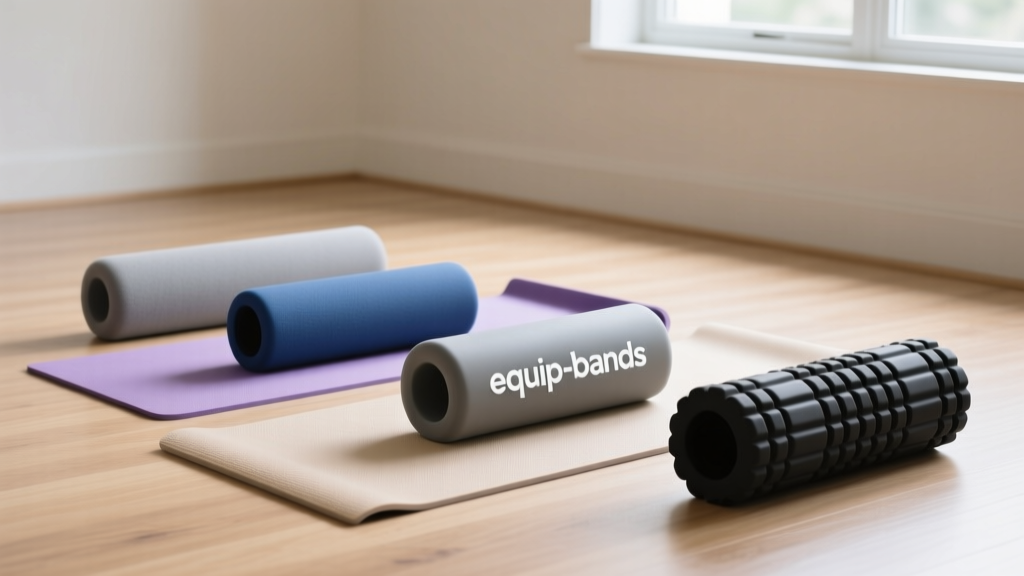
Foam Roller Density & Size Selection for Salt Yoga Mat Recovery
Master foam roller density and size selection with our beginner guide. Learn how to pair the right roller with your salt yoga mat for safe, effective recovery.

Building the Ultimate Recovery Station: Foam Rollers and Salt Yoga Mats
As home yoga studios and recovery spaces evolve in 2026, the Yoga Journal notes a massive surge in the popularity of salt yoga mats. Prized for their natural antimicrobial properties, grounding aesthetics, and thermal regulation during hot yoga, salt-infused and Himalayan crystal mats are a premium investment (typically ranging from $130 to $250). However, integrating myofascial release tools into this space requires careful consideration. If you are a beginner looking to pair foam rolling with your salt yoga mat practice, choosing the wrong foam roller density or size can lead to ineffective recovery, personal injury, or severe damage to your mat's delicate crystalline surface.
This beginner-friendly, step-by-step guide will walk you through the exact science of foam roller density and size selection, ensuring you protect your gear while optimizing your post-yoga recovery.
Step 1: Decoding Foam Roller Density (The Pressure Scale)
Foam rollers are categorized by their material composition and density, which dictates how much pressure they apply to your fascia and muscle tissue. According to the American Council on Exercise (ACE), beginners should always start with lower densities before progressing to deeper tissue work. Here is the breakdown of the four primary density tiers:
| Density Tier | Core Material | Pressure Level | Best For | Avg. Price (2026) |
|---|---|---|---|---|
| Soft (White) | Low-density Polyethylene (LDPE) | Light / Gentle | Beginners, restorative yoga, acute injury rehab | $25 - $45 |
| Medium (Standard) | Standard EVA Foam | Moderate | General maintenance, post-yoga stretching | $15 - $30 |
| Firm (Black/Grid) | Expanded Polypropylene (EPP) | Deep / Intense | Athletes, deep trigger point therapy | $35 - $55 |
| Extra-Firm (Textured) | PVC Core + EVA Shell | Aggressive | Advanced users, severe adhesions | $60 - $85 |
Step 2: Sizing Up — Length and Diameter Dimensions
Size dictates stability and the surface area you can treat at one time. When working on or immediately adjacent to a standard 72x26 inch salt yoga mat, spatial awareness is key.
The 36-Inch x 6-Inch (The Full-Back Standard)
Use Case: Thoracic spine extension, full-body alignment, and Pilates-based rolling.
Mat Integration: A 36-inch roller takes up exactly half the length of your salt yoga mat. It is ideal for lying vertically along the spine to open the chest after deep forward folds. Tip: Place the roller on a microfiber towel over your salt mat to prevent the roller's edges from scraping the salt surface during spinal extensions.
The 24-Inch x 5-Inch (The Studio Commuter)
Use Case: Quads, lats, and general leg work.
Mat Integration: This is the goldilocks size for home studios. It provides enough width to roll both legs simultaneously but leaves ample space on your salt mat for your hands and feet to maintain balance without stepping off the mat's grippy, salt-infused perimeter.
The 12-Inch x 4-Inch (The Targeted Trigger Tool)
Use Case: Calves, IT band (TFL), and glute targeting.
Mat Integration: Highly portable. Because it requires precise balance, you will often need to plant your hands firmly on your salt yoga mat for leverage. The natural moisture-wicking properties of salt mats provide excellent hand traction during these unstable, single-leg rolling movements.
Step 3: Protecting Your Salt Yoga Mat During Use
Salt yoga mats are fundamentally different from standard TPE or PVC mats. They rely on a delicate crystalline topography for grip and grounding. To protect your investment while foam rolling, follow this 3-point preservation framework:
- The Barrier Method: Always lay a thin, tightly woven cotton or microfiber towel between the foam roller and the salt mat. This prevents friction burns on the mat's surface.
- Density Selection: Stick to Medium-Density EVA foam (like the Amazon Basics or OPTP standard lines). EVA is soft enough that if it slips and hits the mat, it will not chip the salt crystals.
- Cleaning Protocol: After rolling, wipe your roller with a damp cloth. If salt dust transfers from the mat to the roller, it will dry out the foam and cause it to flake and degrade within months.
Step 4: Your Beginner Post-Yoga Rolling Routine
According to research highlighted by Harvard Health Publishing, foam rolling for just 5 to 10 minutes post-exercise can significantly reduce delayed onset muscle soreness (DOMS). Here is a beginner-friendly sequence designed to be performed directly beside or on your salt yoga mat.
1. The Calf Release (2 Minutes per leg)
Sit on your salt mat with your legs extended. Place a 12-inch medium-density roller under your right calf. Cross your left leg over the right for added pressure. Plant your hands on the salt mat behind you—the salt texture will grip your palms, preventing your hands from slipping as you lift your hips. Roll slowly from the ankle to just below the knee. Pause for 20 seconds on any tender trigger points.
2. The TFL / Hip Flexor Glide (2 Minutes per side)
Anatomy Note: Beginners often mistakenly roll the side of their thigh (the IT Band). The IT band is a thick fascia that does not stretch. Instead, target the Tensor Fasciae Latae (TFL) at the top of the hip. Lie on your side, place the roller just below your hip bone, and use your forearms on the salt mat to control the pressure. Roll only 3 to 4 inches down the upper thigh.
3. Thoracic Spine Extension (3 Minutes)
Place a 36-inch soft or medium roller horizontally across your mid-back (bottom of the shoulder blades). Keep your hips on the salt mat. Interlace your fingers behind your head to support your neck. Gently lean back over the roller, allowing your chest to open. Do not roll onto your lower back (lumbar spine), as this lacks rib-cage support and can cause hyperextension.
Expert Insight: 'The goal of myofascial release is not to push through excruciating pain. On a scale of 1 to 10, your discomfort should never exceed a 6 or 7. If you are holding your breath or tensing your core, the density of your roller is too high, and your nervous system is fighting the release.' — Sports Medicine & Biomechanics Consensus, 2025
Troubleshooting Common Beginner Edge Cases
- Issue: I feel sharp, shooting nerve pain while rolling my calves.
Solution: Stop immediately. You are likely pressing on the peroneal nerve near the fibular head (outside of the knee). Shift the roller slightly inward to target the muscle belly, avoiding the bony prominences and joints. - Issue: My foam roller keeps slipping off my salt yoga mat.
Solution: Salt mats are designed to grip human skin (which has natural moisture and oils), but they are notoriously slippery against dry EVA foam. Always use a damp microfiber towel as a track for your roller, or perform the rolling movements on the hardwood floor adjacent to your mat, using the mat only for your hands and feet. - Issue: I feel bruised the next day.
Solution: You are using a roller that is too firm, or you are spending too much time on one trigger point. Limit trigger point holds to a maximum of 30 to 45 seconds to avoid capillary damage and tissue bruising.
Final Thoughts on Your Recovery Setup
Selecting the right foam roller density and size is a highly personal process, but when you introduce premium, delicate gear like a salt yoga mat into your sanctuary, the margin for error shrinks. By opting for a medium-density EVA roller in a 24-inch or 36-inch length, utilizing barrier towels, and respecting the anatomical boundaries of your fascia, you will build a sustainable, injury-free recovery practice that honors both your body and your equipment investment.
More gear to consider
All reviews
Pull-Up Assist Band Sizing & Packing Your Gaiam Yoga Mat Bag

Medicine Ball Weight Selection Guide (And Marshalls Yoga Mat Test)

2026 Pilates Equipment Accessories Guide & Yoga Mat Spray Trends

Yoga Block & Strap Buying Guide: Longevity & Manduka Yoga Mat Bag Care

Pilates Accessories Guide: Budget & Average Yoga Mat Thickness
