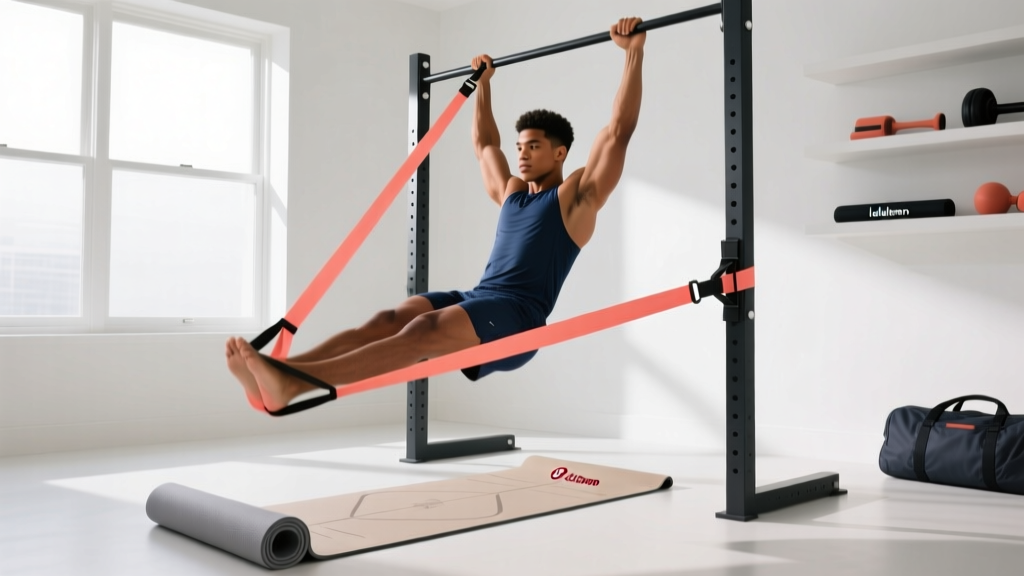
Pull Up Assist Band Sizing for Your Lululemon Travel Yoga Mat
Master pull-up assist band sizing to complement your Lululemon travel yoga mat. This step-by-step beginner guide builds the ultimate portable gym setup.

The Minimalist Gym: Pairing Pull-Up Bands with a Travel Mat
Building a functional, portable gym setup is a priority for traveling fitness enthusiasts and minimalist home-trainers in 2026. While premium floor gear like the Lululemon Travel Yoga Mat (specifically the 3mm polyurethane/rubber model, weighing just 2.5 lbs and priced around $68) perfectly handles mobility, core work, and joint protection, it leaves a massive gap in your routine: vertical pulling. You cannot train your lats, rhomboids, or biceps effectively with just a mat.
The solution? Pairing your mat with a set of 41-inch continuous loop pull-up assist bands. Together, a rolled-up Lululemon travel mat and two resistance bands weigh under four pounds, fit into a carry-on suitcase, and provide a comprehensive full-body stimulus. However, beginners frequently purchase the wrong band tension, leading to stalled progress or shoulder impingement. This step-by-step guide will walk you through exact pull-up assist band sizing, material selection, and safety protocols to build the ultimate travel-friendly strength setup.
Step 1: Decoding Band Color Codes and Tension Profiles
Unlike free weights, resistance bands provide "accommodating resistance"—the tension increases as the band stretches. According to biomechanics research highlighted by the Mayo Clinic, elastic resistance effectively stimulates muscle hypertrophy when the tension at the peak of the contraction matches what you would experience with dumbbells or barbells.
While color coding can vary slightly between manufacturers, the industry standard (pioneered by brands like Rogue and Serious Steel) follows a specific width-to-tension ratio. Below is the master sizing chart for standard 41-inch loop bands.
| Band Color | Width | Estimated Assistance (Bottom of Pull-Up) | Best For | Avg. Price (2026) |
|---|---|---|---|---|
| Red | 1/4" (6mm) | 15 - 35 lbs | Warm-ups, mobility, advanced athletes needing a slight assist | $15 - $18 |
| Black | 3/4" (19mm) | 30 - 50 lbs | Intermediate trainees close to their first unassisted pull-up | $22 - $26 |
| Purple | 1 1/8" (29mm) | 40 - 80 lbs | Beginners learning the movement pattern; heavy lat pulldowns | $30 - $35 |
| Green | 1 3/4" (44mm) | 50 - 120 lbs | Absolute beginners; heavy banded squats/deadlifts on your mat | $40 - $48 |
Note: The assistance listed is measured at maximum stretch (roughly 200% elongation). At the top of a pull-up, where the band is slack, it provides near-zero assistance.
Step 2: Calculating Your Required Assistance Level
Do not guess your band size based on "feel." Use this exact formula to determine which band will allow you to perform sets of 5 to 8 repetitions with proper scapular retraction.
The Band Sizing Formula
Bodyweight - (Max Unassisted Pull-Up Strength) = Required Peak Assistance
Example: You weigh 180 lbs. You can currently do 0 strict pull-ups, but you can hold yourself at the top of the bar (eccentric strength) and control about 40 lbs of your body weight through the mid-range.
180 lbs - 40 lbs = 140 lbs of deficit. You need a band that provides roughly 70-80 lbs of assistance at the very bottom of the movement to help you break the dead hang. Selection: Purple Band.
Real-World Sizing Scenarios for Beginners
- The "Dead Hang" Beginner (0 pull-ups, female, 130-150 lbs): Start with a Purple (40-80 lbs) band. The high peak tension will help you break the inertia of the bottom position, which is where most beginners fail.
- The "Chin-Over-Bar" Beginner (0 pull-ups, male, 180-210 lbs): Start with a Green (50-120 lbs) band. Heavier athletes require more elastic potential energy to offset their mass at the bottom of the rep.
- The "Half-Rep" Intermediate (1-3 sloppy pull-ups): Use a Black (30-50 lbs) band to groove perfect neurological pathways and full range-of-motion without sacrificing form.
Step 3: Material Selection and Brand Recommendations
Not all bands are created equal. When traveling, your gear must withstand varying hotel room temperatures, humidity, and frequent rolling/unrolling.
Layered Natural Latex vs. TPE
Avoid Thermoplastic Elastomer (TPE) bands often found in big-box sporting goods stores. TPE is molded as a single solid piece; when it develops a micro-tear, it snaps catastrophically. Instead, invest in layered natural latex. Brands like Rogue Fitness manufacture their Monster Bands by continuously layering thin sheets of natural latex. If one microscopic layer fails, the surrounding layers hold the band together, giving you visible warning signs (fraying) long before a dangerous snap occurs.
"Elastic resistance is an excellent tool for hypertrophy and strength endurance, but the failure mode of cheap, single-mold TPE bands poses a severe laceration and ocular injury risk. Always inspect layered latex bands for stress whitening before use."
— Biomechanics and Safety Guidelines for Elastic Resistance, 2025 Fitness Equipment Safety Report
Step 4: Anchoring Protocols and Failure Modes
When using your bands in a hotel room or home without a pull-up rig, you will likely use a door anchor. This is where most beginners make critical safety errors.
⚠️ Critical Door Anchor Safety Rules
- Never anchor to hollow-core bedroom doors. The repetitive lateral force of a banded pull-up can splinter the door frame or rip the hinges out of the drywall. Only use solid wood exterior doors or commercial hotel bathroom doors.
- Always anchor at the TOP of the door, pulling DOWN. If you anchor at the bottom and pull up, the door can pop open off the latch, launching the anchor at your face.
- Use a dedicated nylon door anchor ($12-$15). Never just throw the latex band over the top of the door. The sharp 90-degree wooden edge of a door frame acts like a cheese wire, creating micro-cuts in the latex that will cause the band to snap within 5-10 workouts.
Step 5: Integrating Bands with Your Lululemon Travel Mat
The true magic of this setup is how the mat and bands complement each other. The Lululemon Travel Mat's 3mm natural rubber base provides exceptional grip on slick hotel hardwood floors, allowing you to perform grounded band exercises safely.
The Portable Full-Body Routine
Perform this circuit 3 times a week while traveling. Unroll your Lululemon mat to define your workspace and protect your joints.
- Banded Pull-Ups (Door Anchor): 3 sets of 6-8 reps. (Loop band through door anchor, step into the loop, and perform pull-ups).
- Banded Good Mornings (On Mat): 3 sets of 12 reps. Step on the band with bare feet (the Lululemon polyurethane top prevents slipping), loop the other end behind your neck, and hinge at the hips. The mat protects your heels and provides a stable base.
- Banded Push-Ups (On Mat): 3 sets to failure. Wrap the band around your upper back and hold the ends in your palms. The mat's cushioning protects your wrists during high-volume travel workouts.
- Banded Face Pulls (Door Anchor): 3 sets of 15 reps. Crucial for counteracting the "hunched" posture of long flights and desk work.
Storage and Longevity: The "Roll-Up" Method
UV light, ozone, and sweat are the enemies of natural latex. To maximize the lifespan of your bands (which should last 2-3 years with proper care), do not leave them draped over chairs or exposed to sunlight.
Pro-Tip: Lay your bands flat on your Lululemon Travel Yoga Mat, fold the edges of the mat over the bands, and roll the mat up tightly. The mat acts as a UV-blocking, sweat-proof sheath, keeping your bands compressed, clean, and ready for your next travel day. Wipe the mat down with a damp cloth and mild soap (avoid harsh essential oil cleaners, as oils degrade both the polyurethane mat surface and the latex bands).
Frequently Asked Questions
Can I use the Lululemon Reversible Mat instead of the Travel Mat for this setup?
Yes, but it is not recommended for travel. The Reversible Mat (5mm) weighs nearly 5.5 lbs and is much bulkier to roll. The Travel Mat (3mm) is specifically engineered with a lighter, more pliable rubber compound that rolls down to a 4-inch diameter, leaving ample room in your luggage for your resistance bands and anchors.
How do I progress once a band becomes too easy?
Do not jump immediately to a much thinner band. Instead, use "band-stacking." If the Purple band is getting easy, but the Black band is too hard, loop both the Purple and Black bands together on the anchor point. This allows for micro-loading your assistance, bridging the gap between sizes safely.
Are pull-up assist bands safe for rotator cuff rehabilitation?
Bands are excellent for rotator cuff rehab, but not via heavy assisted pull-ups. Use the thin Red band (15-35 lbs) for high-rep, low-load external rotations and band pull-aparts. Always consult a physical therapist before loading an injured shoulder joint with elastic tension.
More gear to consider
All reviews
2026 Gear Trends: Gym Bag Yoga Mat Holder & Exercise Ball Size Guide
Recovery Zone Setup: Foam Roller Guide & Yoga Mat Spray DIY
Pull-Up Assist Band Sizing & Yoga Mat Holder Floor Setups

Guns Equip Weights Essentials: A Field-Tested Guide to Load Distribution, Gear Selection, and Real-World Performance

Space Optimization: Battle Rope Guide & Colorful Yoga Mats
