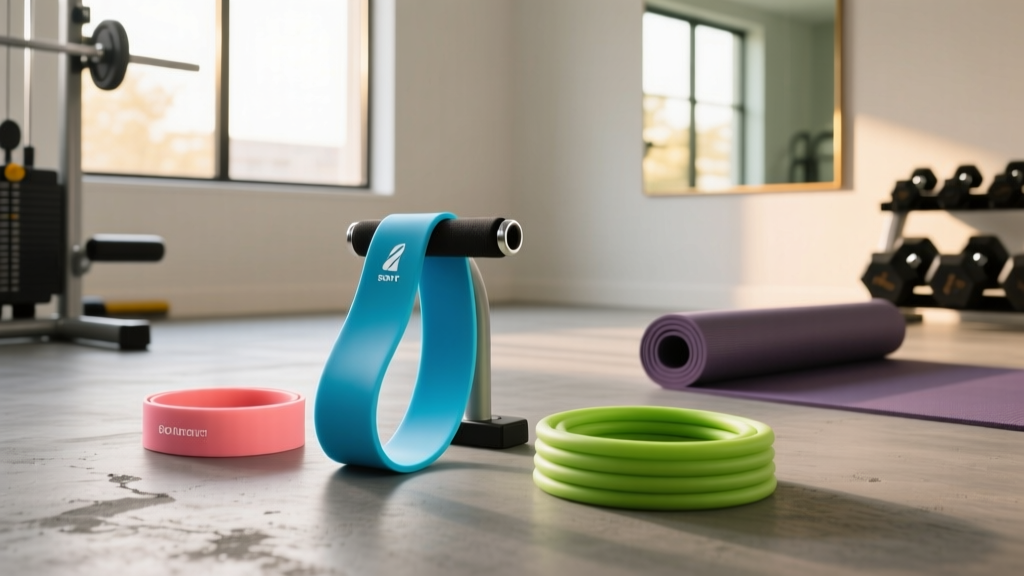
Loop Band vs Tube Band: 2026 Budget Breakdown & R Yolo Yoga Mats
Compare loop bands vs tube bands with our 2026 budget breakdown. Discover cost-per-use, durability, and how to pair them with R Yolo yoga mats.

The Foundation of a Budget Home Gym: Bands and Mats
Building a highly effective home gym on a strict budget requires ruthless prioritization of cost-per-use and biomechanical versatility. When outfitting a dedicated workout space, fitness enthusiasts frequently pair foundational floor gear, such as R Yolo yoga mats, with elastic resistance tools to create a complete sub-$100 training ecosystem. While a quality 6mm TPE mat provides the necessary joint cushioning and stability for floor work, the primary resistance stimulus usually comes from bands.
However, the elastic resistance market is split into two distinct camps: flat continuous loop bands and cylindrical tube bands with carabiners. From a pure value analysis perspective, which option delivers the best return on investment in 2026? This guide breaks down the material science, failure modes, and exact budget allocations to help you maximize every dollar of your fitness budget.
Material Science and Tension Profiles
To understand the long-term value of resistance bands, you must first understand how they generate and degrade under tension. Both loop and tube bands are predominantly manufactured from extruded natural latex, but their structural geometry dictates their performance and lifespan.
Loop Bands (Flat, Continuous)
Standard 41-inch loop bands are extruded as a single, continuous cylinder of latex that is then flattened. Because there are no mechanical joints, clips, or sleeves, the tension is distributed evenly across the entire surface area. The tension curve is exponential—the further you stretch the band, the disproportionately higher the resistance becomes. This makes them ideal for accommodating resistance in powerlifting (e.g., banded squats) and high-tension pull-up assistance.
Tube Bands (Cylindrical, Segmented)
Tube bands feature a hollow latex core encased in a braided nylon sleeve, terminated with metal D-rings and carabiners. The tension curve is largely linear, providing a consistent pull throughout the range of motion. This predictability makes them superior for isolation exercises like lateral raises, triceps pushdowns, and rehabilitation protocols where joint shear must be minimized.
2026 Budget Breakdown: Upfront Costs vs. Long-Term Value
When evaluating fitness gear, the initial price tag is only half the equation. We must calculate the Cost-Per-Use (CPU) over a standard 24-month lifecycle, assuming a moderate training frequency of three sessions per week (approximately 312 uses).
| Feature | Loop Bands (e.g., WODFitters, Rogue) | Tube Band Sets (e.g., Bodylastics, SPRI) |
|---|---|---|
| Initial Investment | $15 - $35 per individual band | $35 - $60 for a 5-band stackable set |
| Total Tension Range | 5 lbs to 150+ lbs (requires buying multiple) | 10 lbs to 150 lbs (included in one set) |
| Average Lifespan | 2 to 4 years (if stored properly) | 1 to 2 years (clips/sleeves fail first) |
| Estimated 2-Year CPU | $0.04 per workout | $0.12 per workout |
| Primary Failure Point | Micro-fissures from UV/Ozone exposure | Carabiner shear or nylon sleeve fraying |
Building the Sub-$100 Studio: Integrating R Yolo Yoga Mats
Let us apply this data to a real-world purchasing scenario. Suppose you have a strict $100 budget to establish a functional home gym corner. According to current market pricing, high-quality budget floor gear like R Yolo yoga mats typically retail between $35 and $45 for a standard 6mm thick, non-slip TPE model. This leaves you with roughly $55 to $65 for your resistance equipment.
The Optimal Budget Allocation Strategy
- $40.00 - R Yolo Yoga Mat (6mm): Provides essential spinal and knee cushioning for floor-based core work, stretching, and tube band anchor points.
- $35.00 - Tube Band Multi-Set (approx. 100 lbs total): Utilized for upper body isolation, rotational core work, and physical therapy movements. The included door anchor expands your exercise library by over 40 variations.
- $20.00 - Single Heavy Loop Band (approx. 50-120 lbs): Reserved exclusively for high-tension compound movements like banded deadlifts, resisted push-ups, and assisted pull-ups where tube band carabiners would pose a safety risk.
By splitting the remaining budget, you mitigate the inherent weaknesses of both band types while maximizing the utility of your floor mat.
Failure Modes and Edge Cases: Where Your Money Burns
To protect your investment, you must understand exactly how these tools break. The National Strength and Conditioning Association (NSCA) frequently highlights the importance of inspecting elastic equipment for structural compromises before heavy loading.
Loop Band Degradation
Because loop bands lack a protective nylon sleeve, the raw latex is exposed to environmental factors. The primary enemy is ozone and UV degradation. If you leave a loop band near a sunlit window or in a humid garage, the latex will oxidize, turning chalky and developing microscopic fissures. Under a 100-lb stretch, these fissures propagate instantly, resulting in a catastrophic snap. Pro Tip: Wipe loop bands down with a damp cloth and store them in an opaque, climate-controlled bin to double their lifespan.
Tube Band Hardware Shear
Tube bands rarely snap in the middle of the latex core. Instead, they fail at the crimped metal junction where the D-ring meets the latex. Furthermore, the braided nylon sleeve can hide a completely severed latex core. You might pull the handle and feel resistance, unaware that only the nylon sleeve is bearing the load—a scenario that can lead to severe whip-back injuries. Always inspect the interior of the sleeve by pulling the fabric back from the D-ring before heavy sets.
Biomechanical Value: Muscle Activation and Joint Health
Does the type of band affect muscle hypertrophy and joint safety? Research published in the National Center for Biotechnology Information (NCBI) demonstrates that elastic resistance training (ERT) provides similar muscle activation patterns to free weights, provided the tension is matched at the point of peak contraction.
"Elastic resistance offers a unique advantage in rehabilitation and hypertrophy training by eliminating the reliance on gravity, allowing for multi-planar resistance that free weights cannot replicate."
— Journal of Strength and Conditioning Research
However, the American Physical Therapy Association (APTA) often recommends tube bands for early-stage rehabilitation. The linear tension curve and ergonomic handles reduce grip fatigue and allow for precise, controlled joint articulation. Conversely, loop bands are favored by strength coaches for accommodating resistance—teaching the central nervous system to accelerate through the sticking point of a lift due to the exponential tension curve.
Maintenance Protocols to Maximize ROI
To ensure your budget allocation yields the lowest possible cost-per-use over the next three years, implement the following maintenance protocols:
- The Silicone Spray Trick: Once every three months, lightly mist your raw latex loop bands with 100% pure silicone spray. This rehydrates the polymer chains and prevents the surface from drying out and cracking.
- Carabiner Lubrication: For tube bands, apply a single drop of PTFE (Teflon) lubricant to the hinge of the carabiners. This prevents metal-on-metal grinding that weakens the gate mechanism over hundreds of open/close cycles.
- Mat Pairing Hygiene: When anchoring tube bands to the legs of heavy furniture or using door anchors, ensure your R Yolo yoga mat is positioned to catch any sweat or dropped handles. TPE mats are highly resistant to the acidic pH of human sweat, but prolonged moisture trapping under heavy rubber bands can cause surface delamination.
Final Verdict: How to Spend Your Money
If your budget is severely restricted and you can only purchase one type of band to pair with your R Yolo yoga mat, buy a multi-piece tube band set. The inclusion of handles, ankle straps, and a door anchor provides an immediate, versatile full-body workout that mimics cable machines.
However, if you are a strength athlete focused on progressive overload, powerlifting accommodation, or high-tension calisthenics assistance, invest in a graded set of 41-inch loop bands. They possess a vastly superior lifespan, lack mechanical failure points, and deliver the heavy, exponential resistance required for advanced adaptation. Ultimately, understanding the distinct value propositions of both tools allows you to engineer a home gym that punches far above its financial weight class.
More gear to consider
All reviews
Mastering the Yoga Mat Aesthetic: Pilates Space Guide
Exercise Ball Size Guide & How to Break In Manduka Yoga Mat

Jump Rope Troubleshooting: Why a Free Yoga Mat Ruins Speed Ropes

Exercise Ball Size Guide: Space Layouts and Using a Yoga Mat on Carpet

2026 Yoga Prop Guide: Blocks, Straps, and DIY Yoga Mat Cleaner Trends
