Space-Saving Battle Ropes: Best Fitness Accessories for Men
Master your home gym layout with our battle rope length and thickness guide. Discover the best space-saving fitness accessories for men.

The Spatial Math: Integrating High-Output Gear into Compact Gyms
When curating the ultimate list of fitness accessories for men, battle ropes consistently rank at the top for metabolic conditioning, grip strength, and power development. However, in the context of home gym design and space optimization, they present a unique architectural challenge. Unlike a adjustable dumbbell set that tucks neatly into a corner, a battle rope demands a dedicated kinetic corridor. If you miscalculate the spatial requirements, you will end up with a rope that slaps against your walls, limits your wave amplitude, or forces you to compromise your gym's overall flow.
This comprehensive guide breaks down the exact geometry, thickness dynamics, and anchor engineering required to integrate battle ropes into tight spaces without sacrificing performance. Whether you are outfitting a standard two-car garage or a dedicated basement workout room, understanding these spatial metrics is critical for selecting the right equipment.
The Geometry of Waves: Sizing Your Rope to Your Room
The most common mistake home gym owners make is assuming a 50-foot rope requires exactly 25 feet of clearance. This ignores the 'slack rule' and the physical space required for the anchor point itself. To generate proper alternating waves and slams, you need approximately 15% to 20% of the rope's total length as 'slack' to allow for wave amplitude and user movement.
Furthermore, according to conditioning guidelines from the National Strength and Conditioning Association (NSCA), proper biomechanical positioning requires the user to maintain a slight forward lean and athletic stance, which pushes the user further back from the anchor point than beginners anticipate.
| Rope Length | Anchor to User Distance | Minimum Room Length Required | Ideal User Profile & Space Type |
|---|---|---|---|
| 30 Feet | 10 - 12 Feet | 14 - 16 Feet | Beginners, small apartments, tight garage corners |
| 40 Feet | 15 - 17 Feet | 19 - 22 Feet | Intermediate users, standard single-car garages |
| 50 Feet | 22 - 25 Feet | 26 - 30 Feet | Advanced athletes, full two-car garages, open basements |
Diameter Dynamics: Thickness vs. Lateral Clearance
Battle ropes typically come in three diameters: 1.5-inch, 2.0-inch, and 2.5-inch. While most guides focus solely on grip strength and cardiovascular demand, from a space optimization perspective, thickness dictates lateral clearance. Thicker ropes are heavier and require wider swing arcs to generate momentum, meaning you need more side-to-side space to prevent the ropes from hitting parked cars, power racks, or walls.
1.5-Inch Ropes (The Space-Saver)
- Weight: 20 to 27 lbs (for a 50ft rope)
- Lateral Clearance Needed: Minimum 4 feet total width
- Layout Advantage: Ideal for narrow corridors or tight spaces between a squat rack and a wall. The tighter wave frequency requires less lateral whip.
2.0-Inch Ropes (The Middle Ground)
- Weight: 35 to 45 lbs
- Lateral Clearance Needed: Minimum 6 feet total width
- Layout Advantage: Best for open garage floors. Requires a dedicated 'clear zone' free of low-profile equipment like kettlebells or plyo boxes.
2.5-Inch Ropes (The Space Hog)
- Weight: 50+ lbs
- Lateral Clearance Needed: Minimum 8 feet total width
- Layout Advantage: Only recommended for wide-open spaces. The massive lateral whip will easily knock over adjacent gear if spatial zoning is not strictly enforced.
Material Warning for Indoor Spaces: Never use natural Manila hemp ropes in a space-optimized indoor gym. Manila sheds dust, fibers, and particulate matter constantly. This creates a cleaning nightmare and ruins the aesthetic of a tightly designed layout. Always opt for Poly Dacron (polyester jacket with a dacron core), which is completely sealed, dust-free, and requires zero maintenance.
Anchor Point Engineering for Compact Layouts
In a small gym, floor space is your most valuable asset. Using a freestanding anchor or wrapping the rope around a heavy dumbbell wastes square footage and creates a tripping hazard. To optimize your layout, you must utilize vertical 'dead space' for your anchor point.
Metabolic studies highlighted by the American Council on Exercise (ACE) show that battle rope workouts generate massive kinetic energy. When you perform alternating waves or double slams, the dynamic pull force on the anchor can easily spike between 300 and 400 pounds. Standard drywall anchors or light-duty eye bolts will rip out of the wall, causing severe damage and injury.
Optimized Mounting Solutions
- Wall-Mounted Heavy Duty Anchors: Products like the Titan Fitness Wall Mount Battle Rope Anchor ($49.99) feature a 3-inch steel ring welded to a heavy-gauge steel plate. Installation Rule: You must use 3/8" x 3" galvanized lag screws driven directly into structural wood studs, or 1/2" concrete wedge anchors if mounting to a foundation wall.
- Structural Pillar Wraps: If your garage has exposed steel I-beams or concrete support pillars, use a heavy-duty nylon strap mount (like the Rogue Fitness Strap Mount, $35.00). This requires zero drilling, preserves the structural integrity of your building, and allows you to place the anchor exactly where your spatial flow dictates.
Acoustic and Vibration Dampening in Tight Zones
An often-overlooked aspect of space optimization is acoustic management. In a compact home gym, the sound of a 40-pound Poly Dacron rope violently slamming into a bare concrete floor creates a concussive noise that will vibrate through the entire house and agitate neighbors.
To solve this without sacrificing floor space, integrate your rope zone with your heavy lifting zone. Lay down 3/4-inch thick vulcanized rubber horse stall mats (typically 4x6 feet, costing around $50-$70 each) in the designated rope corridor. This serves a dual purpose: it provides an impact-absorbing surface for deadlifts and kettlebell swings, while simultaneously dampening the acoustic shockwave of battle rope slams. When the rope is not in use, the mats remain as a permanent, highly functional lifting platform, ensuring zero wasted spatial footprint.
Top Space-Optimized Battle Rope Models (2026 Market)
Based on current market availability, spatial efficiency, and build quality, here are the top models for tight layouts:
1. Titan Fitness 30ft 1.5" Poly Dacron Rope
- Price: $79.99
- Weight: 16 lbs
- Spatial Verdict: The ultimate apartment or small-basement rope. The 30-foot length allows for high-frequency, low-amplitude waves in rooms with as little as 14 feet of depth. The 1.5-inch diameter keeps lateral whip to an absolute minimum.
2. Yes4All 40ft 2.0" Dacron Rope with Camouflage Sleeve
- Price: $105.99
- Weight: 32 lbs
- Spatial Verdict: The sweet spot for standard single-car garages. The 40-foot length provides enough slack for powerful slams without requiring the user to back up into the garage door. The protective sleeve prevents fraying at the anchor point, extending the life of the rope in high-friction wall mounts.
Dual-Purpose Spatial Zoning: The 'Fold-Away' Strategy
The hallmark of elite gym layout design is multi-use zoning. Your battle rope corridor should never be a single-use dead zone. Design your gym so that the 15-to-25-foot clearance path doubles as your primary agility, stretching, and sled-pull lane.
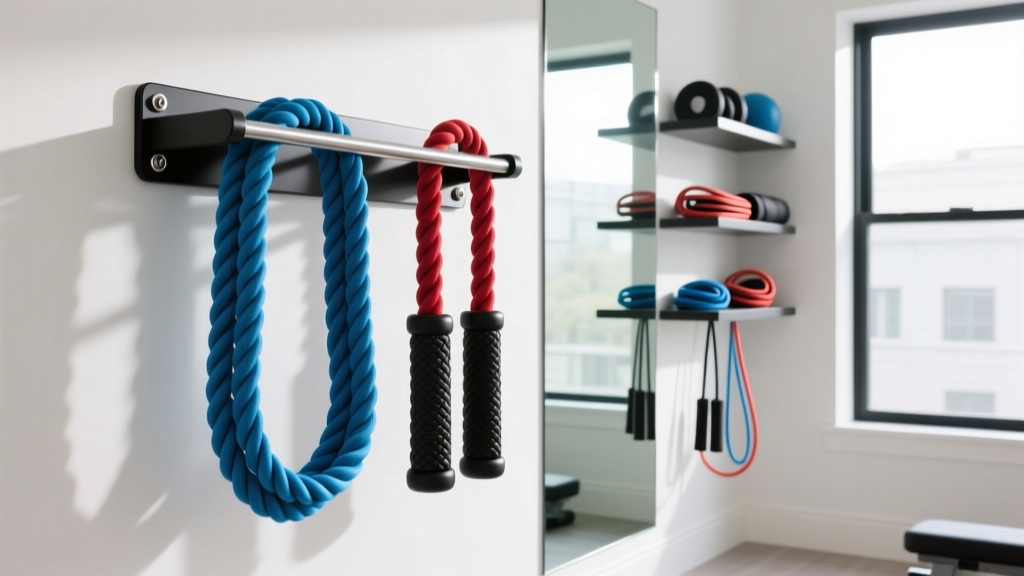
Install heavy-duty wall hooks (such as 16-inch wide J-hooks, approx. $25) at the 15-foot mark on the side wall. When the workout is over, unclip the rope from the anchor, fold it in half, and hang it on the side hooks. This immediately reclaims the floor space, transforming the kinetic corridor back into an open floor plan for yoga, mobility work, or bodyweight circuits. Kinesiological movement patterns documented on ExRx.net emphasize the importance of unobstructed floor space for dynamic stretching and recovery; a properly stored rope ensures your gym adapts to your training modality on the fly.
Final Layout Considerations
Integrating battle ropes into a space-constrained environment requires precise mathematical planning, but the metabolic payoff is undeniable. By respecting the slack rule, choosing the correct diameter for your lateral clearance, engineering a bombproof vertical anchor, and utilizing acoustic dampening mats, you can seamlessly add one of the most effective fitness accessories for men into even the tightest home gyms. Measure twice, mount securely, and optimize your flow.
More gear to consider
All reviews
Battle Rope Sizing & What to Use to Clean a Yoga Mat

Stability Ball vs BOSU Ball & Yoga Mat Thickness Chart
Home Gym Layout: Stability Ball vs BOSU & 3mm vs 5mm Yoga Mat

Beyond Alo vs Lululemon Yoga Mat: Foam Roller Mistakes

Resistance Band Levels & Thickness of Yoga Mats Guide
