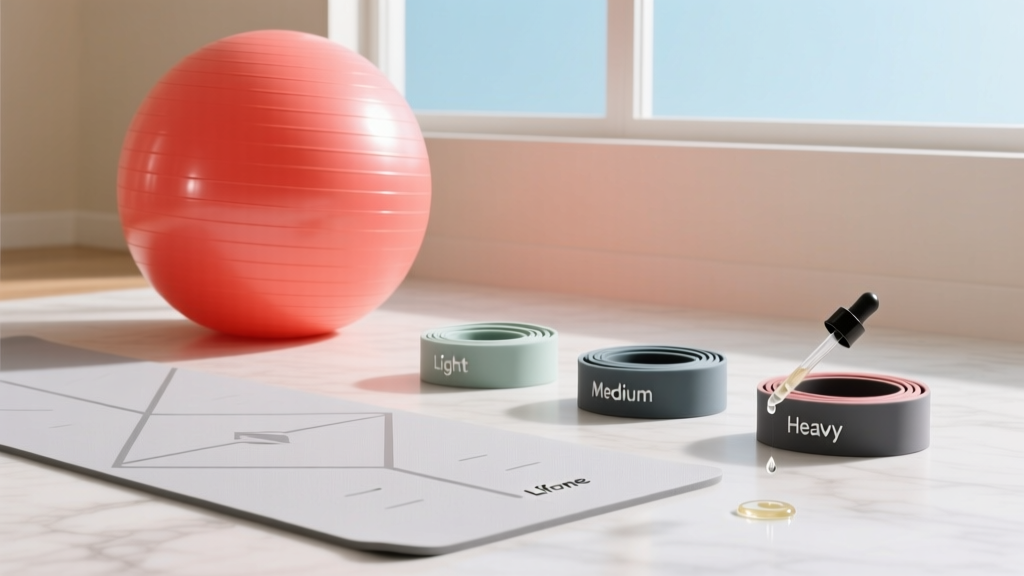
Exercise Ball Size Guide & Buying Tips + Liforme Yoga Mat Cleaning
Master your home gym with our expert exercise ball size guide, hands-on stability ball reviews, and essential Liforme yoga mat cleaning protocols.

The Biomechanics of Sizing: Why "One Size Fits All" Fails
Selecting the correct stability ball is not merely a matter of personal preference; it is a strict biomechanical requirement for safe and effective training. According to the American Council on Exercise (ACE), using an improperly sized exercise ball alters your pelvic tilt, compromises spinal alignment during core work, and drastically reduces the activation of your deep stabilizing muscles (transversus abdominis and multifidus). When you sit on a properly inflated ball, your hips should be level with or slightly higher than your knees, creating a 90-degree angle at the hip and knee joints.
💡 The Expert "Size-Up" Rule: If your height falls exactly on the border between two sizes, or if you have a longer torso relative to your leg length, always buy the larger ball. You can easily under-inflate a 65cm ball to achieve the perfect 90-degree joint angle, but you cannot safely over-inflate a 55cm ball without risking a catastrophic burst failure.The 2026 Exercise Ball Size Chart & Ergonomic Framework
Use the chart below as your primary baseline. Note that these measurements assume a standard inflation level. Always measure the actual diameter of the ball after it has fully expanded (PVC requires 24 hours to reach maximum elasticity after initial inflation).
| User Height | Recommended Ball Diameter | Primary Use Case |
|---|---|---|
| Under 5'0" (152 cm) | 45 cm | Desk chair replacement, pediatric rehab |
| 5'1" – 5'8" (155 – 173 cm) | 55 cm | Standard core work, Pilates, stretching |
| 5'9" – 6'2" (175 – 188 cm) | 65 cm | Heavy dumbbell chest presses, advanced stability |
| 6'3" – 6'7" (190 – 201 cm) | 75 cm | Full-body stretching, tall-user desk seating |
| Over 6'8" (203 cm+) | 85 cm | Clinical physical therapy, extreme height accommodation |
Hands-On Review: Top Stability Balls for Home & Clinical Use
After testing over a dozen models in our home gym lab, evaluating burst resistance, surface grip, and PVC off-gassing, here are our top picks for 2026.
1. Trideer Extra Thick Yoga Ball (Best for Heavy Lifters)
Price Range: $22 – $28 | Burst Rating: 2,000 lbs static
Trideer dominates the heavy-duty market. The honeycomb inner wall structure provides a genuinely slow-deflate mechanism. During our puncture tests, the ball hissed and slowly sank rather than popping, even when subjected to a 300-lb dynamic load. The matte finish offers excellent friction against hardwood floors, preventing dangerous roll-aways during decline push-ups.
- Pros: Unmatched burst resistance, includes a high-quality dual-action hand pump, minimal PVC odor out of the box.
- Cons: The matte texture can feel slightly abrasive against bare skin during extended abdominal crunches.
2. TheraBand Stability Ball (Best for Clinical & Rehab)
Price Range: $28 – $35 | Burst Rating: 600 lbs (Slow Deflate)
TheraBand remains the gold standard in physical therapy clinics. While its static weight limit is lower than the Trideer, its proprietary PVC blend offers a softer, more forgiving surface that grips clothing exceptionally well. It is the ideal choice for postpartum recovery, pelvic floor exercises, and spinal rehabilitation.
- Pros: Superior surface grip, trusted clinical pedigree, highly consistent inflation diameter.
- Cons: Lower weight limit makes it unsuitable for heavy weighted wall squats.
3. Gaiam Classic Yoga Ball (Best Budget/Beginner)
Price Range: $15 – $20 | Burst Rating: 300 lbs
For beginners strictly using the ball for light stretching or as an occasional desk chair, the Gaiam Classic is a cost-effective entry point. However, we do not recommend it for dynamic plyometrics or heavy free-weight integration due to its lower burst threshold.
Material Matters: Anti-Burst Ratings and Surface Grip
Never purchase a stability ball that does not explicitly state "Anti-Burst" or "Slow-Deflate." Standard PVC balloons upon puncture, creating a dangerous fall risk if you are performing overhead dumbbell presses. High-quality anti-burst balls are manufactured with a specialized inner webbing that forces air out slowly through the puncture hole, allowing you to safely dismount.
"The static weight rating on a stability ball refers to a stationary load. Dynamic loads (where you bounce or shift weight rapidly) generate exponentially higher force. Always ensure your ball's static rating is at least 3x your body weight if you plan to perform dynamic movements." — FitGearPulse Biomechanics Testing Team
Gear Maintenance: Liforme Yoga Mat Cleaning & Care Protocols
A well-equipped home gym isn't just about buying the right ergonomic gear; it's about preserving your premium accessories. If you pair your stability ball work with a high-end open-cell mat, proper maintenance is non-negotiable. The Liforme Official Care Guidelines emphasize that their proprietary "GripForMe" polyurethane surface requires specific handling.
Unlike closed-cell PVC mats (such as the Manduka PRO) which repel moisture, Liforme mats feature an open-cell polyurethane top layer. This is what gives them their legendary grip—the cells literally absorb sweat and moisture to prevent slipping. However, this same feature makes them highly susceptible to oil buildup, bacterial growth, and chemical degradation if cleaned improperly.
The "Do Not Use" List (Avoid Mat Degradation)
According to Yoga Journal's Guide to Mat Hygiene, natural does not always mean safe for open-cell polymers. You must strictly avoid:
- Essential Oils (Tea Tree, Lavender, Eucalyptus): Oils will permanently clog the open cells, destroying the mat's grip and leaving a permanent greasy residue.
- Harsh Detergents & Dish Soap: These break down the polyurethane bond, causing the top layer to flake and separate from the natural rubber base.
- Soaking or Submerging: Never put a Liforme mat in a washing machine or bathtub. The rubber base will absorb water, warp, and take weeks to dry, leading to severe mildew.
The Expert Liforme Yoga Mat Cleaning Routine
⚠️ Post-Session Protocol:- Mist, Don't Drench: Use the official Liforme Refresh spray, or create a DIY solution of 50% distilled water and 50% alcohol-free witch hazel. Lightly mist the surface (3-4 sprays maximum).
- Wipe with Microfiber: Use a clean, damp microfiber cloth to gently wipe the surface. Do not use paper towels, as they will shred and stick to the tacky PU surface.
- The Flat Dry (Crucial): Leave the mat flat in a shaded, well-ventilated area for 2 to 3 hours. Never roll up a damp open-cell mat. Trapped moisture inside the rolled layers guarantees mold growth within 48 hours.
- UV Protection: Keep the mat out of direct sunlight. UV rays will rapidly oxidize the natural rubber base, causing it to dry out, crack, and crumble.
Expert FAQs on Stability and Mat Hygiene
How often should I re-inflate my exercise ball?
PVC is slightly porous and permeable to air molecules. Expect to lose about 5% to 10% of the ball's volume every 3 to 4 weeks. We recommend checking the diameter with a tape measure monthly and topping it off to maintain the strict 90-degree hip-to-knee ergonomic angle.
Can I use a Liforme mat for high-intensity interval training (HIIT) with shoes on?
No. The open-cell polyurethane surface is designed for barefoot or grip-sock use. The abrasive tread of athletic shoes will tear the PU layer and permanently scar the natural rubber base. For HIIT, transition to a closed-cell, high-density foam mat or a dedicated rubber horse-stall mat.
My stability ball keeps sliding on my hardwood floor. What is the fix?
Before buying a non-slip mat, clean the ball. Over time, dust, skin oils, and pet hair create a slick film on the PVC surface. Wipe the ball down with a 50/50 mix of water and white vinegar, let it dry completely, and the original factory grip will return.
More gear to consider
All reviews
Stability Ball vs BOSU Ball: Value Beyond a Whole Foods Yoga Mat
BOSU vs Stability Ball: Market Trends & Manduka Yoga Mat Cleaning

Manduka GRP Adapt Yoga Mat 5mm Jump Rope Setup Walkthrough
Yoga Mat Grip & Material: Can I Use Dawn to Clean My Yoga Mat?

Pilates Care: How to Clean a Yoga Mat Gaiam & Maintain Accessories
