
How to Select Yoga Mat Accessories: Blocks & Straps Guide
Master how to select yoga mat accessories with our budget breakdown. Compare cork, foam, and wood blocks plus strap hardware for maximum value.

Beyond the Mat: The True Value of Yoga Props
When building a home studio or upgrading your gear, most practitioners spend weeks researching how to select yoga mat materials like natural rubber, TPE, or polyurethane. Yet, the props you use to support your practice—specifically blocks and straps—dictate your alignment, injury prevention, and long-term progression. A premium mat cannot compensate for a compressing foam block or a slipping nylon strap.
From a budget breakdown and value analysis perspective, buying cheap props is a false economy. This guide deconstructs the material science, hardware durability, and cost-per-year (CPY) metrics of yoga blocks and straps, ensuring your investment aligns with your practice frequency.
The Prop Budget Matrix: Material vs. Longevity
Before diving into specific brands, it is crucial to understand the baseline market tiers. The table below outlines what you can realistically expect at different price points in the current market.
| Material / Type | Avg. Cost Range | Density / Durability | Best Use Case |
|---|---|---|---|
| Standard EVA Foam | $6 - $12 | Low (1.2 - 1.5 lbs/ft³) | Occasional use, travel, restorative |
| High-Density Foam | $14 - $22 | Medium (2.5 - 3.0 lbs/ft³) | Daily Vinyasa, general support |
| Agglomerated Cork | $20 - $32 | High (Rigid, heavy) | Hot yoga, weight-bearing balances |
| Bamboo / Hardwood | $28 - $45 | Maximum (Solid core) | Studio environments, Iyengar practice |
| Cotton D-Ring Strap | $12 - $24 | High (Tear-resistant weave) | Deep stretching, alignment checks |
How to Select Yoga Mat Blocks: A Material Deep Dive
The standard yoga block dimensions are 4" x 6" x 9". However, the value of a block is entirely dependent on its core material and structural integrity under load.
EVA Foam: The Density Trap
Ethylene-Vinyl Acetate (EVA) foam is the most common and affordable block material. However, not all foam is created equal. Generic blocks found in big-box stores often feature a density of 1.2 lbs per cubic foot. Under the weight of an adult in a pose like Ardha Chandrasana (Half Moon Pose), these blocks compress, wobble, and eventually suffer from permanent structural deformation within 6 to 8 months of daily use.
Value Pick: Look for high-density EVA foam (minimum 3.0 lbs/ft³). According to Manduka's educational guides, their recycled high-density foam blocks maintain their rigid edge support even after years of heavy studio use. Spending $18 on a high-density block saves you from the $8 replacement cycle of cheap foam.
Cork: The Grip and Weight Advantage
Cork blocks are manufactured using agglomerated cork granules bound with natural or synthetic resins. The primary value proposition of cork is its moisture-wicking surface; as your hands sweat, cork actually becomes more grippy, whereas foam becomes slippery.
Failure Mode Alert: Cork is brittle on impact. If you frequently practice on hardwood floors and drop your blocks, the edges will chip and crumble over time. To maximize the lifespan of a $26 cork block, use it on a thick mat or carpet, and avoid dropping it on its corners.
Wood and Bamboo: The Iyengar Standard
Hollow-core bamboo blocks (around $35) offer unparalleled rigidity and are incredibly lightweight compared to solid wood. However, they lack surface friction. If you have dry hands, a bamboo block in Trikonasana (Triangle Pose) can slide across your mat. They are best reserved for practitioners who require absolute zero-compression for joint rehabilitation or precise Iyengar alignment work.
Strap Selection: Hardware, Weave, and Tension
While blocks provide elevation, straps provide extension. When evaluating straps, the fabric is secondary to the hardware and the stitching that holds it together.
D-Ring vs. Cinch Buckle
Warning: The Cinch Buckle HazardMany budget straps ($7-$10) use plastic polycarbonate cinch buckles. Under high tension (e.g., hamstring stretches or shoulder openers), UV exposure and repeated stress cause these plastics to become brittle. A snapping plastic buckle under 100+ lbs of tension can cause severe facial or joint injury. Always opt for heavy-duty, zinc-plated steel D-rings.
Fabric Weave and Stitching
The industry standard for premium straps is 100% unbleached cotton or a cotton-canvas blend. Nylon straps, while cheaper and more colorful, suffer from edge-fraying and can cause friction burns on your hands during tight wraps.
The most critical value metric is the stitching at the D-ring loop. You must look for bar-tack stitching—a dense, zigzag reinforcement pattern. Standard straight-stitching will pull through the cotton webbing after a few months of heavy pulling. As noted in Hugger Mugger's expert articles, a properly bar-tacked cotton strap can withstand hundreds of pounds of tensile force without fraying, making a $16 cotton strap a literal 'buy-it-for-life' item.
Choosing the Right Length
- 6-Foot Straps: Ideal for practitioners under 5'4" or for targeted arm/shoulder work.
- 8-Foot Straps: The universal standard. Fits most adults (5'4" to 6'0") for hamstring and back stretches.
- 10-Foot Straps: Essential for practitioners over 6'0", or for restorative yoga where the strap must loop around the mat, a bolster, and the body simultaneously.
The 'Buy It For Life' (BIFL) Cost-Per-Year Analysis
To truly understand value, we must calculate the Cost-Per-Year (CPY) based on a practitioner attending or practicing 3 times a week.
CPY Breakdown: Foam vs. Cork Blocks
Budget EVA Foam Block ($8): Compresses and loses structural integrity in 8 months. Replaced annually.
5-Year Cost: $40 | CPY: $8.00
Premium Agglomerated Cork Block ($26): Maintains rigidity and grip for 7+ years with proper care.
5-Year Cost: $26 | CPY: $5.20
Verdict: The cork block is not only superior for alignment and grip, but it is actually 35% cheaper per year over a standard 5-year lifecycle.
Expert Troubleshooting & Edge Cases
Even premium gear requires specific maintenance to protect your investment. Here are non-obvious edge cases that ruin props prematurely:
The Cotton Strap Shrinkage Problem
If you sweat heavily on your strap or wash it in a machine, 100% cotton webbing will shrink. An 8-foot strap can shrink to 7.5 feet after a hot wash, altering your muscle memory and stretch depth. Solution: Hand-wash straps in cold water with a mild detergent and hang them to dry. Never put a yoga strap in the dryer.
Cork Block Sealing and Dusting
New cork blocks often shed fine dust during the first few weeks of use. This is a byproduct of the molding process, not a sign of degradation. Wipe the block down with a slightly damp cloth (water and a drop of tea tree oil for antibacterial properties) before your first session. Avoid using harsh chemical mat sprays containing essential oils like sweet orange or eucalyptus directly on cork, as these can break down the natural resins binding the granules over time.
Final Verdict: Where to Allocate Your Budget
When figuring out how to select yoga mat accessories, the golden rule of budget allocation is to invest heavily in the hardware that bears your body weight. Skimp on decorative strap colors or branded logos, but never compromise on foam density, D-ring metallurgy, or bar-tack stitching. By prioritizing high-density materials and robust hardware, you build a prop kit that enhances your biomechanics and outlasts your favorite mat by a decade. For further reading on alignment principles, Yoga Journal offers extensive visual guides on integrating these props safely into advanced asanas.
More gear to consider
All reviews
Exercise Ball Size Guide: Pairing With Your Yoga Mat Material

Battle Rope Sizing & Value: Avoid Yoga Mat Cleaning Spray Damage

Pilates Accessories Care: How Long Does a Yoga Mat Last?

Loop vs Tube Bands: 2026 Trends & Moonkissed Collective Orchid Mat
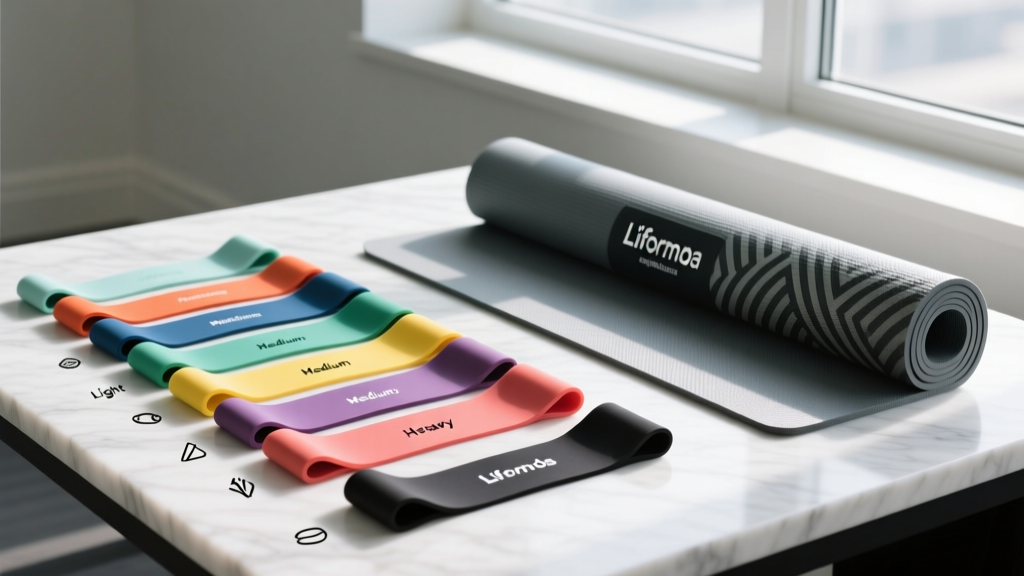
Band Sets: Levels, Types & The Liforme Yoga Mat Discount Code Myth
