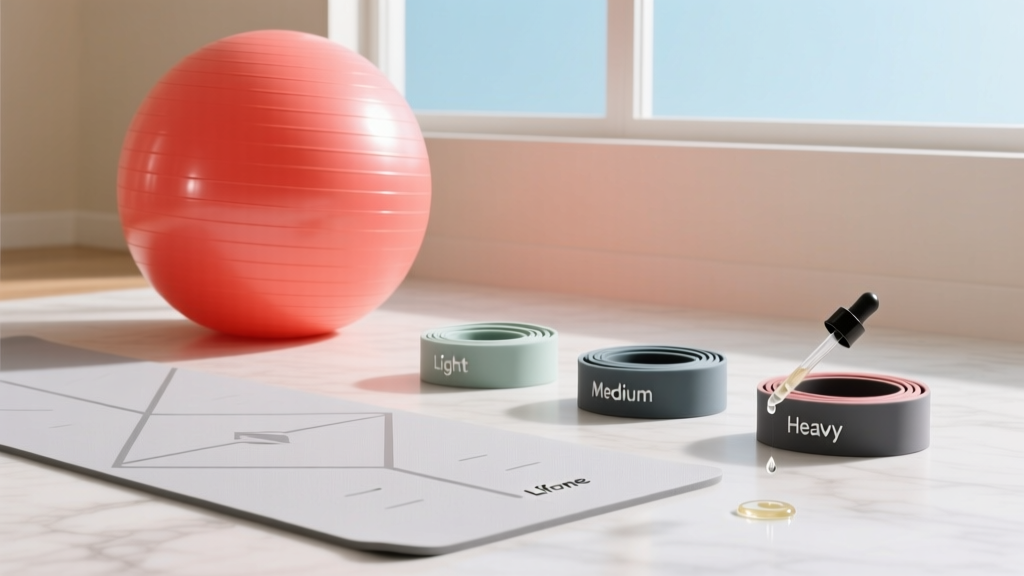
Exercise Ball Size Guide & NBR vs TPE Yoga Mat Budget Breakdown
Master your home gym budget with our exercise ball size guide and an in-depth NBR vs TPE yoga mat value analysis for optimal comfort and cost.

Building a Budget-Conscious Home Gym: Core & Floor Foundations
Outfitting a home gym in 2026 requires a strategic balance between biomechanical support and financial efficiency. Two of the most critical, yet frequently misunderstood, pieces of equipment are the stability ball and the yoga mat. Whether you are rehabilitating an injury, practicing daily mobility flows, or adding core instability to your strength training, selecting the wrong size ball or the wrong mat material can lead to joint pain, poor posture, and wasted money. This comprehensive guide merges an exact exercise ball size guide with a rigorous NBR vs TPE yoga mat value analysis to help you allocate your fitness budget where it actually matters.
The Exercise Ball Size Guide: Biomechanics & Sizing Matrix
The effectiveness of a stability ball hinges entirely on proper sizing. According to the American Council on Exercise (ACE), proper pelvic alignment on a stability ball requires your hips to be level with or slightly higher than your knees when seated, creating a 90-degree angle at the hip and knee joints. If the ball is too small, you force your hips into excessive flexion, straining the lumbar spine. If it is too large, you lose ground contact and core engagement.
Height-to-Diameter Sizing Chart
| User Height | Recommended Ball Diameter | Actual Inflated Size (Approx) | Best Use Case |
|---|---|---|---|
| Under 5'0" (152 cm) | 45 cm | 18 inches | Desk chair replacement, light core work |
| 5'0" - 5'5" (152-165 cm) | 55 cm | 22 inches | Yoga flows, Pilates, general stretching |
| 5'6" - 5'11" (167-180 cm) | 65 cm | 26 inches | Weighted core exercises, wall squats |
| 6'0" - 6'3" (182-190 cm) | 75 cm | 30 inches | Heavy resistance training, deep stretching |
| Over 6'3" (190+ cm) | 85 cm | 34 inches | Advanced mobility, tall-user desk seating |
The 3-Stage Inflation Protocol (Preventing Seam Failure)
A common failure mode with budget stability balls is seam tearing during initial inflation. PVC and anti-burst materials require time to stretch and acclimate to room temperature. Follow this protocol to ensure your ball reaches its true diameter without voiding the warranty:
- Stage 1 (The 80% Rule): Inflate the ball to roughly 80% of its target diameter. Let it sit at room temperature (68°F - 72°F) for 24 hours. This allows the polymer chains in the PVC to relax and expand.
- Stage 2 (Target Diameter): Inflate to the exact recommended size. Use a measuring tape around the equator of the ball. Let it rest for another 12 hours.
- Stage 3 (Final Top-Off): PVC naturally off-gasses and shrinks slightly in the first week. Top off the air to achieve the perfect 90-degree knee angle.
NBR vs TPE Yoga Mat: The Material Value Analysis
While the stability ball dictates your core alignment, your mat dictates your joint health and traction. The debate surrounding the NBR vs TPE yoga mat materials is one of the most common dilemmas for home gym buyers. Both are synthetic alternatives to toxic PVC, but they serve vastly different biomechanical needs and budget tiers.
Material Science: What Are You Actually Buying?
NBR (Nitrile Butadiene Rubber): NBR is a synthetic copolymer that is foam-pressed into thick, highly cushioned mats. It is essentially a dense memory foam designed for impact absorption. NBR mats typically range from 10mm to 15mm in thickness.
TPE (Thermoplastic Elastomer): TPE is a closed-cell material that blends plastic and rubber properties. It is injection-molded or heat-pressed, resulting in a denser, lighter, and more grippy surface. TPE mats usually sit in the 5mm to 6mm range.
Head-to-Head Comparison Matrix
| Feature | NBR (Nitrile Butadiene Rubber) | TPE (Thermoplastic Elastomer) |
|---|---|---|
| Average Price (2026) | $20 - $35 | $38 - $65 |
| Thickness & Cushion | 10mm - 15mm (Excellent) | 5mm - 6mm (Moderate) |
| Weight | Heavy (2.5 - 4.0 lbs) | Lightweight (1.5 - 2.5 lbs) |
| Grip (Dry vs. Wet) | Poor when sweaty / Good dry | Excellent dry / Moderate wet |
| Durability & Tearing | Prone to flaking and tearing | Highly durable, resists tearing |
| Eco-Friendliness | Low (Synthetic, hard to recycle) | High (Recyclable, no toxic off-gassing) |
When to Choose NBR: The Joint-Protection Priority
Physical therapists, as noted by resources from the American Physical Therapy Association (APTA), frequently recommend thicker, high-density foam surfaces for patients managing patellofemoral pain syndrome or recovering from knee meniscus repairs. If your home workouts consist primarily of floor-based Pilates, physical therapy rehab, or kneeling core exercises, an NBR mat like the BalanceFrom GoYoga 10mm ($24.99) provides unmatched shock absorption. Edge Case Warning: NBR is highly susceptible to degradation from UV light and essential oils. Do not leave an NBR mat in direct sunlight, and avoid cleaning it with tea-tree oil-based sprays, which will break down the foam structure within months.
When to Choose TPE: The Mobility & Flow Priority
If your routine involves standing balance poses (like Warrior III), Vinyasa flows, or dynamic stretching with your stability ball, TPE is the superior investment. Yoga Journal consistently highlights closed-cell TPE for its ability to provide a stable, non-compressible foundation that prevents ankle rolling during single-leg balances. The Gaiam Performance TPE Mat ($45.00) offers a dual-textured surface that grips hardwood floors securely while providing enough density to protect the wrists during downward dog transitions.
Budget Breakdown: Building Your Core & Floor Setup
To maximize your home gym budget, you must pair the right ball with the right mat based on your specific training modality. Here are two optimized setups for 2026:
Setup A: The Rehab & Floor-Core Budget ($46.98)
- Mat: BalanceFrom NBR 10mm ($24.99) - Maximizes knee and spine cushioning.
- Ball: URBNFit Elite 65cm ($21.99) - Reliable anti-burst tech for slow, controlled floor movements.
- Value Proposition: Under $50 for a complete floor-setup that protects vulnerable joints during high-repetition, low-impact physical therapy or core isolation routines.
Setup B: The Dynamic Flow & Mobility Setup ($87.50)
- Mat: Gaiam Performance TPE 6mm ($45.00) - Provides the traction and stability needed for standing transitions.
- Ball: TheraBand Pro Series 65cm ($42.50) - Clinical-grade, slow-deflate safety for dynamic weight shifts and advanced balancing.
- Value Proposition: Higher upfront cost, but the TPE mat will outlast NBR by at least 3 years, and the TheraBand ball resists the micro-punctures that plague cheaper PVC models, lowering your long-term cost-per-use.
Hidden Costs and Maintenance Edge Cases
When calculating your budget, factor in the hidden costs of mat and ball maintenance. NBR mats tend to absorb sweat and harbor bacteria if not cleaned with a specialized enzymatic cleaner ($12-$15). TPE mats, being closed-cell, can be wiped down with a simple vinegar-water solution. Furthermore, stability ball plugs are a notorious failure point. Budget balls often include cheap plastic plugs that snap upon removal. Always purchase a $5 silicone replacement plug kit on day one to ensure you can adjust your ball's inflation as the PVC stretches over its first month of use.
Expert Verdict: Where to Spend and Where to Save
The NBR vs TPE yoga mat decision ultimately comes down to your joint health versus your need for stability. Save money by choosing NBR if your workouts are strictly floor-based and joint-centric. Spend the extra $20 on TPE if you require a versatile, durable surface for standing flows and dynamic movements. Pair your chosen mat with a correctly sized, 3-stage inflated anti-burst stability ball, and you will have a biomechanically sound, budget-optimized home gym that rivals commercial studio setups.
More gear to consider
All reviews
Stability Ball vs BOSU Ball: Beyond the Yoga Mat Size Chart
Pilates Mat vs Yoga Mat: Grip, Thickness & Material Compared

Yoga Block & Strap Guide: Match the Best Thickness for Yoga Mat

Beyond the Bunny Yoga Mat: A Beginner's Resistance Band Guide

Pull Up Assist Band Sizing: Beginner Guide & Eko Lite Yoga Mat Setup