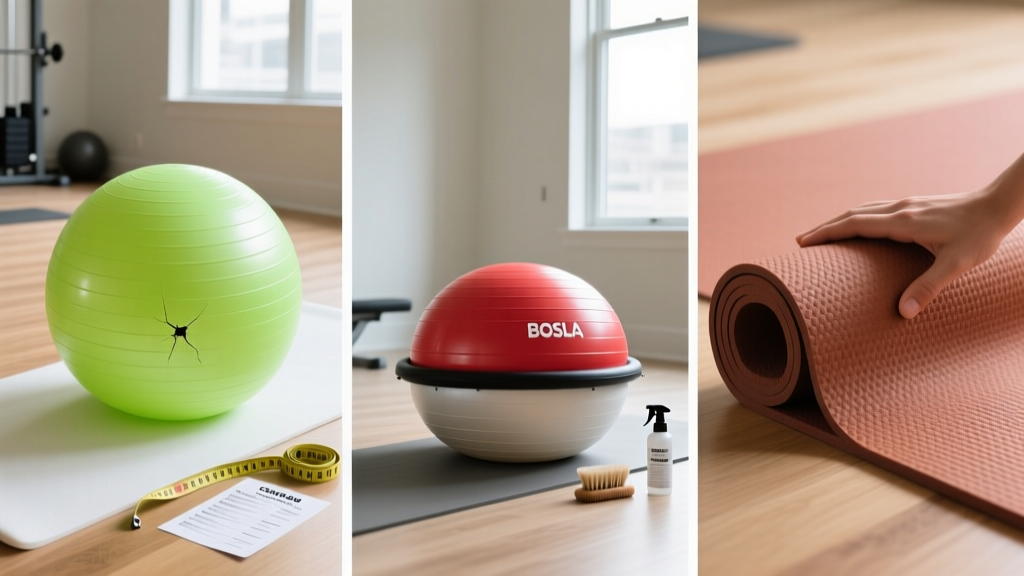
Stability Ball vs BOSU Ball Care & Bala Yoga Mat Review
Compare stability ball vs BOSU ball maintenance for maximum longevity, plus our in-depth Bala yoga mat review and essential gear care tips.

The Core Comparison: Stability Ball vs BOSU Ball Maintenance
When outfitting a home gym or upgrading a commercial fitness studio, balance and stability equipment represents a significant investment. However, the longevity of these tools is entirely dependent on proper maintenance. A standard Swiss stability ball and a BOSU Balance Trainer may look like they belong to the same inflatable family, but their material compositions, structural stress points, and care requirements are vastly different. Furthermore, pairing your balance work with premium floor gear requires equal attention to material science. In this guide, we break down the exact maintenance protocols for inflatable balance equipment and conclude with a comprehensive Bala yoga mat review, focusing on how to protect its premium polyurethane and natural rubber construction.
According to equipment safety guidelines from the American Council on Exercise (ACE), improper cleaning agents and environmental exposure are the leading causes of premature failure in PVC and rubber fitness accessories. Understanding the chemical vulnerabilities of your gear is the first step toward maximizing its lifespan.
Material Matrix: PVC vs. Polyurethane vs. Polycarbonate
Before diving into cleaning routines, it is crucial to understand what your equipment is actually made of. Standard stability balls (like the popular TheraBand Stability Ball, priced around $29.95) are constructed from anti-burst Polyvinyl Chloride (PVC). The BOSU Pro Balance Trainer ($149.99) features a heavy-duty vinyl/PVC dome attached to a rigid polycarbonate or rubberized base. The Bala Yoga Mat ($128.00) utilizes a natural rubber base with an open-cell polyurethane (PU) top layer. Each of these materials reacts differently to heat, UV light, and chemical cleaners.
| Material Feature | Standard Stability Ball (PVC) | BOSU Dome & Base | Bala Yoga Mat (Rubber/PU) |
|---|---|---|---|
| Primary Vulnerability | UV degradation & puncture | Base warping & seam tearing | Oil absorption & rubber oxidation |
| Safe Cleaning Agents | Mild dish soap & water | Non-abrasive vinyl cleaner | Damp microfiber, specialized mat wash |
| UV Sensitivity | High (becomes brittle) | Moderate (fades and weakens) | Extreme (causes flaking/dry rot) |
| Expected Lifespan | 1 to 3 years | 5 to 10 years | 3 to 5 years |
Step-by-Step Longevity Protocol for Swiss & Stability Balls
The most common failure mode for stability balls is not a sudden pop, but rather micro-tears in the PVC matrix caused by improper inflation and harsh chemicals. To ensure your stability ball retains its burst-resistant properties, follow this exact protocol:
1. The 24-Hour Inflation Rule
When inflating a new PVC stability ball, the material is initially stiff. Inflate the ball to about 80% of its recommended diameter, then let it rest at room temperature (68°F to 72°F) for 24 hours. This allows the PVC polymers to stretch and acclimate. Top it off to 100% the next day. Skipping this step causes micro-stress fractures in the seams that will eventually lead to catastrophic failure under load.
2. Proper Cleaning Chemistry
Never use bleach, ammonia, or alcohol-based wipes on a PVC stability ball. These solvents strip the plasticizers from the PVC, causing it to dry out and crack. Instead, mix one drop of mild, unscented dish soap (like Dawn) into a spray bottle of warm water. Mist the ball lightly and wipe it down with a soft microfiber cloth. Allow it to air dry completely before deflating or storing.
3. Valve Maintenance
The air valve is the weakest point of any stability ball. Once a month, apply a tiny drop of food-grade silicone lubricant to the valve pin to keep the rubber gasket supple. This prevents slow air leaks and ensures the plug seats perfectly when reinserted.
BOSU Balance Trainer Care: Protecting the Dome and Base
The BOSU Balance Trainer is a premium piece of equipment, and its care routine must reflect its complex construction. The official BOSU manufacturer documentation emphasizes that the junction where the inflatable dome meets the rigid base is the most critical area to monitor.
Pro Tip: The Height RuleAlways measure your BOSU dome height. The BOSU Pro model should be inflated so the dome sits exactly 8.5 to 10 inches above the base. Over-inflating the dome to 11 inches or higher places immense lateral stress on the polycarbonate base and the adhesive seam, drastically increasing the risk of the dome tearing away from the platform during lateral plyometric movements.
Cleaning the Dome vs. The Base
The vinyl dome can be cleaned with a 50/50 mix of water and white vinegar, which naturally cuts through sweat and body oils without degrading the material. However, the rigid base requires a different approach. If you have the older model with a rubberized non-slip base, avoid petroleum-based cleaners, which will cause the rubber to dissolve into a sticky residue. Use a dedicated rubber mat cleaner and a soft-bristled brush to remove embedded dust and chalk from the base's grip rings.
Preventing Base Warping
Never store a BOSU trainer resting on its dome for extended periods in a hot environment (such as a car trunk or an un-air-conditioned garage). The weight of the heavy base pressing down on the heated dome can cause permanent deformation. Always store it flat on its base, or stack it dome-to-dome with another BOSU if space is limited.
Bala Yoga Mat Review: Material Longevity & Daily Care
While balance balls require inflation management, premium yoga mats demand strict chemical and environmental boundaries. In this Bala yoga mat review, we evaluate the brand's foray into high-end floor accessories, specifically focusing on how to maintain its unique material profile. Priced at $128.00, the Bala Yoga Mat is designed for practitioners who demand superior grip and aesthetic minimalism, but its open-cell polyurethane top layer and natural rubber base require meticulous care.
Grip Technology and Material Breakdown
The Bala Yoga Mat utilizes an open-cell PU top layer that absorbs moisture to create a suction-like grip during hot yoga or heavy sweating sessions. While this provides unparalleled stability, it also means the mat absorbs oils, lotions, and bacteria. According to material care guides featured in Yoga Journal, open-cell mats must be cleaned immediately after heavy use to prevent the breakdown of the polyurethane matrix.
- Daily Maintenance: Wipe down with a damp microfiber cloth and a specialized PU-safe mat spray (avoiding any products containing tea tree oil, lavender, or eucalyptus).
- Deep Cleaning: Once a month, use a pH-balanced, enzyme-based cleaner to break down trapped sebum and dead skin cells without damaging the open-cell structure.
- Drying Protocol: Because of the open-cell top and dense rubber base, the Bala mat requires a full 24 to 48 hours to dry completely when hung over a wide, non-metallic drying rack. Rolling it up while damp will lead to mildew and delamination.
Many DIY yoga mat cleaners rely on essential oils for fragrance and antimicrobial properties. However, essential oils are lipophilic (oil-loving) and will rapidly break down the natural rubber base of the Bala Yoga Mat, causing it to dry rot, flake, and lose its structural integrity. Stick to water-based, oil-free cleaners only.
Storage and UV Protection
Natural rubber is highly susceptible to UV degradation. Leaving the Bala Yoga Mat in direct sunlight for even a few hours can cause the rubber polymers to oxidize, resulting in a chalky, brittle surface that flakes onto your clothing. Always store the mat rolled loosely (with the top layer facing outward to prevent the edges from curling upward) in a cool, dark closet or inside an opaque, breathable cotton mat bag.
Environmental Factors: Heat, Humidity, and Equipment Decay
Whether you are maintaining a $30 stability ball, a $150 BOSU trainer, or a $128 Bala Yoga Mat, the ambient environment of your home gym dictates the lifespan of your gear. High humidity accelerates the growth of mold inside the valves of inflatable equipment and within the open cells of premium yoga mats. Conversely, low humidity and high heat (such as placing gear near a radiator or HVAC vent) will rapidly extract the plasticizers from PVC and the natural moisture from rubber, leading to catastrophic brittleness.
To optimize your gear's environment, aim to keep your fitness space at a consistent 40% to 50% relative humidity and a temperature between 65°F and 75°F. If you live in a highly humid climate, consider running a dehumidifier in your workout space and utilizing silica gel packets inside the storage bins where your deflated stability balls and rolled mats are kept.
Frequently Asked Questions (FAQ)
Can I use a standard bicycle pump for my stability ball and BOSU?
Yes, but you must use the correct adapter and monitor the pressure carefully. Bicycle pumps do not have the volume of air output that dedicated inflatable bed pumps do, making the process tedious. More importantly, never use an air compressor, as the sudden influx of high-pressure air can blow the internal seams of the PVC or BOSU dome instantly.
How do I fix a slow leak in my stability ball?
If the leak is at the valve, try removing the plug, applying a small amount of silicone grease to the threads, and reinserting it firmly. If the leak is a micro-puncture in the PVC body, the ball is no longer safe for use. Patching a stability ball compromises its anti-burst rating, creating a severe safety hazard during weighted exercises.
Why is my Bala Yoga Mat leaving dark marks on my hardwood floor?
Natural rubber mats can sometimes react with the polyurethane finishes or waxes used on hardwood floors, especially in the presence of heat and friction. To prevent this, always unroll your Bala mat on a dedicated rug or a thin, closed-cell foam underlay when practicing on finished wood surfaces, and never leave the mat resting in the same spot on the floor for more than a few hours.
How often should I replace my balance equipment?
Even with perfect maintenance, PVC stability balls should be replaced every 1 to 3 years due to invisible polymer fatigue. A high-quality BOSU trainer can last up to a decade if the dome is kept at the correct inflation height and the base is protected from impact damage. Premium mats like the Bala Yoga Mat will typically last 3 to 5 years before the open-cell top layer begins to permanently degrade from friction and repeated washing.
More gear to consider
All reviews
Is a TPE Yoga Mat Toxic? Material, Thickness & Grip Compared

Stability Ball vs BOSU Ball Value Analysis & DIY Yoga Mat Bag Pattern

Stability Ball vs BOSU: 2026 Trends & The Yoga Mat Rolled Up Test

Loop vs Tube Bands & Crochet Yoga Mat Strap Pattern: Compact Layouts
Beyond Buying Yoga Mats at Whole Foods: Block & Strap Care Guide
