Decathlon Yoga Mat Basic 4mm Reviews & Pilates Accessories Guide
Explore our Decathlon Yoga Mat Basic 4mm reviews and 2026 Pilates accessories guide. Expert picks for rings, bands, and mats for home studios.

The Foundation of Home Pilates: Evaluating the Budget-Friendly Mat
The home fitness landscape in 2026 has seen a massive resurgence in classical and contemporary Pilates. While reformer studios dominate social media, the foundational work of Joseph Pilates was designed for the mat. However, executing exercises like the Roll-Up or Spine Stretch Forward requires precise ground feedback and joint protection. This brings us to a highly searched topic: Decathlon Yoga Mat Basic 4mm product info and reviews. Is this ultra-budget-friendly, entry-level mat actually viable for a dedicated Pilates practice, or should you invest in specialized accessories?
In this comprehensive guide, we provide a hands-on review of the Decathlon Outshock Basic 4mm mat, followed by an expert-curated Pilates equipment accessories guide to help you build a biomechanically sound home studio without breaking the bank.
Hands-On Review: Decathlon Yoga Mat Basic 4mm
Decathlon’s Outshock brand has long dominated the budget fitness space. The Basic 4mm mat (Model 8524154) is marketed primarily for yoga, but its utility in Pilates is a subject of intense debate among instructors. We tested this mat over a 30-day period, focusing exclusively on mat Pilates routines.
Product Specifications & Build Quality
| Feature | Specification | Pilates Relevance |
|---|---|---|
| Material | TPE (Thermoplastic Elastomer) | PVC-free, eco-friendly, moderate grip when dry. |
| Dimensions | 175 cm x 60 cm (68.9" x 23.6") | Adequate for most heights, but narrow for wide-leg V sits. |
| Thickness | 4mm (0.15 inches) | High ground feedback, low spinal cushioning. |
| Weight | 0.85 kg (1.87 lbs) | Highly portable for studio travel. |
| Retail Price | $14.99 / £9.99 | Unbeatable entry-level price point. |
During spinal articulation exercises (e.g., Rolling Like a Ball or the Seal), users with prominent spinous processes or low body fat will experience 'bottoming out'—where the 4mm foam compresses entirely, causing bone-to-floor impact. If you have a sensitive thoracic spine, this mat requires a secondary folded towel for sacral and spinal support.
Performance in Practice
Where the Decathlon Basic 4mm truly shines in a Pilates context is stability and proprioception. According to guidelines on core stabilization from the Mayo Clinic, Pilates relies heavily on the deep stabilizing muscles of the abdomen and pelvis. A thinner 4mm mat forces your intrinsic foot and ankle muscles to work harder during standing balance sequences (like the Tree or Side Kick Series), preventing the 'wobble' effect common on plush 10mm+ mats.
However, the TPE surface lacks the polyurethane (PU) 'sweat-grip' coating found on premium $80+ mats. During high-rep endurance sets like the Hundred, if your hands become sweaty, you will experience micro-slipping. We recommend using this mat in a climate-controlled room or pairing it with grip accessories.
Mat Thickness Matrix: Is 4mm Enough?
To contextualize the Decathlon mat, here is how 4mm compares to other industry standards for Pilates mat work:
- 3mm - 4mm (Travel/Decathlon Basic): Best for standing work, reformer-class simulations, and advanced practitioners who need maximum floor feedback. Poor for beginners with joint pain.
- 6mm (Standard Yoga Mat): The middle ground. Acceptable for general fitness Pilates, but still lacks the density required for repetitive spinal rolling.
- 10mm - 15mm (Dedicated Pilates Mat): The gold standard for classical mat work. High-density NBR or EVA foam protects the vertebrae during the Teaser and Jackknife. Brands like Stott Pilates and Merrithew mandate 10mm+ for their certification courses.
The 2026 Pilates Accessories Guide: Upgrading Your Kit
If you are using the Decathlon 4mm mat as your foundation, you must strategically select accessories to compensate for its lack of cushioning while amplifying resistance. Here are our top expert picks for a complete home Pilates ecosystem.
1. The Magic Circle (Pilates Ring)
The Magic Circle is essential for adding isometric resistance to the adductors (inner thighs) and pectorals.
- Premium Pick: Stott Pilates 14-inch Flex-Band Ring ($45.00). Features padded, ergonomic grips that sit perfectly between the ankles without digging into the medial malleolus (ankle bone) during the Inner Thigh Squeeze.
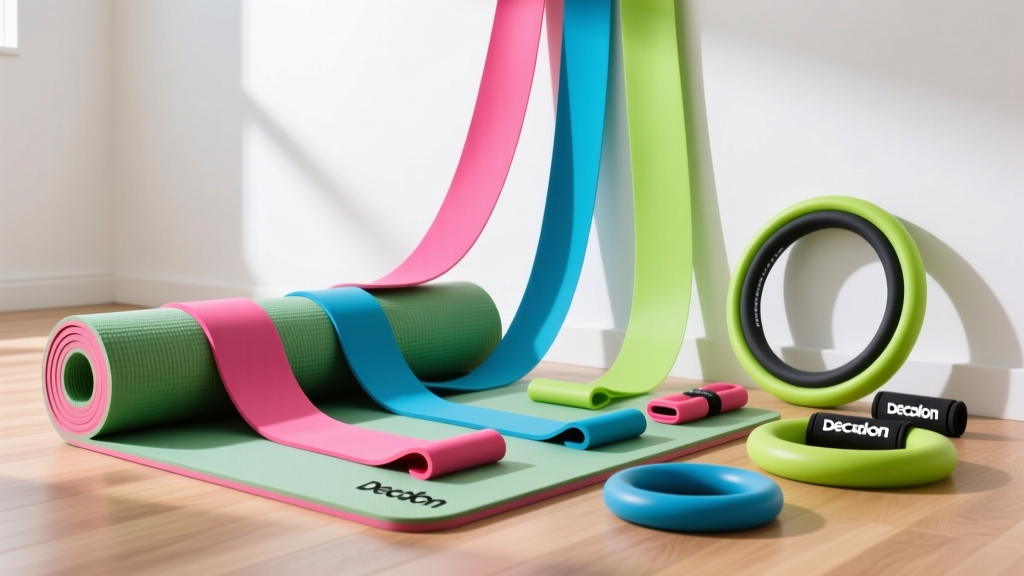
- Budget Alternative: Decathlon Core Pilates Ring ($12.99). While the fiberglass core offers a surprisingly similar 15-lb resistance curve to the Stott, the hard plastic grips lack padding. Pro-Tip: Wrap the Decathlon ring's grips in thin athletic tape or microfiber cloth to prevent bruising on the ankles during high-rep sets.
2. Soft Mini Stability Balls (9-Inch)
As highlighted by Harvard Health Publishing, engaging the deep core requires constant neuromuscular feedback. A 9-inch soft PVC Pilates ball (priced around $10–$15) is a game-changer for the Decathlon mat setup.
💡 Technique Integration: The 'Hundred' UpgradePlace the mini ball between your knees during the Hundred. The slight instability of the air-filled ball forces your pelvic floor and transverse abdominis to engage 30% harder to maintain the ball's position, compensating for the lack of heavy spring resistance found on a Reformer.
3. Resistance Bands with Door Anchors
Mat Pilates lacks the overhead pulling mechanics of the Reformer's arm springs. To replicate exercises like Pull Straps or Tricep Presses, you need a continuous loop resistance band system.
- Expert Pick: TheraBand CLX Cones ($22.00). The unique loop design eliminates the need to wrap the band around your wrists, which can cut off circulation during the Swimming or Pull Down exercises. The Gold level (medium resistance) perfectly mimics the red spring on a Merrithew Reformer.
4. Biomechanical Grip Socks
Because the Decathlon Basic 4mm TPE surface loses traction when damp, grip socks are non-negotiable for home studios in 2026. Avoid generic 'yoga socks' with widely spaced rubber dots. Look for Sticky Toes or Pilatesocks brands that feature a continuous silicone-web pattern across the entire plantar fascia. This ensures that during Plank or Side Plank transitions, your toes do not slide outward, protecting the hip labrum from shear force injuries.
Building Your Budget Pilates Studio: Cost Breakdown
You do not need a $4,000 Reformer to achieve profound core adaptations. By leveraging budget foundations and strategic accessories, you can build a highly effective setup.
| Equipment Category | Recommended Product | Estimated Cost | Primary Biomechanical Benefit |
|---|---|---|---|
| Foundation Mat | Decathlon Basic 4mm TPE | $14.99 | High proprioception, standing stability. |
| Spinal Cushioning | High-Density EVA Foam Block | $8.50 | Sacral support for rolling exercises. |
| Adductor Resistance | Decathlon Core Ring (Taped) | $12.99 | Inner thigh and pelvic floor engagement. |
| Spring Simulation | TheraBand CLX (Gold) | $22.00 | Overhead pulling and tricep isolation. |
| Traction | Silicone-Web Grip Socks | $18.00 | Prevents shear force on TPE mats. |
| Total Studio Cost | --- | $76.48 | Comprehensive full-body Pilates coverage. |
Expert Verdict
When analyzing the Decathlon Yoga Mat Basic 4mm product info and reviews through the lens of a Pilates instructor, the verdict is nuanced. As a standalone mat for classical, floor-heavy Pilates, it falls short due to inadequate spinal cushioning. However, as a highly affordable, portable base layer for a modern, accessory-driven home Pilates practice in 2026, it is exceptional.
By pairing this 4mm mat with a soft mini ball, a loop resistance band, and a foam block for targeted spinal support, you bypass the mat's inherent limitations. This strategic approach allows you to reap the profound core-stabilizing benefits of Pilates while keeping your initial equipment investment under $80.
More gear to consider
All reviews
2026 Trends: Crochet Yoga Mat Bag Craze & Stability vs BOSU Balls

Exercise Ball Size Guide: Plus, Do You Need a Yoga Mat for Pilates?

Best Tracker Bath: Real-World Performance, Accuracy Benchmarks, and Smart Integration Tested

Setup Guide: Speed, Weighted & Beaded Ropes on a Burgundy Yoga Mat

Medicine Ball Weight Guide & Setup: Yoga Mat Clas Ohlson Test