Battle Rope Length & Thickness Guide + Yoga Mat Rack Storage
Master battle rope length and thickness for your workouts. Learn pro maintenance tips, including how a heavy-duty yoga mat rack extends gear lifespan.

The Material Science of Battle Rope Degradation
Battle ropes are among the most punishing pieces of equipment in a modern garage gym. They endure violent friction, high-tension whipping, and constant exposure to sweat and environmental humidity. Before diving into our comprehensive battle rope length and thickness guide, it is critical to understand the materials you are buying and maintaining. As of 2026, the market is dominated by two primary materials: Poly Dacron and natural Manila hemp.
Poly Dacron is a synthetic blend featuring a polypropylene core wrapped in a braided polyester sheath. According to equipment standards highlighted by the National Strength and Conditioning Association (NSCA), synthetic ropes are hydrophobic, meaning they resist water absorption, making them ideal for indoor and outdoor use. Manila ropes, conversely, are hygroscopic. They absorb moisture from the air and your sweat. If a Manila rope is stored improperly on a damp concrete floor, the internal fibers will literally rot from the inside out, leading to catastrophic snapping under tension.
Understanding this material science is the foundation of longevity. A premium 50-foot Poly Dacron rope from Rogue Fitness or Titan Fitness will set you back between $135 and $165 in 2026. Protecting that investment requires precise sizing, rigorous cleaning protocols, and strategic storage solutions.
Battle Rope Sizing Matrix: Length and Thickness
Choosing the right dimensions is not just about fitness level; it is about spatial awareness and anchor-point stress. A rope that is too long for your space will bottom out, creating harsh shockwaves that degrade the anchor strap and the rope's internal core. Use the matrix below to select your ideal configuration.
| Thickness | Length | Avg. Weight | Grip Demand | Best Use Case | 2026 Avg. Price |
|---|---|---|---|---|---|
| 1.5-inch | 30 ft | 16 lbs | Low | Endurance, rehab, small apartments | $65 - $80 |
| 1.5-inch | 50 ft | 27 lbs | Medium | HIIT, continuous wave conditioning | $90 - $110 |
| 2.0-inch | 40 ft | 27 lbs | High | Standard garage gyms, athletic power | $105 - $125 |
| 2.0-inch | 50 ft | 37 lbs | Very High | Full-body slams, MMA conditioning | $135 - $155 |
| 2.5-inch | 50 ft | 55 lbs | Extreme | Strongman grip training, heavy slams | $170 - $210 |
Pro Tip: Remember that a 50-foot rope folded in half only gives you 25 feet of working length. You need at least 25 feet of clearance between you and your anchor point to generate proper alternating waves without the rope violently bottoming out and fraying the center.
The Silent Killer: Concrete and Moisture
The most common failure mode for battle ropes is not fraying from use; it is mold, mildew, and core degradation from improper storage. Garage gyms are notorious for temperature fluctuations. When a cold concrete floor meets warm, humid air, condensation forms. If you leave your battle rope coiled on the ground, the bottom layers wick this moisture. Over a few months, the polypropylene core traps the dampness, leading to a foul odor and structural weakening.
To maximize the lifespan of your gear, it must be elevated, allowed to breathe, and kept away from direct UV light if stored outdoors.
The Heavy-Duty Yoga Mat Rack Storage Hack
When outfitting a home gym, space optimization is critical. Most dedicated lifters invest in a commercial-grade yoga mat rack to store their PVC, TPE, and natural rubber mats. However, this equipment has a secondary, highly underutilized purpose that serves as the ultimate battle rope longevity hack.
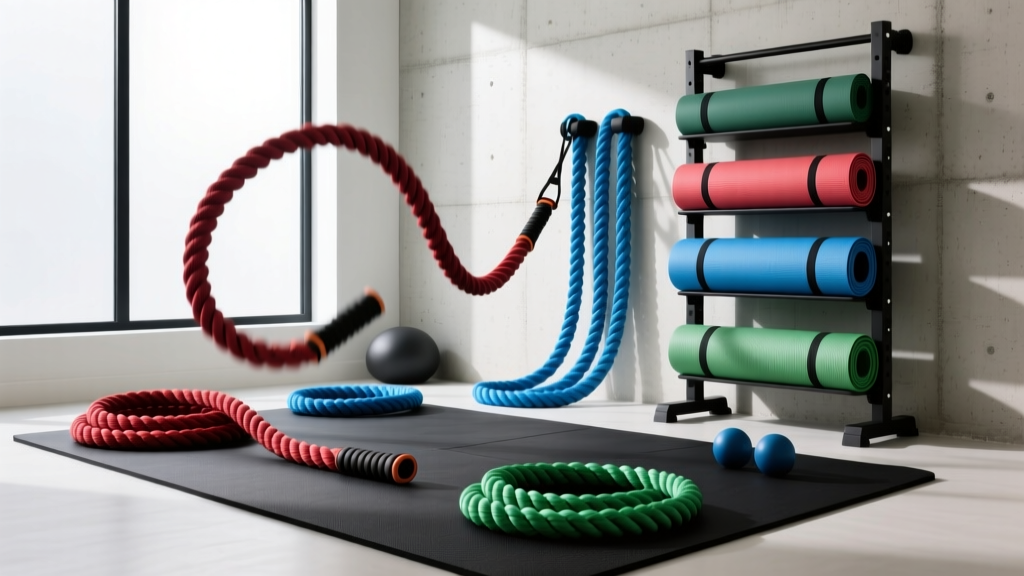
A heavy-duty, wall-mounted steel yoga mat rack (such as the 5-tier models from Titan Fitness or Balanced Body) features thick 18-inch steel pegs rated for 50+ pounds each. A standard 50-foot, 2-inch Poly Dacron rope weighs roughly 37 pounds. By hanging your coiled rope on the lowest peg of your yoga mat rack, you achieve three critical maintenance goals:
- Moisture Elevation: The rope is suspended 12 to 18 inches off the ground, completely eliminating the risk of concrete condensation wicking.
- Air Circulation: Hanging the coil vertically allows ambient air to flow through the loops, drying out sweat and humidity after intense conditioning sessions.
- Space Reclamation: You consolidate your stretching and conditioning gear into one high-density wall zone, keeping your workout floor clear for Olympic lifting or gymnastics movements.
WARNING: Manila Rope Storage
If you are using a natural Manila hemp rope, hanging it on your yoga mat rack is mandatory, not optional. Manila fibers are highly susceptible to mold when left on garage floors. Furthermore, never store a Manila rope in a sealed plastic bin; it requires active airflow to prevent dry rot and internal decay.
Step-by-Step Maintenance and Coiling Protocol
Proper coiling prevents 'memory twists'—permanent kinks in the synthetic sheath that cause the rope to tangle and whip unpredictably during use. Follow this protocol after every session:
- The Wipe Down: Use a microfiber cloth dampened with a solution of 90% distilled water and 10% white vinegar. Never use bleach or harsh ammonia-based cleaners, as these degrade the polyester braided sheath over time, causing it to fuzz and unravel.
- The Over-Under Coil: Do not simply wrap the rope in a circle around your elbow. This introduces a half-twist into the core with every loop. Instead, use the 'over-under' method: make one loop over your arm, then twist your wrist inward for the next loop to go under. This lays the rope flat and neutral.
- The Rack Hang: Secure the coil with a heavy-duty Velcro strap or a bungee cord, and hang it directly onto the bottom peg of your steel yoga mat rack.
- End-Point Inspection: Monthly, check the heat-shrink tubing at the ends of the rope. If the polyolefin tubing shows signs of cracking, use a heat gun to apply a new layer of 3:1 shrink ratio, 2-inch diameter tubing to prevent the core from slipping out of the sheath.
Troubleshooting Edge Cases and Wear Patterns
Even with meticulous care, high-volume athletes will encounter specific wear patterns. Here is how to troubleshoot and extend the life of your gear based on insights from the American Council on Exercise (ACE) regarding equipment safety standards.
1. Sheath Fuzzing and Fraying
If the polyester sheath begins to look fuzzy near the 10-foot marks (where your hands typically grip), this is normal friction wear. To halt the fraying, carefully run a lighter or heat gun over the fuzzy area to melt the synthetic fibers back together. Do not apply tape; athletic tape will leave a sticky residue that attracts dirt and accelerates abrasion.
2. Anchor Strap Degradation
The anchor point takes massive shock loads. If you are wrapping your rope directly around a steel pole or a rough concrete pillar, the friction will saw through the Poly Dacron sheath in a matter of weeks. Always use a heavy-duty nylon tree-sling or a dedicated steel anchor mount with a smooth, rounded carabiner to isolate the rope from abrasive surfaces.
3. Mat Rack Peg Bending
While a commercial steel yoga mat rack is designed for heavy loads, cheap wire racks marketed for home offices will bend under the 37-pound dynamic load of a dropped battle rope. Ensure your wall-mounted rack uses at least 1/2-inch solid steel pegs and is secured directly into wall studs using lag bolts, not drywall anchors.
Final Thoughts on Gear Longevity
Treating your conditioning equipment with the same respect as your barbells and dumbbells is the hallmark of a serious home gym owner. By selecting the correct length and thickness for your specific spatial and physiological needs, and by implementing a dedicated storage system utilizing a heavy-duty yoga mat rack, you can easily push the lifespan of a premium battle rope past the 5-year mark. Protect your investment, respect the materials, and your gear will be ready for every slam, wave, and whip you can throw at it.
More gear to consider
All reviews
Yoga Block & Strap Buying Guide + How to Clean Manduka Yoga Mat

Exercise Ball Size Guide: Average Yoga Mat Width & Longevity Tips

Pilates Accessories Care: Maintain Your Lululemon Yoga Mat Dupe

Smart Yoga Mats Setup: Matching Resistance Band Types and Levels

Battle Rope Layout Guide & Manduka Yoga Mat Strap Storage