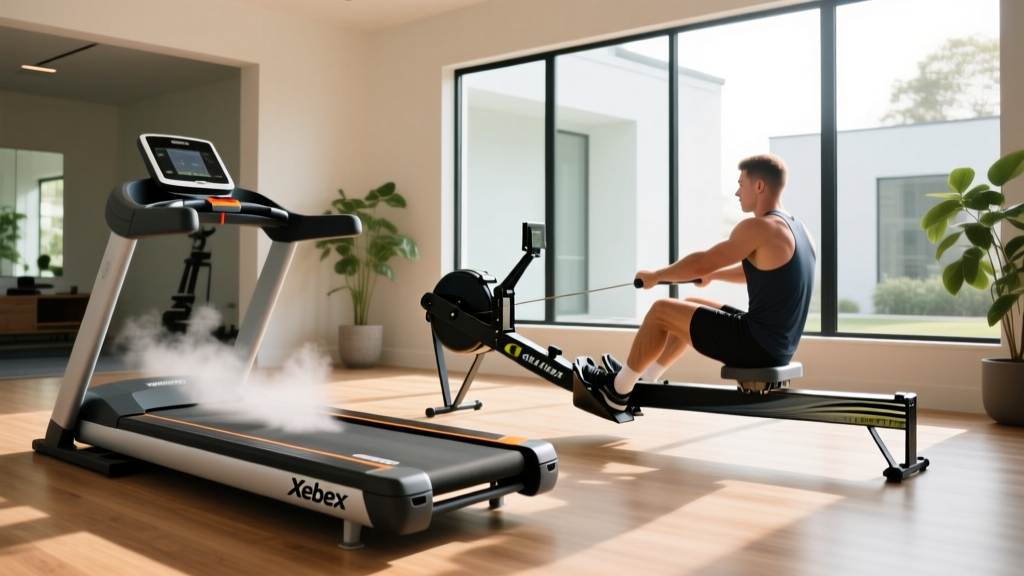
Xebex Treadmill vs Rowing Machine: Buying Guide & Technique
Compare the Xebex treadmill and top rowing machines. Dive into our rowing machine buying guide, technique tips, and pricing to find your perfect cardio fit.

The Cardio Showdown: Xebex Air Runner vs. The Rowing Machine
When outfitting a high-performance home gym in 2026, the debate often narrows down to two elite conditioning tools: the self-powered curved treadmill and the indoor rowing machine. The Xebex treadmill—specifically the flagship Air Runner 3.0—is a staple in CrossFit boxes and elite sprint training facilities. It demands pure cardiovascular output with zero technical onboarding. You simply step on and run.
However, the rowing machine offers a radically different stimulus. It recruits up to 86% of the body's musculature per stroke but demands strict technical proficiency to avoid injury and maximize wattage output. If you are torn between investing in the Xebex treadmill or pivoting to a high-end rower, this head-to-head comparison and comprehensive rowing machine buying guide will help you make the right choice for your biomechanics, budget, and fitness goals.
Core Premise: The Xebex Air Runner is a lower-body dominant, high-impact (relatively speaking, though curved decks reduce joint shear) running simulator. The rowing machine is a full-body, zero-impact horizontal power generator. Your choice dictates not just your workout style, but the technical learning curve you are willing to accept.Head-to-Head: Equipment Breakdown & 2026 Pricing
Before diving into the rowing machine buying guide, we must establish the baseline specifications and current market pricing for the top contenders in this space. Below is a comparison matrix featuring the Xebex Air Runner 3.0 against the industry-standard Concept2 RowErg and the heavy-duty Xebex Rower.
| Feature | Xebex Air Runner 3.0 (Treadmill) | Concept2 RowErg (Standard) | Xebex Rower (Air/Magnetic) |
|---|---|---|---|
| 2026 MSRP | $2,899 - $3,199 | $990 - $1,200 | $1,499 - $1,699 |
| Resistance Type | Self-Powered (Curved Slat Belt) | Air (Variable via Damper) | Air + Magnetic (16 Levels) |
| Max User Weight | 350 lbs | 500 lbs | 440 lbs |
| Footprint (In Use) | 70' L x 32' W x 63' H | 96' L x 24' W x 14' H | 102' L x 28' W x 36' H |
| Technical Learning Curve | None (Natural Running Gait) | High (Requires Stroke Mastery) | High (Requires Stroke Mastery) |
| Telemetry / Console | LCD (Watts, Pace, HR, Distance) | PM5 (Advanced Erg Data, Drag Factor) | LCD (Pace, Watts, Calories, HR) |
The Rowing Machine Buying Guide: Core Decision Factors
If the head-to-head comparison above has you leaning toward the rower, you must navigate the specific nuances of rowing ergonomics. Unlike the Xebex treadmill, where the primary buying decision is simply deck width and belt durability, buying a rowing machine requires an understanding of fluid dynamics, rail mechanics, and data tracking.
1. Resistance Mechanisms: Air vs. Magnetic vs. Water
For serious conditioning, air resistance remains the gold standard. As you pull harder, the flywheel spins faster, creating exponential drag. This mimics the physics of moving a shell through water. Magnetic resistance (found in some hybrid models) offers a quieter stroke but lacks the infinite, effort-based resistance curve of pure air. Water rowers provide excellent auditory feedback but often lag in telemetry accuracy and require periodic water purification treatments.
2. The Drag Factor Misconception
Many buyers mistakenly believe a higher damper setting (1-10) equals a better workout. According to Concept2's official technique guide, the damper is merely a gearbox. For most athletes, a drag factor between 110 and 130 (usually a damper setting of 3 to 5) is optimal. Setting the damper to 10 is the rowing equivalent of riding a bicycle in the heaviest gear uphill; it will fatigue your muscular system before your cardiovascular system reaches peak capacity.
3. Rail Length and Ergonomics
If you are taller than 6'2', you must verify the inseam clearance. The standard Concept2 RowErg accommodates up to a 38-inch inseam, while the Tall version (with elevated legs) is required for athletes with longer levers. The Xebex Rower offers a slightly longer monorail, accommodating up to a 40-inch inseam without requiring an aftermarket extension.
Mastering the Rowing Technique (The Steep Learning Curve)
The most significant advantage of the Xebex treadmill is its accessibility. Running is a primal movement pattern. Rowing, conversely, is a highly technical, sequenced power transfer. Poor technique on a rower does not just reduce your wattage output; it actively invites lumbar spine injuries and rib stress fractures.
'Unlike running on a curved treadmill where your body naturally self-regulates stride length and cadence, the rowing machine forces you to manually orchestrate a kinetic chain. If the sequence breaks down, the load transfers directly to your lower back.'
The 4 Phases of the Rowing Stroke
To safely transition from a treadmill runner to a rower, you must memorize the stroke sequence. The power distribution should always be 60% legs, 20% core, and 20% arms.
- The Catch: Shins are perfectly vertical. Arms are straight, shoulders are relaxed, and the torso is hinged forward at roughly 11 o'clock. You are loading the posterior chain like a coiled spring.
- The Drive: The sequence is strictly Legs, then Core, then Arms. You push the footplate away explosively. Only when the legs are nearly fully extended do you swing the torso back to 1 o'clock, followed by the arms pulling the handle to the lower sternum.
- The Finish: Legs are flat and extended. The torso is slightly leaned back (1 o'clock). The handle is resting just below the pecs, elbows drawn past the ribcage. This is a momentary pause, not a rest.
- The Recovery: The exact reverse of the drive. Arms extend first, torso hinges forward to 11 o'clock, and only then do the knees bend to slide back to the catch. The recovery should take twice as long as the drive (a 1:2 ratio).
This occurs when an athlete pushes with their legs but forgets to engage their core, causing the hips to shoot backward while the shoulders stay in place. This places massive shear force on the lumbar spine. To fix this, focus on keeping the shoulder angle relative to the hips constant during the first half of the drive.
Biomechanics, Joint Loading, and Caloric Expenditure
When comparing the Xebex Air Runner to a rowing machine, we must look at joint loading. Running, even on a shock-absorbing curved slat belt, involves repetitive ground reaction forces equivalent to 2.5 times your body weight per stride. For athletes with chronic plantar fasciitis, Achilles tendinopathy, or severe knee osteoarthritis, the Xebex treadmill may eventually exacerbate these conditions during high-volume training blocks.
Rowing is a closed-kinetic-chain, zero-impact exercise. According to Mayo Clinic's guidelines on aerobic exercise, low-impact modalities like rowing allow for sustained cardiovascular conditioning without the micro-trauma associated with weight-bearing exercises. A 185-pound athlete can expect to burn roughly 294 calories in 30 minutes of vigorous rowing, which is highly comparable to the caloric expenditure of running at a 6-minute-per-mile pace on the Xebex Air Runner.
Muscle Recruitment Matrix
- Xebex Treadmill: Primarily targets the calves, hamstrings, glutes, and quadriceps. Core and upper body act merely as stabilizers.
- Rowing Machine: Targets the quadriceps and glutes (drive), latissimus dorsi and rhomboids (pull), erector spinae (core hinge), and calves (stabilization at the catch).
Final Verdict: Which Should You Buy?
Your decision ultimately hinges on your technical patience and your specific physiological needs.
Buy the Xebex Air Runner Treadmill if: You are a runner looking to improve your sprint mechanics, you want a machine that multiple users of varying skill levels can jump onto instantly, and you have the budget ($3,000+) and ceiling clearance for a large, upright piece of equipment. It is the ultimate tool for high-intensity interval training (HIIT) where immediate pacing changes are required.
Buy a Rowing Machine (Concept2 or Xebex) if: You need a zero-impact, full-body conditioning tool that builds both aerobic capacity and muscular endurance. If you are willing to spend 3 to 4 weeks drilling the catch-and-drive sequence to build neuromuscular efficiency, the rowing machine offers a vastly superior return on investment (especially the Concept2 RowErg at under $1,000). It builds a resilient posterior chain that will actually make you a better, more injury-resistant runner when you do hit the pavement.
More gear to consider
All reviews
Curved Manual vs Motorized: Is the Starpower Treadmill Right for You?

Air Bike vs Assault Bike & Lifetime Fitness F3 Treadmill Space Guide

Merit 715T Treadmill Belt Maintenance: 2026 Cost & Value Analysis
Curved vs Motorized: Is a HealthRider Treadmill Right for You?

Ava Addams Treadmill Trend: Folding Treadmill Maintenance & Reviews
