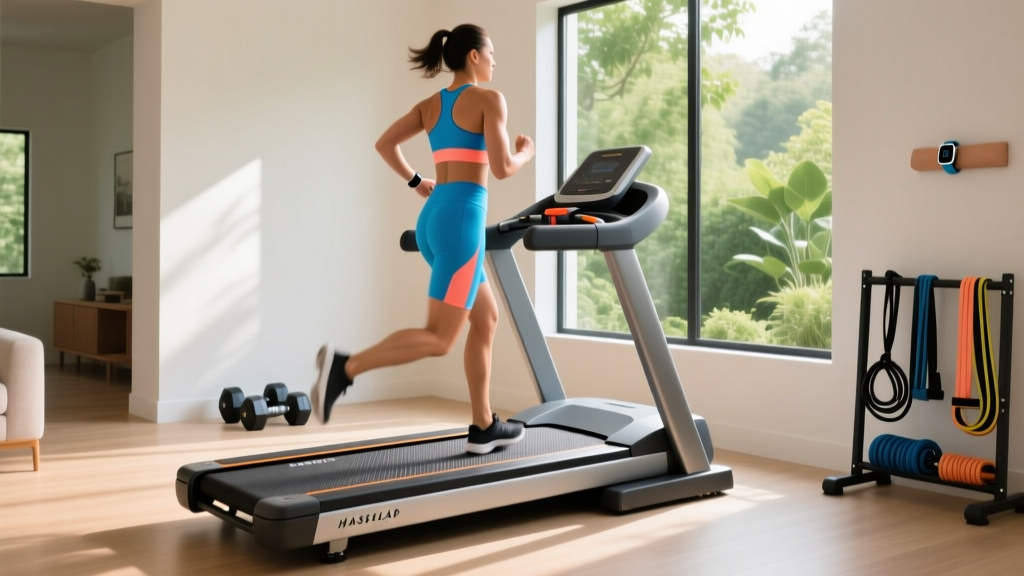
Knee Pain After Treadmill Running? Feature Buying Guide
Experiencing knee pain after treadmill running? Compare joint-friendly treadmill features and troubleshoot your form to protect your patellofemoral joint.

If you are consistently dealing with knee pain after treadmill running, the problem likely extends beyond your running shoes. While overuse injuries are common in cardiovascular training, the repetitive, fixed-path mechanics of a treadmill place unique sheer forces on the patellofemoral joint and iliotibial (IT) band. When you combine poor biomechanics with a treadmill that lacks the appropriate shock absorption, belt dimensions, or motor consistency, the knee becomes the primary shock absorber for your body weight.
At FitGearPulse, we approach joint health from an engineering and biomechanical perspective. This guide will troubleshoot the root causes of treadmill-induced knee pain, compare the critical machine features that mitigate impact, and provide a 2026 buyer’s matrix for joint-friendly treadmills.
The Biomechanics of Treadmill-Induced Knee Pain
Running on a motorized belt fundamentally alters your stride compared to overground running. Because the belt pulls your foot backward, runners tend to rely less on their hamstrings and glutes for propulsion, shifting the workload to the quadriceps. This quad-dominant gait increases the compressive forces on the patella (kneecap). According to the Mayo Clinic, patellofemoral pain syndrome (PFPS) is one of the most common causes of anterior knee pain in runners, often triggered by repetitive stress and improper load distribution.
Furthermore, the American Academy of Orthopaedic Surgeons (AAOS) notes that repetitive friction of the IT band over the lateral femoral epicondyle is exacerbated by the slight, unnatural pelvic rotation that occurs when runners attempt to stabilize themselves on a moving belt. If your treadmill deck is too rigid, or if you are overstriding to keep up with a lagging motor, these forces multiply exponentially.
Critical Treadmill Features to Compare for Joint Health
Not all treadmills are created equal when it comes to impact mitigation. When shopping for a machine to prevent or alleviate knee pain, you must scrutinize three specific hardware features.
1. Deck Cushioning Systems and Elastomer Durometers
The cushioning system is the first line of defense against ground reaction forces (GRF). Entry-level treadmills often use basic rubber pucks that compress uniformly, offering little variable shock absorption. Premium joint-friendly treadmills utilize multi-zone elastomers with varying durometer (hardness) ratings. For example, a high-quality deck will be softer in the strike zone (heel/midfoot) to absorb the initial 2.5x bodyweight impact, and firmer in the toe-off zone to provide energy return. Slat-belt treadmills, like those made by Woodway, use vulcanized rubber that absorbs impact entirely differently than traditional MDF decks, reducing joint stress by up to 40%.
2. Belt Dimensions: The Overstriding Trap
A belt that is too short or narrow forces you to subconsciously shorten your stride or run with a tense, narrowed gait. For runners over 5'8", a standard 20-inch by 55-inch belt is a primary culprit for knee pain. You need a minimum belt size of 22 inches wide by 60 inches long. This allows for natural lateral drift and full stride extension, preventing the 'chopping' stride that increases cadence but severely limits shock absorption time in the knee joint.
3. Continuous Horsepower (CHP) and Motor Lag
Motor size directly impacts knee health. If a treadmill motor is underpowered (e.g., 2.5 CHP) and you are running at 7.5 mph, the belt will micro-stutter or lag upon footstrike. This millisecond hesitation forces your knee to absorb the braking force rather than rolling through the stride. For dedicated running, a minimum of 3.0 CHP (Continuous Duty) is mandatory to maintain belt velocity consistency.
2026 Joint-Friendly Treadmill Comparison Matrix
Below is a comparison of top-performing treadmills currently on the market, evaluated specifically on features that protect knee and joint health.
| Model | 2026 Price Range | Cushioning Technology | Belt Size (W x L) | Motor (CHP) | Best For |
|---|---|---|---|---|---|
| Woodway 4Front | $6,899 | Vulcanized Rubber Slat Belt (No deck friction) | 22" x 60" | 3.5 HP AC | Severe joint issues, elite rehab |
| NordicTrack Commercial 1750 | $1,999 | Runners Flex (3-zone variable cushioning) | 22" x 60" | 3.5 CHP | Heavy runners, long-distance |
| Sole F63 | $1,199 | Cushion Flex Whisper Deck (8-node elastomers) | 20" x 60" | 3.0 CHP | Budget-conscious daily joggers |
| Horizon 7.4 | $1,299 | 3-Zone Variable Response Cushioning | 22" x 60" | 3.0 CHP | Wide-stride runners, HIIT |
Troubleshooting Your Current Setup Before Buying
Before investing thousands in a new machine, you must rule out user-error and biomechanical flaws. If your current treadmill has a 3.0+ CHP motor and a 60-inch belt, your knee pain after treadmill running is likely a form issue. Follow this troubleshooting protocol:
- Audit Your Cadence: Use a metronome app or your smartwatch to check your steps per minute (SPM). A cadence below 160 SPM indicates overstriding. Overstriding causes your foot to land ahead of your center of mass, acting as a brake and sending a massive shockwave directly through the tibia into the knee. Aim to increase your cadence to 170-180 SPM by taking shorter, quicker steps.
- Implement the 1% Incline Rule: Running on a perfectly flat (0%) treadmill removes the natural wind resistance you face outdoors, altering your pelvic tilt and increasing braking forces. Setting the treadmill to a 1% to 1.5% incline mimics outdoor energy costs, engages the glutes and hamstrings, and significantly reduces patellofemoral compression.
- Stop Holding the Handrails: Holding onto the console or rails shifts your center of gravity backward. This forces you to reach further forward with your feet, exacerbating the overstriding mentioned above.
Frequently Asked Questions
Is a manual (curved) treadmill better for knee pain than a motorized one?
Curved manual treadmills (like the TrueForm Runner or AssaultRunner) require you to drive the belt with the balls of your feet, which naturally encourages a midfoot strike and a higher cadence. This drastically reduces the heel-strike braking forces that cause anterior knee pain. However, they require significantly more cardiovascular effort and are not ideal for slow, steady-state recovery walking.
How long should I rest if I develop sharp knee pain from the treadmill?
Sharp, localized pain (especially under or around the kneecap) is a signal of tissue inflammation, not just muscle fatigue. The Physio-pedia clinical guidelines recommend immediate load management. Stop running for 7 to 10 days, switch to low-impact cardio like an elliptical or swimming, and consult a physical therapist if the pain persists during daily activities like stair climbing.
Does treadmill belt lubrication affect knee impact?
Indirectly, yes. A dry, unlubricated belt creates high friction against the deck. This forces the motor to work harder, causing the micro-stutters and belt lag that disrupt your stride rhythm and force your knees to absorb uneven impact. Ensure your belt is lubricated with 100% silicone treadmill lube every 150 miles or every 3 months.
Final Verdict
Resolving knee pain after treadmill running requires a dual approach: optimizing your biomechanics and ensuring your equipment is engineered to dissipate ground reaction forces. If you are running on a sub-3.0 CHP motor with a 55-inch belt, no amount of form correction will entirely save your joints. Invest in a machine with a 22" x 60" belt, multi-zone elastomer cushioning, and commit to a 170+ SPM cadence to keep your knees healthy for the long haul.
More gear to consider
All reviews
The Fastest Treadmill for Small Spaces: 2026 Folding Reviews
Reebok Jet 100 Treadmill vs Curved Manual: Beginner Guide
Jillian Michaels ProForm Treadmill Noise Fixes & Cardio Comparisons
Rowing Guide: Beating Treadmills That Don't Require a Subscription
ProForm 490 C Treadmill vs Under Desk Treadmills: Office Review
