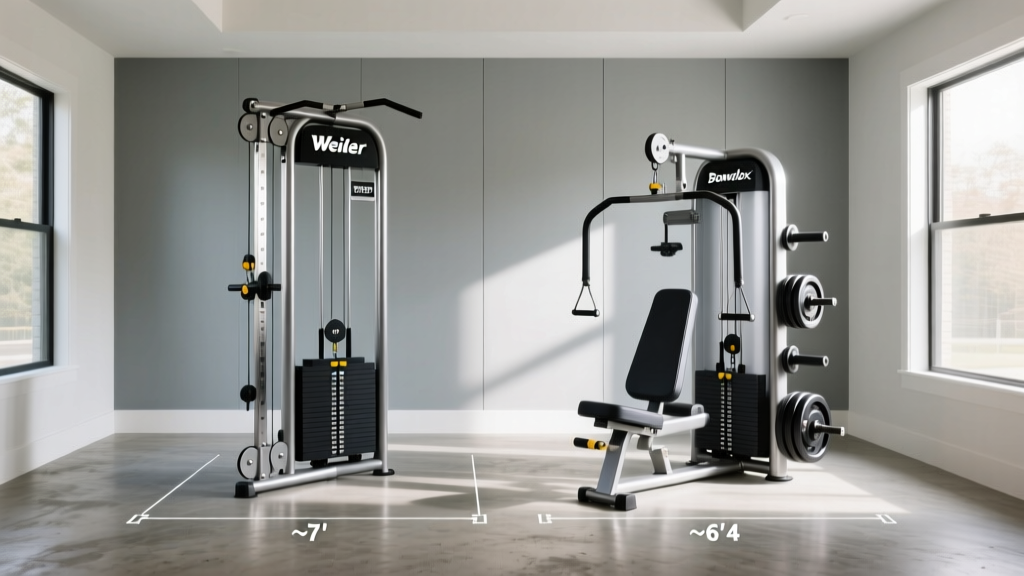
Weider 8530 Home Gym vs Bowflex PR1000: Remodel Guide
Planning a home gym remodel? We compare the Weider 8530 home gym against the Bowflex PR1000 for ceiling clearance, floor load, and space planning.

Planning Your Home Gym Remodel: The Anchor Equipment Rule
When renovating a spare room, basement, or garage into a dedicated fitness space, the biggest mistake homeowners make is finalizing drywall, lighting, and flooring before selecting their anchor equipment. Your primary machine dictates the room's structural requirements, electrical layout, and spatial flow. In 2026, two of the most common entry-to-mid-level anchor machines found in residential remodels are the traditional weight-stack Weider 8530 home gym and the resistance-rod-based Bowflex PR1000. While both promise full-body workouts, their physical footprints and structural demands are vastly different. Choosing the wrong one for your specific architectural constraints can lead to smashed ceiling lights, sagging floor joists, or a cramped room that violates basic safety clearances.
Remodeler's Quick Tip: Always measure your space with the machine's operating clearance in mind, not just its static footprint. A machine might fit in a 5x5 corner, but if you cannot pull the lat bar down without hitting a drywall seam or light fixture, the space is functionally useless.Head-to-Head: Spatial & Structural Requirements
Before ripping up carpet or pouring self-leveling concrete, you must understand how the Weider 8530 home gym and the Bowflex PR1000 interact with your home's architecture. Below is a direct comparison of their physical specifications as they relate to home renovation planning.
| Feature | Weider 8530 Home Gym | Bowflex PR1000 |
|---|---|---|
| Static Footprint | ~70' L x 40' W | 103' L x 80' W |
| Machine Height | 80 Inches | 82 Inches |
| Operating Clearance Needed | 6x6 Feet (Vertical focus) | 8x10 Feet (Lateral focus) |
| Total Machine Weight | ~350 lbs (inc. stack) | ~148 lbs |
| Resistance Type | 200 lb Vinyl Weight Stack | Up to 210 lbs Power Rods |
| Ideal Remodel Location | Basements, Low-Ceiling Garages | Upstairs Flex Rooms, Wide Garages |
Ceiling Height & Overhead Clearance
One of the most critical factors in any home gym renovation is ceiling height, particularly when installing a cable-based machine. The Weider 8530 home gym stands at approximately 80 inches (6 feet, 8 inches) tall. In a standard basement remodel where ceiling heights often range from 84 to 96 inches due to exposed HVAC ductwork and plumbing joists, the Weider provides a crucial 4-to-16-inch buffer. This allows you to install recessed LED panel lighting directly above the lat pulldown station without risking a collision when the bar is returned to the top of the stack.
Conversely, the Bowflex PR1000 stands slightly taller at 82 inches, but its primary clearance issue is lateral. The Power Rods require significant outward flexing space. If you are remodeling a narrow galley-style spare room or a segmented garage bay, the Bowflex's 80-inch width requirement means you cannot place it flush against a side wall. You must frame your drywall with at least 24 inches of lateral buffer on both sides to accommodate the rod bend during heavy chest presses or rows.
Floor Joist Load & Subfloor Prep
When remodeling an upstairs bedroom or a second-floor flex space into a gym, structural engineering becomes paramount. According to the National Association of Home Builders (NAHB), standard residential floor joists are typically designed for a uniform live load of 40 pounds per square foot (PSF). However, gym equipment creates concentrated 'point loads'.
The Weider 8530 home gym weighs roughly 350 pounds when fully assembled with its weight stack. This mass is distributed across a relatively small base footprint of about 12 square feet, resulting in a point load of nearly 29 PSF just from the machine sitting idle. Add a 200-pound user and dynamic downward force during leg extensions, and you are pushing the limits of standard 16-inch on-center joist spacing.
Contractor's Warning: If placing a heavy weight-stack machine on a second floor, always position it so the base runs perpendicular to the floor joists, ideally spanning multiple joists. For added safety during a remodel, lay down a 3/4-inch CDX plywood subfloor beneath your rubber mats to distribute the point load across a wider surface area.
Because the Bowflex PR1000 weighs less than 150 pounds and utilizes a wider, more distributed base, it is vastly superior for second-floor remodels where structural reinforcement is not in the budget.
Weider 8530 Home Gym: The Basement Champion
For homeowners finishing a basement or converting a low-clearance garage, the Weider 8530 home gym remains a highly practical anchor choice in 2026. Its traditional stack-and-cable design provides a consistent, gravity-based resistance curve that many lifters prefer over synthetic rods. Furthermore, its narrow 40-inch width allows it to be tucked into alcoves or placed between structural support columns in unfinished spaces.
Remodeling Pros & Cons
- Pro: Compact lateral footprint allows for placement in narrow basement bays.
- Pro: 80-inch height clears standard low-hanging basement obstructions.
- Con: Heavy point-load requires subfloor reinforcement on upper levels.
- Con: The 200 lb stack limit may require advanced users to eventually upgrade, rendering the initial remodel obsolete.
Bowflex PR1000: The Upstairs & Flex-Space Contender
If your renovation involves converting a master bedroom, attic, or second-floor bonus room, the Bowflex PR1000 is the safer architectural bet. Its lightweight frame eliminates the need for expensive structural reinforcement. However, you must design the room's layout to accommodate its massive 8x10 foot operating envelope.
Remodeling Pros & Cons
- Pro: Lightweight frame is safe for any standard residential floor without joist reinforcement.
- Pro: No weight stack means no loud clanking noises transferring through floorboards to the rooms below.
- Con: Requires a wide, open room; cannot be placed in tight corners or narrow alcoves.
- Con: Power rods can degrade over time if exposed to extreme temperature fluctuations in uninsulated garage remodels.
Essential Remodeling Tips for Cable & Rod Machines
Beyond the machine itself, your renovation must account for the environment surrounding the equipment. Follow this step-by-step checklist to ensure your home gym is functional, safe, and durable.
- Install Heavy-Duty Flooring: For the Weider 8530, skip the cheap foam puzzle mats. Invest in 3/8-inch (8mm) vulcanized rubber rolls. If remodeling a concrete basement, lay down a 6-mil polyethylene vapor barrier first to prevent moisture from degrading the rubber and rusting the machine's base plates.
- Mirror Placement Strategy: When framing walls for gym mirrors, leave a 6-inch gap from the floor to accommodate baseboards and prevent kicking the glass during leg exercises. Ensure mirrors are mounted on studs or heavy-duty drywall anchors, as the vibration from a dropping weight stack can shake poorly secured glass loose over time.
- Lighting & Electrical: Avoid pendant lights or flush-mount fixtures directly over the lat pulldown area. Opt for recessed LED can lights or edge-lit panel lights. Ensure your remodel includes a dedicated 15-amp circuit for high-velocity floor fans or portable AC units, as enclosed gym rooms require significant airflow.
- Ventilation & HVAC: The American Council on Exercise (ACE) emphasizes the importance of air quality and temperature control in workout spaces. If your remodel encloses a previously open space, ensure your HVAC system can deliver adequate CFM (Cubic Feet per Minute) to the room, or install a dedicated exhaust fan to manage humidity and prevent mold growth on drywall and equipment.
Final Verdict: Which Fits Your Renovation?
The choice between these two machines ultimately comes down to your home's architectural realities. If you are remodeling a basement with low ceilings, narrow bays, and a concrete slab, the Weider 8530 home gym is your ideal anchor. It maximizes vertical space and provides traditional weight-stack training without requiring a massive lateral footprint. However, if your renovation is taking place on the second floor, in a wide attic, or in a space where noise transfer and floor loading are primary concerns, the Bowflex PR1000 is the undisputed champion. By selecting your anchor equipment before you frame your first wall, you guarantee a home gym that is as structurally sound as it is functional.
More gear to consider
All reviews
The EōS Change: Complete Home Gym Setup & Floor Plan

Weatherproof 10x10 Home Gym Layout: Outdoor Guide
Must Have Equipment for a Home Gym: Couples Setup Guide

Designing Amazing Home Gyms for Serious Strength Training

Is Home Gym Equipment FSA Eligible? Dual Budget Setup Guide
