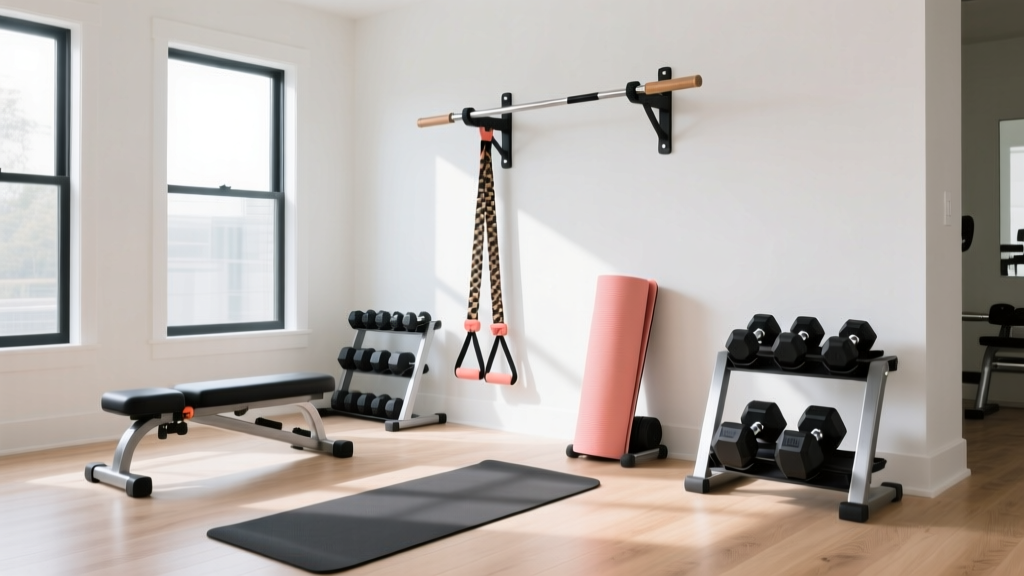
Space-Saving Home Gym Design Layout: Essential Beginner Starter Kit
Discover the ultimate beginner starter kit and space-saving home gym design layout to maximize your workout area without sacrificing essential equipment.

Building a functional fitness space in a limited footprint is less about buying the most expensive gear and more about mastering spatial geometry. When you are just starting out, the right home gym design layout dictates not only your safety but your long-term consistency. A poorly planned room leads to cluttered floors, tripped toes, and abandoned resolutions. Conversely, a meticulously zoned layout transforms a cramped 8x10 spare bedroom or a tight garage corner into a high-performance training sanctuary.
According to the Mayo Clinic, establishing a dedicated, distraction-free environment is one of the primary drivers of exercise adherence. But how do you select a beginner starter kit that respects your spatial constraints while delivering a full-body stimulus? This guide breaks down the exact equipment dimensions, clearance metrics, and zoning strategies you need to engineer the perfect space-optimized setup.
The Spatial Blueprint: Defining Your Minimum Viable Footprint
Before purchasing a single piece of iron, you must audit your available square footage. The most common mistake beginners make is buying standard Olympic-length equipment for compact rooms. A standard 7-foot Olympic barbell requires a minimum width of 11 feet when factoring in the collars and your body's lateral movement. If your room is 10 feet wide, a barbell is an immediate safety hazard.
For a true space-optimized beginner setup, we operate on the 8x10 foot (80 sq. ft.) minimum viable footprint. This allows for a central active zone, a perimeter storage boundary, and the mandatory 36-inch safety clearance required around adjustable benches for dumbbell flyes and floor transitions.
ⓘ The 36-Inch Clearance RuleAlways maintain a minimum of 36 inches of unobstructed clearance on all sides of your primary workout bench. This accounts for the natural arc of dumbbell movements, the physical footprint of the dumbbell handles when resting on the floor, and emergency bail-out space if a repetition fails.
The Space-Optimized Beginner Starter Kit
To maximize a compact home gym design layout, every piece of equipment must serve multiple functions or possess a collapsible footprint. Here is the exact 2026 starter kit blueprint, prioritizing high-density utility over bulky single-use machines.
1. Adjustable Dumbbells (The Rack Replacements)
A traditional 5-50 lb rubber hex dumbbell set requires a 4-foot tiered rack, consuming roughly 6 square feet of floor space and weighing over 300 lbs. Instead, invest in a premium adjustable set. The Nuobell 552 (approx. $429/pair) or the Bowflex SelectTech 552 (approx. $349/pair) replace 15 pairs of dumbbells. As noted in Wirecutter's comprehensive adjustable dumbbell testing, these models condense hundreds of pounds of iron into a footprint of less than 2 square feet.
2. The Foldable Flat/Incline Bench
Do not buy a fixed commercial bench. Opt for a heavy-duty foldable model like the REP Fitness FB-1300 (approx. $169) or the Flybird Adjustable Bench (approx. $139). When folded, these benches drop to a mere 7 to 10 inches in height, allowing you to slide them under a bed, stand them upright in a closet, or mount them flush against a wall.
3. High-Density Flooring
Skip the cheap EVA foam puzzle mats; they compress under heavy adjustable dumbbells, creating an unstable base that ruins your pressing mechanics. For a spare bedroom or living area, use 8mm vulcanized rubber tiles (approx. $2.50 per sq. ft.). If you are building in a garage, purchase two 4x6 ft, 3/4-inch horse stall mats from Tractor Supply Co. (approx. $55 each). They are virtually indestructible, protect concrete from dropped iron, and provide the exact density needed for joint stability.
Equipment Footprint Comparison Matrix
| Equipment Type | Traditional Setup | Space-Optimized Setup | Square Footage Saved |
|---|---|---|---|
| Free Weights (5-50 lbs) | 4ft Rack (12 sq ft) | Adjustable Pair (2 sq ft) | 10 sq ft |
| Workout Bench | Fixed Commercial (16 sq ft) | Foldable/Flat (4 sq ft active) | 12 sq ft (when stored) |
| Pull-up Station | Freestanding Tower (16 sq ft) | Doorway Telescopic Bar (0 sq ft) | 16 sq ft |
| Cardio | Elliptical/Treadmill (22 sq ft) | Kettlebell + Jump Rope (1 sq ft) | 21 sq ft |
Zoning Your Home Gym Design Layout
A successful layout relies on distinct functional zones. Even in an 80-square-foot room, separating your space mentally and physically prevents the 'clutter creep' that derails home workouts.
Zone A: The Active Strike Zone (Center)
This is the core 4x6 foot rectangle in the center of your room. It houses your rubber matting and your foldable bench during use. Rule: Nothing permanent is stored in this zone. It must remain clear to allow for floor work, stretching, and kettlebell swings.
Zone B: Vertical Storage & Anchoring (Perimeter Walls)
When floor space is scarce, you must build upward. Install a heavy-duty slatwall or a simple pegboard system on your primary wall. Use this to hang resistance bands, jump ropes, lifting straps, and foam rollers. If your door frame allows, mount a Perfect Fitness Multi-Gym Doorway Pull-up Bar (approx. $35). It leverages the door's structural trim to support up to 300 lbs without requiring a single drilled hole, preserving your security deposit and your floor plan.
Zone C: Environmental Control (The Invisible Zone)
Compact rooms trap heat and humidity rapidly, which can cause your adjustable dumbbells' internal steel mechanisms to rust and degrade. You must account for airflow in your layout. Position a Vornado 630 Air Circulator (approx. $50) in a corner, angled toward the ceiling to create continuous vortex airflow. If your room lacks a window, consider installing a simple through-wall exhaust fan to manage moisture output during high-intensity interval training.
Real-World Layout Scenarios
Scenario A: The 10x10 Spare Bedroom
The Challenge: Wall-to-wall carpet, standard 8-foot ceilings, and a closet you want to keep functional.
The Layout Strategy: Place your 8mm rubber tiles in the exact center of the room, floating them away from the baseboards to prevent wall scuffs. Store the folded bench inside the closet. Keep the adjustable dumbbells on a small, heavy-duty rolling cart (like the Seville Classics 3-Tier Cart, $45). This allows you to wheel the weights out of the closet into the Active Strike Zone only when needed, completely hiding your gym when guests arrive.
Scenario B: The Single-Car Garage Corner (8x10 ft)
The Challenge: Concrete slab, extreme temperature fluctuations, and proximity to parked vehicles.
The Layout Strategy: Lay down the 3/4-inch horse stall mats flush against the back wall. Mount a folding squat rack (like the PR-1106 Wall Mount Folding Rack, approx. $350) if ceiling height permits, as it folds to just 4 inches from the wall. However, if you strictly want a beginner dumbbell setup, mount a heavy-duty steel shelf 24 inches off the ground to hold your adjustable dumbbells, keeping them away from garage floor moisture and potential water heater leaks. Ensure your layout leaves a clear 3-foot walking path to the garage door service entry.
Pro-Tip: The Mirror Illusion
Mounting a large, shatterproof acrylic gym mirror (e.g., 48x24 inches) on the wall directly opposite the room's entryway bounces natural light and visually doubles the depth of the room. This reduces the claustrophobic feeling of small-room training and provides essential form feedback for unilateral dumbbell movements.
Final Thoughts on Spatial Efficiency
Your home gym design layout should serve your habits, not obstruct them. By prioritizing high-density adjustable equipment, enforcing strict clearance metrics, and utilizing vertical storage, a beginner can build a world-class training environment in less than 80 square feet. Start with the mat, the bench, and the dumbbells. Master your spatial blueprint first, and the physical results will naturally follow.
More gear to consider
All reviews
How to Maintain Your Murphy Bed Home Gym for Longevity

Weatherproof Guide to Creating a Home Gym Outdoors

Home Gym Weights & Tools Checklist: What You Actually Need (and What You Don’t)
Leg Curl Home Gym Comparison: Best Picks for 2026 Remodels

Smart Home Gym Layouts: A Beginner's Step-by-Step Floor Plan Guide
