
Wall Mounted Dumbbell Rack Dimensions and Cost Analysis
Analyze wall mounted dumbbell rack dimensions and costs. Compare DIY, mid-range, and premium storage budgets to maximize home gym space.

The Spatial Dilemma: Freestanding vs. Wall-Mounted Storage
Space is the ultimate premium in a home gym. According to RunRepeat's comprehensive home gym statistics, the average dedicated home workout space hovers between 150 and 200 square feet. When you are trying to fit a power rack, a rowing machine, and a full set of adjustable or fixed dumbbells, every square inch matters. This is where analyzing traditional dumbbell rack dimensions against wall-mounted alternatives becomes a critical exercise in both spatial geometry and financial planning.
Freestanding storage is convenient, but it devours usable floor space. Wall-mounted equipment storage for home gyms reclaims that footprint, but it introduces new variables: structural integrity, shear force physics, and installation costs. In this 2026 budget breakdown and value analysis, we will dissect the exact costs, dimensions, and structural requirements of taking your dumbbell storage off the floor and onto the wall.
Standard Dumbbell Rack Dimensions vs. Wall Clearance
Before tearing into your drywall, you must understand the spatial trade-offs. Standard freestanding racks require a wide base to prevent tipping under dynamic loads. Wall-mounted systems eliminate the base but require precise horizontal clearance and stud alignment.
| Storage Type | Footprint (L x W) | Wall Clearance / Depth | Max Load Capacity | Avg. Cost (2026) |
|---|---|---|---|---|
| Freestanding 3-Tier A-Frame | 34" x 22" (5.2 sq ft) | N/A (Floor standing) | 800 - 1,200 lbs | $140 - $220 |
| Wall-Mounted 3-Tier Shelf | 0 sq ft (Floor) | 8" - 12" protrusion | 400 - 600 lbs | $150 - $350 |
| DIY Heavy-Duty Bracket System | 0 sq ft (Floor) | 10" - 14" protrusion | 500 - 800 lbs | $65 - $110 |
When evaluating traditional freestanding options, standard dumbbell rack dimensions usually consume a 34 by 22-inch footprint. By shifting to a wall-mounted system, you reclaim roughly 5.2 square feet of floor space—enough to slide a compact exercise bike or a plyometric box underneath your weights.
Budget Breakdown: Wall-Mounted Storage Systems
The market for wall-mounted gym storage has matured significantly. Below is a tiered financial analysis of your options, ranging from weekend DIY projects to commercial-grade modular systems.
Tier 1: The DIY Heavy-Duty Bracket System ($65 - $110)
If you are comfortable with a stud finder and a drill, building your own wall shelves offers the highest return on investment. The key is avoiding flimsy residential shelving brackets. You need industrial-grade steel.
- Brackets: Purchase four 12-inch heavy-duty cast iron or 1/4-inch steel flat-bar brackets (e.g., Everbilt or similar industrial brands). Cost: ~$40.
- Shelving Material: Use 2x10 structural pine or a 1.5-inch thick rubber-coated steel shelf. Cost: ~$25 - $45.
- Fasteners: Do not use standard lag bolts. Use structural screws like the GRK Fasteners RSS line (3/8" x 3 1/8"). They offer superior shear strength and do not require pre-drilling, reducing installation time and preventing wood splitting. Cost: ~$15.
Tier 2: Mid-Range Modular Wall Rails ($150 - $280)
For lifters who want adjustability without welding, modular wall-mounted rails (often adapted from plate storage or utility racks) are the sweet spot. Brands like Titan Fitness and Fringe Fitness offer wall-mounted peg systems and shallow utility shelves.
These systems typically mount to standard 16-inch on-center (OC) wooden studs. The primary advantage here is modularity; you can adjust the height of the shelves as your dumbbell collection grows. However, the weight capacity is generally limited by the 11-gauge steel mounting plates, capping out safely around 400 lbs total.
Tier 3: Premium Integrated Wall Racks ($350 - $650+)
High-end systems, such as custom-fabricated 3-tier wall dumbbell racks or heavy-duty Simpson Strong-Tie reinforced commercial mounts, are designed for serious garage gyms. These units feature laser-cut 3/16-inch steel, integrated rubber lip guards to prevent dumbbell rolling, and specialized gussets that distribute sheer force across four or six wall studs. You are paying for aesthetic perfection, extreme load ratings (800+ lbs), and zero DIY guesswork.
⚠️ Expert Warning: The Physics of Shear Force
Dumbbells are not static loads. When you return a 50 lb dumbbell to a wall shelf, the dynamic impact multiplies the downward force. Furthermore, the moment arm (the distance from the wall to the center of the dumbbell) creates severe rotational torque on your fasteners. A 50 lb weight resting 10 inches from the wall generates 500 in-lbs of torque per bracket. Standard drywall anchors will fail catastrophically under this dynamic shear force. You must anchor directly into the center of wooden studs or use wedge anchors for poured concrete walls.
Critical Installation Costs and Hidden Expenses
When budgeting for wall-mounted equipment storage, the rack itself is only half the equation. Failing to account for structural preparation is the most common budgeting mistake home gym owners make.
- Stud Alignment Issues ($20 - $40): Most premium wall racks are pre-drilled for 16-inch OC studs. If your home was built with 24-inch OC studs, or if your desired placement falls between studs, you must open the drywall and install horizontal 2x6 blocking between the studs to create a secure mounting surface. Factor in drywall repair and paint.
- Concrete Wall Anchoring ($30 - $60): If your gym is in a basement with poured concrete walls, you cannot use wood screws. You will need a hammer drill, masonry bits, and specialized concrete wedge anchors or epoxy anchoring systems to handle the vibrational shear of dropping weights.
- Protective Backing ($25): Metal dumbbells will scar your drywall or paint over time. Installing a strip of 3/4-inch horse stall matting behind the shelving tiers protects the wall and dampens the acoustic vibration when weights are racked.
Value Analysis: Is Wall-Mounting Worth the Investment?
To determine the true value of wall-mounted storage, we must calculate the Cost Per Square Foot Reclaimed (CPSFR).
Let us assume a high-quality freestanding 3-tier rack costs $180 and occupies 5.2 square feet. A comparable mid-range wall-mounted system costs $220, plus $40 in structural fasteners and installation materials, totaling $260. The wall system costs $80 more upfront.
However, by reclaiming 5.2 square feet, you gain the ability to keep a $300 smart bike or a $150 folding massage table in the room without it feeling claustrophobic. In urban environments or finished basements where real estate effectively costs $150+ per square foot in utility value, spending an extra $80 to save 5.2 square feet yields an immediate and massive return on investment.
Pros and Cons of Wall-Mounted Dumbbell Storage
- PRO: Frees up critical floor space for dynamic movements (kettlebell swings, lunges).
- PRO: Eliminates the tripping hazard of low-profile freestanding A-frame racks.
- PRO: Makes floor cleaning and mopping significantly easier.
- CON: Requires permanent modification to walls (drilling into studs/concrete).
- CON: Weight capacity is strictly limited by your wall's structural framing.
- CON: Racking heavy dumbbells (50+ lbs) at chest or eye level can be ergonomically awkward compared to waist-height freestanding racks.
Expert Verdict & Space-Saving Framework
Understanding exact dumbbell rack dimensions is critical before committing to a wall-mounted alternative. If your dumbbell set maxes out at 30 or 40 lbs, a mid-range wall-mounted shelf system ($150-$250) is an unparalleled space-saver that offers incredible value. The ergonomic strain of lifting heavier weights to chest height is negligible, and the floor space you reclaim will transform your gym's flow.
However, if you are a heavy lifter with a full commercial set of hex dumbbells ranging up to 100 lbs, the dynamic shear force and the ergonomic difficulty of racking heavy weights on a wall make freestanding, heavy-duty floor racks the safer, more practical choice. For the vast majority of home gym enthusiasts operating in the 5 to 50 lb range, taking your storage vertical is the smartest budget and spatial decision you can make in 2026.
More gear to consider
All reviews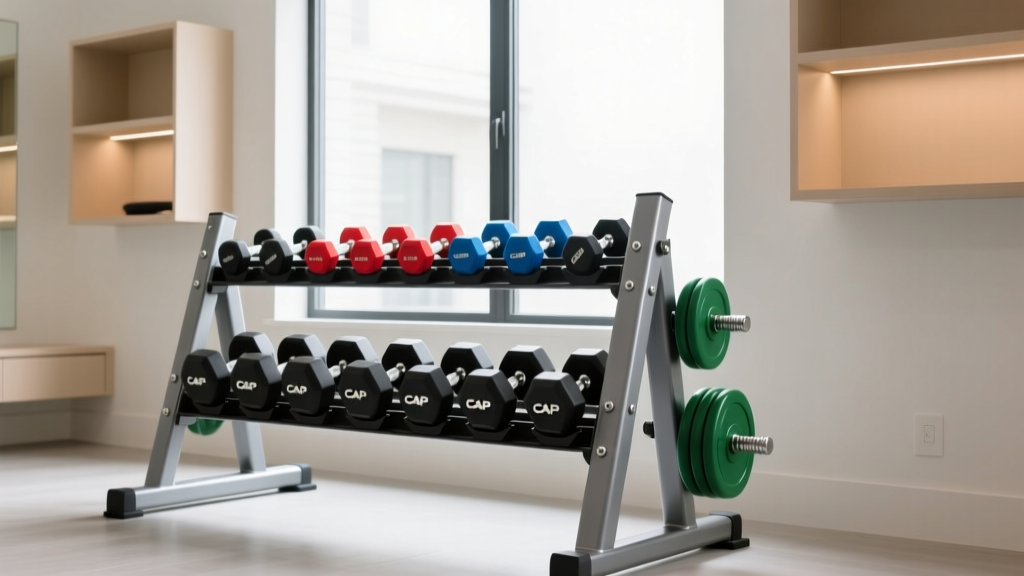
Cap Dumbbell Rack Troubleshooting: Fix Common Storage Mistakes

Space-Saving Gym Layouts: Wall Storage & Small Dumbbell Rack Guide

Compact Storage Setup for Military Press Dumbbell Standing Workouts

Ethos Dumbbell Rack Troubleshooting: Fix Common Storage Mistakes

Best Dumbbell Weight Holder Racks: 2026 Comparison
