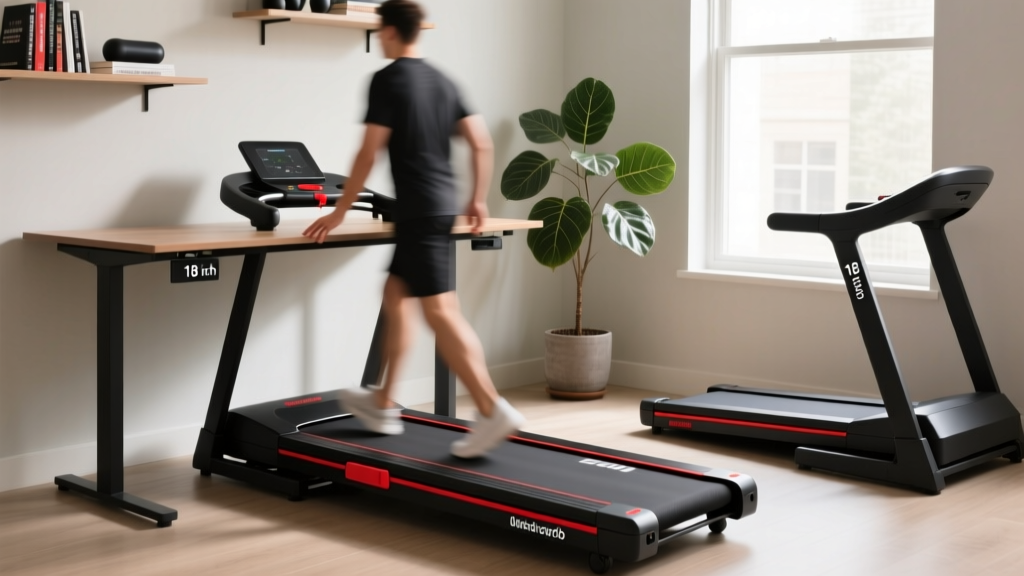
Under Desk Treadmill Office Review & Curved Treadmill Pros and Cons
Explore our 2026 under desk treadmill for office use review. We analyze spatial layouts, desk clearance, and curved treadmill pros and cons for small spaces.

As remote and hybrid work models solidify in 2026, the home office has evolved from a simple desk-and-chair setup into a multi-functional wellness hub. Integrating cardiovascular equipment into a workspace requires meticulous spatial planning. You are not just fitting a machine into a room; you are designing an ergonomic workflow that accommodates desk heights, door clearances, acoustic dampening, and structural floor limits. In this comprehensive under desk treadmill for office use review, we evaluate the top space-saving models on the market while also addressing a common design dilemma: weighing the spatial and functional curved treadmill pros and cons for compact office layouts.
The Spatial Blueprint: Under Desk Treadmill Office Reviews
When optimizing a 10x10 guest room or a corner office nook, every square inch matters. Under-desk treadmills prioritize a low-profile deck and a compact motor housing, allowing them to slide beneath sit-stand desks or fold away into closets. However, not all low-profile treadmills are created equal regarding spatial efficiency and heavy-duty office use.
1. WalkingPad X21 (2026 Edition): The Ultra-Compact Folder
The WalkingPad X21 remains the gold standard for extreme space optimization. Featuring a patented 180-degree fold, it reduces its footprint from 49.2 x 17.7 inches to a remarkably compact 33.5 x 17.7 inches when folded. At just 4.5 inches thick, it easily slides under standard bed frames or vertically against a wall. The trade-off for this ultra-slim profile is a 2.5 HP motor that caps at 3.7 mph, making it strictly a walking machine. For users who want to maintain a steady 2.0 to 3.0 mph pace while answering emails, its spatial efficiency is unmatched.
2. UREVO Strol 2E: The 2-in-1 Hybrid
If your office layout requires occasional jogging after work hours, the UREVO Strol 2E offers a clever spatial compromise. It features a foldable handlebar that locks into place, transforming it from a 5.1-inch under-desk walker into a standard light jogging treadmill (up to 7.6 mph). Unfolded, it measures 56.3 x 25.6 inches. The spatial catch? The handlebar adds visual bulk and requires an additional 12 inches of depth clearance when deployed, meaning you must design your office layout with a dedicated 'workout zone' that isn't blocked by rolling desk chairs.
3. Lifespan TR1200-Glow: The Heavy-Duty Workhorse
For dedicated home offices with ample square footage, the Lifespan TR1200-Glow is the premium choice. It does not fold, measuring a permanent 56 x 28.5 inches. However, its 6-inch deck height and heavy-duty steel frame support up to 300 lbs while operating at a whisper-quiet 2.25 HP continuous duty motor. Spatially, it demands a permanent footprint, but its integrated desk console and superior shock absorption make it the best choice for users who spend 4+ hours a day walking while working.
Clearance Metrics & Desk Height Requirements
A common failure mode in home office layout design is ignoring the 'stack height'—the combined height of the user, the treadmill deck, and the desk. Standard sitting desks are fixed at 29 inches. If you add a 5-inch treadmill deck, your standing elbow height will be misaligned with your keyboard, leading to severe shoulder ergonomics issues. According to Cornell University Ergonomics guidelines, your desk surface must be raised to accommodate the user's standing elbow height plus the treadmill base.
| Model | Type | Unfolded Footprint | Folded Footprint | Deck Height | Min. Desk Height Required |
|---|---|---|---|---|---|
| WalkingPad X21 | Folding Under-Desk | 49.2" x 17.7" | 33.5" x 17.7" | 4.5" | 41" - 44" |
| UREVO Strol 2E | 2-in-1 Hybrid | 56.3" x 25.6" | 56.3" x 25.6" (Flat) | 5.1" | 42" - 45" |
| Lifespan TR1200-Glow | Heavy-Duty Office | 56.0" x 28.5" | Non-Folding | 6.0" | 43" - 46" |
| AssaultRunner Elite | Curved Manual | 69.3" x 32.8" | Non-Folding | 7.5" | N/A (Not for under-desk) |
The Motorless Behemoth: Curved Treadmill Pros and Cons for Compact Offices
When designing a high-end home gym that doubles as an office, many fitness enthusiasts consider motorless curved treadmills. Before dedicating a massive portion of your floor plan to one, it is vital to objectively evaluate the curved treadmill pros and cons through the lens of space optimization and layout design.
The Spatial and Functional Pros
- Zero Motor Clearance Constraints: Because models like the TrueForm Runner or AssaultRunner Elite lack a front motor housing, you can place them flush against a wall or in a tight corner without worrying about motor overheating or ventilation clearance.
- Infinite Speed & High NEAT Output: Curved treadmills are user-powered. They allow for explosive sprints and high-intensity interval training (HIIT) during short work breaks, drastically increasing Non-Exercise Activity Thermogenesis (NEAT) and combating the metabolic risks of prolonged sitting, a concern heavily highlighted by the Mayo Clinic.
- Aesthetic & Build Quality: The slatted belt design and heavy steel frames often serve as a striking, modern centerpiece in a luxury home office layout.
The Spatial and Functional Cons
- Massive Footprint: The AssaultRunner Elite measures 69.3 inches long and 32.8 inches wide, consuming over 15.7 square feet of permanent floor space. Unlike under-desk models, it cannot be folded or tucked away.
- Incompatibility with Desk Work: The aggressive curve and 7.5-inch deck height make it impossible to use while typing. It is strictly a dedicated workout machine, meaning your office layout must accommodate both a standard work desk and a dedicated cardio zone.
- Severe Floor Load Concerns: Curved treadmills weigh between 285 lbs and 350 lbs. When placed on an upper floor (like a second-story bedroom office), the concentrated static weight, combined with the dynamic impact loading of a 200 lb runner, can approach the 40-50 PSF (pounds per square foot) structural limits of older residential floor joists.
Space Optimization Pro-Tip: If your office layout dictates a curved treadmill, place it perpendicular to the floor joists rather than parallel. This distributes the dynamic impact load across multiple joists, preventing long-term structural sagging and reducing low-frequency vibration transfer to the rooms below.
Acoustic Profiles, Vibration, and Floor Load Limits
Space optimization is not just about visual footprint; it is about acoustic space. In a shared home, the noise profile of your cardio machine dictates where it can be placed.
Under-Desk Treadmills: The primary noise source is the motor hum and the friction of the belt. High-quality models like the Lifespan TR1200-Glow operate at roughly 50-55 decibels at 2.0 mph, which is easily masked by background office noise or a phone call. However, footfall impact can travel through the floor. To optimize your layout, place a 3/8-inch thick high-density EVA foam anti-vibration mat beneath the treadmill. This adds 0.375 inches to your deck height but prevents structural vibration transfer.
Curved Treadmills: Without a motor, the only sound is the mechanical slapping of the rubber slats against the deck and the user's footfalls. While the mechanical noise is relatively low, the kinetic energy transferred into the floor during a sprint is immense. Curved treadmills require heavy-duty rubber horse-stall mats (typically 3/4-inch thick) to absorb the shock, which further alters your spatial clearance and door-swing calculations.
Ergonomic Workflow Integration
Integrating cardio into your workday requires adherence to established health guidelines. The American Heart Association recommends at least 150 minutes of moderate-intensity aerobic activity per week. An under-desk treadmill set at 1.5 mph to 2.0 mph allows users to easily accumulate 30 to 45 minutes of light activity daily without compromising typing accuracy or cognitive focus.
However, layout design must account for cable management. When utilizing a motorized under-desk treadmill, the power cord and the safety magnetic lanyard create tripping hazards. Route power cables through under-desk cable trays and ensure the treadmill's safety key lanyard is clipped to your clothing, not tethered to the desk, to prevent equipment damage if you step off the belt unexpectedly.
Step-by-Step Layout Planning for 2026
- Audit Your Desk Type: If you have a fixed 29-inch desk, an under-desk treadmill is ergonomically unviable without a separate lowering keyboard tray. Invest in a motorized sit-stand desk with a minimum height of 46 inches.
- Measure the 'Roll Zone': Map out the 30-inch clearance radius behind your desk chair. If your under-desk treadmill is permanently on the floor, ensure your chair can roll back without its casters catching on the treadmill's power cord or rear stabilizer.
- Calculate the Stack Height: Measure your standing elbow height from the floor. Add the treadmill's deck height (e.g., 5 inches). Set your sit-stand desk to this exact measurement to maintain a neutral 90-degree elbow angle while typing.
- Assess Upper-Floor Joists: If your office is on the second floor or above, and you are considering a 300+ lb curved treadmill, consult a structural engineer or opt for a lightweight, folding under-desk model to preserve floor integrity.
Final Verdict: Choosing Your Office Cardio Footprint
When evaluating the best equipment for your home office, the decision ultimately hinges on your spatial constraints and workflow goals. For 90% of remote workers, a high-quality folding under-desk treadmill like the WalkingPad X21 or UREVO Strol 2E offers the perfect synthesis of spatial efficiency, ergonomic compatibility, and daily NEAT generation. They respect the physical boundaries of a workspace, allowing you to transition seamlessly from deep work to active recovery.
Conversely, while the curved treadmill pros and cons reveal an incredible machine for raw athletic performance and high-intensity conditioning, its massive footprint, incompatibility with desk work, and severe floor-loading requirements make it a poor fit for standard office space optimization. Reserve curved treadmills for dedicated garage gyms or basement fitness rooms, and let the under-desk treadmill reign supreme as the ultimate space-saving cardio solution for the modern 2026 home office.
More gear to consider
All reviews
Treadmill in Garage: Cardio Machine Noise Comparison

Rowing Buying Guide & Technique: Lubrication for Treadmill Belt Care
Treadmill Drive Belt Tension and Motor Horsepower: Beginner Guide
Modified Bruce Treadmill Test Protocol vs Bikes: Space Guide
WalkingPad P1 Folding Treadmill: 2026 Budget Analysis
