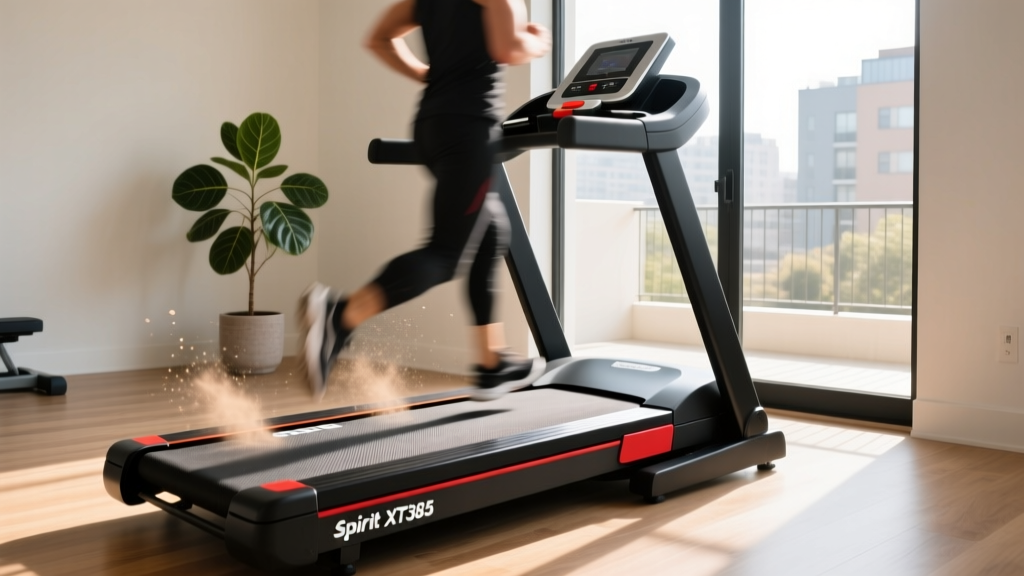
Spirit XT385 Treadmill Review: Beginner Buying Guide
Read our Spirit XT385 treadmill review and beginner buying guide. Compare key features, motor specs, and belt sizes to find the right cardio machine.

Welcome to the 2026 Treadmill Market: A Beginner's Blueprint
Navigating the home fitness equipment market can feel like learning a new language. Between acronyms like CHP, LCD, and EVA cushioning, it is easy to overpay for features you do not need or underinvest in critical components that dictate a machine's lifespan. As we evaluate the current landscape of home cardio, the $1,000 to $1,500 price bracket remains the ultimate sweet spot for durability and performance.
To help you make an informed decision, we are using our detailed Spirit XT385 treadmill review as the benchmark for this step-by-step beginner's buying guide. By comparing the XT385's specifications against industry standards and direct competitors, you will learn exactly which features matter, which are mere marketing fluff, and how to choose a machine that aligns with your biomechanical needs and living space.
The Beginner's Treadmill Checklist
Before diving into the technical breakdown, keep these four non-negotiable metrics in mind when shopping for a home treadmill in 2026:
- Motor: Minimum 3.0 Continuous Horsepower (CHP) for runners; 2.5 CHP for walkers.
- Belt Size: Minimum 20 inches wide by 55 inches long (60 inches preferred for running).
- Weight Capacity: At least 50 lbs greater than the heaviest user's body weight.
- Warranty: Lifetime coverage on the frame and motor is mandatory in this price tier.
Step 1: Decoding the Motor and Drive System
The motor is the heartbeat of your treadmill. The most common trap for beginners is confusing Peak Horsepower with Continuous Horsepower (CHP). Peak horsepower measures the maximum output the motor can hit for a brief second, while CHP measures the power it can sustain continuously during a heavy workout without overheating.
The Spirit XT385 Motor Benchmark
In our Spirit XT385 treadmill review, we found it is equipped with a 3.5 CHP motor. This is a significant upgrade from the 2.0 to 2.5 CHP motors found in sub-$800 department store models. A 3.5 CHP motor runs cooler and quieter because it does not have to strain to maintain your speed, especially if you are running at 8+ MPH or utilizing a steep incline.
Furthermore, the XT385 utilizes 2.5-inch precision-machined rollers. Larger rollers reduce the friction on the walking belt, which in turn reduces the drag on the motor. This mechanical synergy is what allows the XT385 to maintain its top speed of 12 MPH smoothly, extending the overall lifespan of the drive system.
Step 2: Belt Dimensions and Deck Cushioning
Your treadmill's deck and belt dictate your joint health. According to the Centers for Disease Control and Prevention (CDC), adults need at least 150 minutes of moderate-intensity aerobic activity weekly, making joint preservation a critical factor for long-term consistency.
Sizing the Running Surface
The Spirit XT385 features a 20-inch by 60-inch running belt. For walking and light jogging, a 20-inch width is perfectly adequate and helps keep the machine's overall footprint manageable for smaller home gyms. However, if you are a taller runner (over 6 feet) with a wide, sprawling gait, you might eventually prefer a 22-inch wide belt, which we will address in our competitor comparison below.
Shock Absorption Mechanics
Running on asphalt sends shockwaves up to three times your body weight through your knees and hips. The XT385 utilizes a multi-zone cushioning system. The front of the deck (where your foot strikes) is heavily cushioned to absorb impact, while the rear of the deck (where your foot pushes off) is firmer to provide energy return. This biomechanical design mimics the natural transition of outdoor running while significantly reducing the repetitive stress associated with hard surfaces.
Step 3: Incline, Speed, and Console Technology
In 2026, console technology has shifted away from massive, fragile touchscreens toward durable, distraction-free LED displays that integrate seamlessly with your personal devices.
Incline and Speed Metrics
The XT385 offers a 0% to 15% incline and speeds up to 12 MPH. The inclusion of dedicated quick-key buttons on the handrails for both speed and incline is a massive ergonomic advantage. Fumbling through a menu to change your incline while running at 7 MPH is a safety hazard; physical quick-keys solve this problem instantly.
Expert Warning: Heart Rate Tracking Accuracy
While the XT385 includes built-in pulse sensors on the handlebars, grip sensors are notoriously inaccurate during high-intensity interval training (HIIT) due to sweat and hand movement. The American Heart Association recommends monitoring exertion levels closely. For precise zone training, bypass the console sensors and pair a Bluetooth chest strap or optical armband with the treadmill's telemetry receiver.
Step 4: The 2026 Competitor Comparison Matrix
To truly understand the value of the Spirit XT385, we must compare it against its two biggest rivals in the $1,100 to $1,300 price bracket: the Sole F80 and the Horizon 7.4. All three are exceptional machines, but they cater to slightly different user profiles.
| Feature | Spirit XT385 | Sole F80 | Horizon 7.4 |
|---|---|---|---|
| Motor | 3.5 CHP | 3.5 CHP | 3.5 CHP |
| Belt Size | 20" x 60" | 22" x 60" | 22" x 60" |
| Display | 7.5" LED | 9.0" LCD | 7" LCD |
| Max Incline | 15% | 15% | 15% |
| Weight Capacity | 350 lbs | 350 lbs | 350 lbs |
| Warranty (Parts) | 10 Years | 5 Years | 3 Years |
| Approx. 2026 Price | $1,299 | $1,199 | $1,099 |
The Verdict on the Matrix: The Sole F80 and Horizon 7.4 offer a slightly wider 22-inch belt, which is excellent for taller runners. However, the Spirit XT385 absolutely dominates in long-term value with its 10-year parts warranty, double or triple the coverage of its rivals. If you do not strictly require a 22-inch wide belt, the XT385 is the superior financial investment.
Step 5: Weight Capacity and Frame Stability
A treadmill's weight capacity is a direct reflection of its frame's steel gauge and structural integrity. The Spirit XT385 boasts a 350 lb weight capacity. The golden rule of treadmill buying is to select a machine with a weight limit at least 50 lbs higher than the heaviest user. This buffer prevents the deck from bowing under heavy impact and stops the motor from drawing excessive amperage, which can trip your home's circuit breakers.
The XT385 frame is constructed from heavy-duty steel with a wide stance. This prevents the lateral wobbling often experienced on cheaper, narrow-framed treadmills when you run at high speeds or step heavily off-center.
Step 6: Maintenance, Edge Cases, and Failure Modes
Even the best-reviewed treadmills will fail prematurely if neglected. Based on years of servicing home cardio equipment, here are the most common failure modes and how to avoid them:
- Belt Friction and Motor Burnout: The most common cause of electronic board failure is a dry walking belt. A dry belt creates massive friction, forcing the motor to draw excess current, which eventually fries the lower control board. Solution: Lubricate the XT385's belt with 100% silicone treadmill lubricant every 3 months or every 150 miles.
- Dust Ingestion: Treadmills act like vacuums, pulling dust and pet hair into the motor compartment. Solution: Vacuum under and around the motor hood every 6 months. Never use a wet mop near the treadmill base, as moisture will warp the MDF deck.
- Power Surges: A 3.5 CHP motor draws significant power upon startup. Solution: Never plug your treadmill into a shared outlet with high-draw appliances like a refrigerator or microwave. Always use a dedicated 15-amp or 20-amp circuit, and use a high-quality surge protector rated for at least 4000 joules.
Final Decision Framework: Is the Spirit XT385 Right for You?
To finalize this beginner's guide, use this quick decision matrix to determine if the Spirit XT385 is the correct purchase for your specific home gym scenario:
- Buy the Spirit XT385 if: You want the absolute best warranty in the $1,300 class, you prefer a distraction-free LED console over fragile touchscreens, and your primary users are under 6 feet tall (making the 20-inch belt width perfectly adequate).
- Look at the Sole F80 instead if: You are a taller runner (6'1" or above) with a wide stride and absolutely require a 22-inch wide running surface to feel comfortable and safe at high speeds.
- Look at budget models if: You are strictly a walker, have a very tight budget (under $800), and will only use the machine for 30 minutes a day at speeds under 4 MPH.
Ultimately, investing in a high-quality treadmill is an investment in your cardiovascular longevity. By focusing on continuous horsepower, structural weight capacity, and robust warranty terms rather than flashy gimmicks, you ensure your home cardio setup remains a reliable pillar of your health routine for the next decade.
More gear to consider
All reviews
Peloton Treadmill vs NordicTrack: Noise Level Showdown

Does Incline Treadmill Build Muscle? Motor HP Mistakes

Stationary Bike Types to Complement a Proper Treadmill Workout (2026)

Virtuix Omni One Treadmill vs Standard: Belt Maintenance Cost Analysis
Treadmill Motor Guide: LifeSmart TM4500 PowerTouch HP Explained
