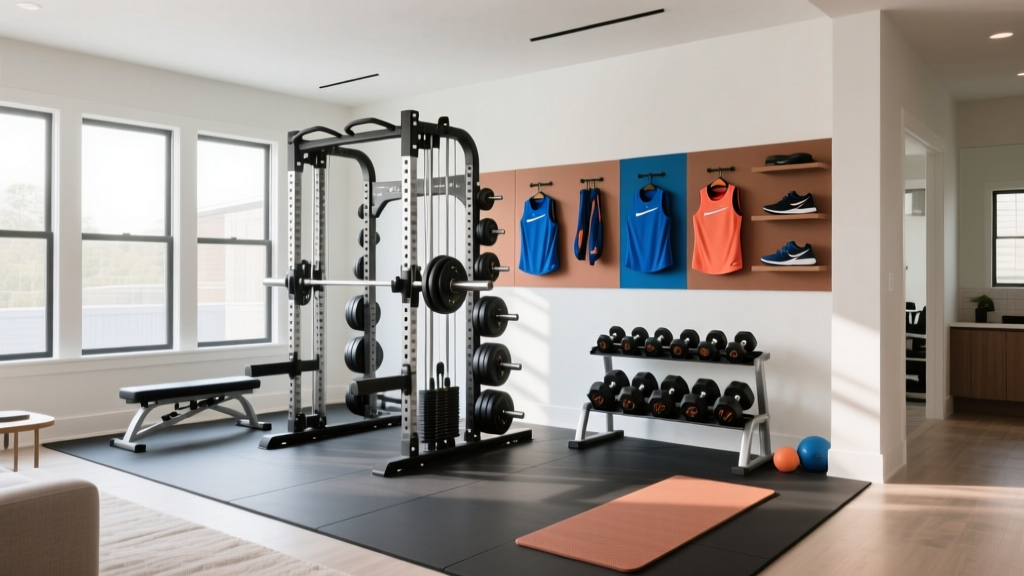
Tuff Stuff Odyssey 5 Home Gym vs. a $500 Budget Setup
We compare the premium Tuff Stuff Odyssey 5 home gym against a curated $500 budget setup. Discover which rig wins on biomechanics, space, and value.

The All-in-One Titan vs. The Lean Free-Weight Arsenal
When planning a dedicated workout space, lifters typically face a stark divergence in equipment strategy: invest heavily in a single, comprehensive multi-gym, or piece together a modular free-weight rig on a strict budget. In 2026, the Tuff Stuff Odyssey 5 home gym remains a benchmark for high-end, all-in-one garage gym installations. But is its premium price tag justified when compared to a meticulously curated budget home gym setup under 500 dollars?
This head-to-head product comparison strips away the marketing fluff. We are analyzing biomechanics, spatial footprints, long-term failure modes, and exact pricing to determine which setup actually delivers the best return on investment for your specific training goals.
Editor's Note: This comparison evaluates the Tuff Stuff Odyssey 5 (CSM-150 series) against a 2026 market-priced budget bundle. Prices reflect current Q1 2026 retail averages and may fluctuate based on seasonal sales and shipping surcharges.Contender 1: The Tuff Stuff Odyssey 5 Home Gym
The Tuff Stuff Odyssey 5 is a commercial-grade functional trainer and Smith machine hybrid. It is engineered for users who want cable-based constant tension alongside the safety of a guided barbell path.
Specifications & Pricing (2026)
- MSRP: $3,899 - $4,299 (depending on dealer and freight shipping)
- Footprint: 71' L x 54' W x 84' H
- Weight: 615 lbs (shipping weight over 750 lbs)
- Resistance: Dual 200 lb selectorized weight stacks (4:1 pulley ratio on functional trainer, 1:1 on Smith)
The Biomechanical Advantage
The primary advantage of the Odyssey 5 is its linear bearing Smith system. Unlike free weights, which require significant stabilizer muscle recruitment to maintain an arcuate bar path, the Odyssey 5's Smith carriage locks you into a strict vertical plane. This is highly advantageous for hypertrophy-focused movements like split squats or inverted rows, where balance failure often precedes muscular failure. Furthermore, the dual 200 lb cable stacks allow for unilateral cable crossovers and rotational core work that a basic dumbbell set simply cannot replicate due to gravity's strictly vertical pull.
Contender 2: The Ultimate $500 Budget Setup
Building a budget home gym setup under 500 dollars requires ruthless prioritization. You must sacrifice cable kinematics and guided safety mechanisms in exchange for raw, versatile free-weight resistance. Here is the exact 2026 loadout that maximizes hypertrophy and strength gains without breaking the bank.
| Equipment | Specific Model / Type | Est. Cost |
|---|---|---|
| Adjustable Dumbbells | Yes4All Dial Adjustable (5-50 lbs, Pair) | $185 |
| Adjustable Bench | Fitness Reality 1000 Super Max (FID) | $130 |
| Pull-Up Station | Perfect Fitness Multi-Gym Doorway Bar | $45 |
| Resistance Bands | WODFitters Tube Set with Door Anchor | $35 |
| Flooring | BalanceFrom 3/4' EVA Foam Tiles (6-pack) | $40 |
| Core / Accessory | Yes4All 20 lb Kettlebell + Ab Wheel | $45 |
| Total Estimated Cost | $480 | |
The Free-Weight Advantage
According to research highlighted by the Stronger By Science team, free weights demand higher activation from synergistic stabilizer muscles. When you perform a dumbbell bench press with the Yes4All 50s, your rotator cuff and serratus anterior work overtime to prevent the weights from drifting laterally. This translates to better functional strength and joint resilience over time, a factor the guided Smith machine partially bypasses.
Head-to-Head Comparison Matrix
| Feature | Tuff Stuff Odyssey 5 | $500 Budget Free-Weight Setup |
|---|---|---|
| Max Resistance | 200 lbs per cable / 300+ lbs Smith | 50 lbs per hand (100 lbs total) |
| Space Required | ~27 sq ft (plus 3ft clearance) | ~15 sq ft (easily stored in closet) |
| Drop-Set Speed | Instant (pin selector) | Slow (dial rotation per dumbbell) |
| Assembly Time | 6-8 hours (2 people recommended) | 45 minutes (1 person) |
| Floor Load Impact | High (Requires reinforced joists if above grade) | Low (Safe for any standard apartment floor) |
Deep Dive: Failure Modes & Edge Cases
Most buying guides ignore what happens when equipment ages. As domain experts, we evaluate the actual failure modes of both setups.
Odyssey 5 Failure Points
The Achilles heel of any selectorized cable machine is the nylon-coated aircraft cable and the pulley bearings. In a humid, unclimate-controlled garage, the Odyssey 5's steel weight plates can develop surface oxidation, which creates friction against the guide rods. Furthermore, if you frequently perform explosive movements (like cable woodchops), the internal cable crimps can fray over a 3-to-5-year span, requiring a $150-$200 professional re-cabling service.
Budget Setup Failure Points
The weak link in the sub-$500 setup is the adjustable dumbbell mechanism. Dial-based dumbbells (like the Yes4All or budget Bowflex clones) utilize plastic internal gears to lock the weight plates. Edge Case Warning: If you drop a dial-adjustable dumbbell from even a height of 12 inches, the plastic retaining clips can shatter, rendering the handle useless. Unlike the Odyssey 5, which can take a beating, budget adjustable dumbbells must be placed gently on the bench or floor between sets.
Critical Safety Note: The American Council on Exercise (ACE Fitness) notes that while machines offer a safer environment for solo lifters pushing to absolute failure, free weights require strict adherence to form. If you train alone in a basement without safety spotter arms, the $500 dumbbell setup is actually safer for heavy bench pressing than a barbell, as you can simply drop the dumbbells to your sides if you fail a rep.
Spatial Planning: Apartments vs. Garages
Your physical environment will likely make this decision for you.
- The Apartment / Spare Bedroom: The Tuff Stuff Odyssey 5 weighs over 600 lbs. Placing this in a second-story bedroom risks exceeding standard residential live-load limits (typically 30-40 lbs per square foot). The $500 setup, weighing less than 130 lbs total, is perfectly safe for apartments and can be tucked into a standard 3x3 foot closet when not in use.
- The Dedicated Garage: If you have a concrete slab garage with an 8-foot or higher ceiling clearance, the Odyssey 5 becomes a viable option. Its 71-inch depth leaves ample room for a deadlift platform in front of the unit, creating a complete commercial-style training zone.
The Final Verdict: Which Should You Build?
Do not view the Tuff Stuff Odyssey 5 home gym and the budget home gym setup under 500 dollars as direct competitors; view them as solutions to entirely different logistical problems.
Buy the Tuff Stuff Odyssey 5 If:
- You have a budget exceeding $4,000 and a dedicated ground-floor space.
- Your primary goal is hypertrophy, cable-based isolation, and safe solo-lifting without a spotter.
- You value the aesthetics and permanence of a commercial gym rig in your home.
Build the $500 Budget Setup If:
- You are renting, live in an apartment, or have strict spatial constraints.
- You prioritize functional stabilizer strength and athletic movement patterns.
- You are a beginner or intermediate lifter who does not yet require more than 50 lbs of dumbbell resistance per hand to achieve progressive overload.
Ultimately, muscle tension is muscle tension. A $480 free-weight rig will build an incredible physique if paired with progressive overload and consistency, while the Odyssey 5 offers a luxurious, frictionless experience for those with the capital and square footage to support it. Choose the rig that fits your floor plan, and let the gains follow.
More gear to consider
All reviews
Rogue Home Gym Builder 2026: Electrical & Safety Trends

Couples Gym: Upgrading the Men's Health Home Gym Awards 2021 Beginner Kettlebell
Maintaining Your Bedroom Home Gym: Longevity Tips for Small Spaces

Best Home Gym Gifts for Him: 2026 No-Damage Apartment Setups

2026 Electrical & Safety Requirements for a Home Gym in Garage