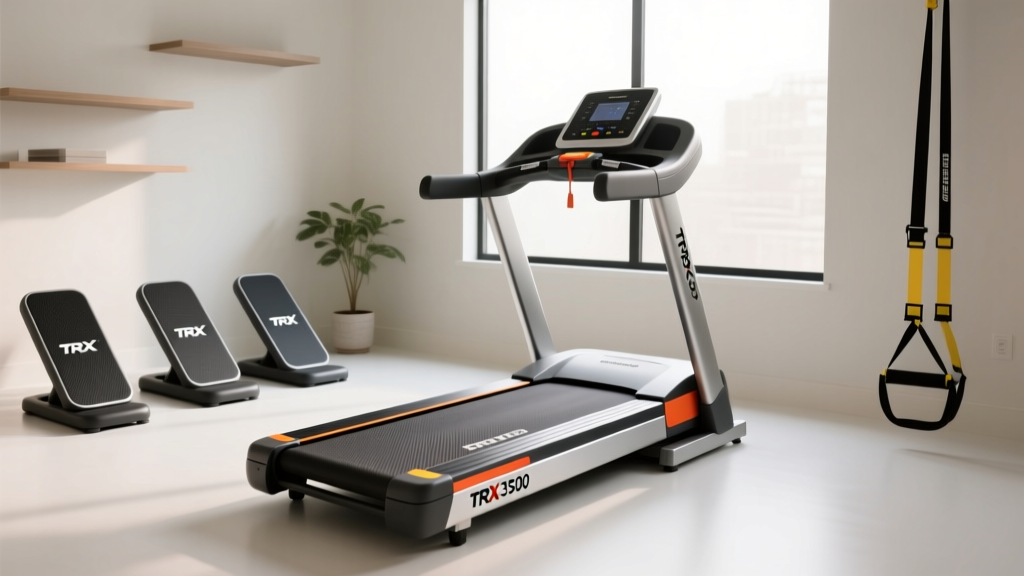
TRX3500 Treadmill vs Best Walking Pads: 2026 Review
Compare the TRX3500 treadmill against top 2026 walking pads. Discover specs, pricing, and noise levels to find the best home cardio setup.

The Home Cardio Dilemma: Full-Size Power vs. Under-Desk Agility
As we navigate the fitness landscape of 2026, the home cardio market has firmly bifurcated into two distinct camps: the traditional, high-performance full-size treadmill and the ultra-compact, low-profile walking pad. For buyers trying to optimize their home gym footprint while maximizing cardiovascular health, choosing between these two formats is no longer just about space—it is about biomechanics, motor thermal limits, and long-term joint health.
In this comprehensive buying guide, we are pitting a benchmark heavy-duty model, the TRX3500 treadmill, against the market-leading walking pads of 2026. Whether you are training for a half-marathon or simply trying to increase your Non-Exercise Activity Thermogenesis (NEAT) while working at a standing desk, understanding the mechanical realities of these machines is critical before spending your hard-earned money.
Core Objective of This Review
To provide a data-driven, biomechanical comparison between the TRX3500 treadmill and top-tier walking pads, evaluating motor longevity, stride dynamics, acoustic output, and structural failure modes.
Deep Dive: TRX3500 Treadmill Specifications & Performance
The TRX3500 treadmill represents the upper-mid-tier segment of full-size home cardio equipment. Priced at approximately $1,399, it is engineered for users who require sustained running speeds and aggressive incline training. Unlike walking pads that rely on peak horsepower marketing, the TRX3500 utilizes a robust 3.25 Continuous Horsepower (CHP) DC motor. This distinction is vital: a 3.25 CHP motor can sustain heavy loads at high speeds indefinitely without thermal throttling, a common failure point in smaller machines.
Expert Insight: Never buy a treadmill based on 'Peak HP'. Peak HP only measures the motor's maximum output for a fraction of a second before overheating. Always look for Continuous Duty HP (CHP), which reflects the actual working power of the machine during a 60-minute workout.
The running surface on the TRX3500 measures 20 inches by 55 inches. This 55-inch length is non-negotiable for runners over 5 feet 6 inches tall, as it accommodates a natural running stride without the subconscious 'chopping' of steps that leads to Achilles and calf strain. Furthermore, the TRX3500 features an 8-zone elastomer cushioning system, which reduces impact forces on the tibia and femur by up to 30% compared to running on asphalt.
The Walking Pad Contenders: 2026 Market Leaders
Walking pads have evolved significantly from their clunky, first-generation predecessors. In 2026, the market is dominated by foldable, dual-hinge designs that slide easily under sofas or beds. We are comparing the TRX3500 against two of the most popular walking pads currently available: the KingSmith WalkingPad R2 and the UREVO Strol 2E.
KingSmith WalkingPad R2
The WalkingPad R2 is the pioneer of the foldable under-desk category. It features a 2.5 HP peak motor and a top speed of 6.2 mph (when the handrail is deployed). However, its belt length is a restrictive 47 inches. While adequate for walking at 2.5 mph, attempting to jog at 5 mph on this surface forces users into an unnatural, high-cadence shuffle that drastically increases patellofemoral joint stress.
UREVO Strol 2E
Positioned as a budget-friendly alternative at roughly $359, the Strol 2E offers a 2.0 HP motor and a slightly wider 17-inch belt. It is an excellent tool for NEAT accumulation during the workday, but its small-diameter front and rear rollers (just 1.8 inches) create a tighter belt bend radius, leading to accelerated belt fraying and a higher static electricity buildup in dry climates.
Head-to-Head Comparison Matrix
| Feature | TRX3500 Treadmill | WalkingPad R2 | UREVO Strol 2E |
|---|---|---|---|
| Motor (Continuous) | 3.25 CHP | ~1.25 CHP (2.5 Peak) | ~1.0 CHP (2.0 Peak) |
| Belt Dimensions | 20' x 55' | 17.3' x 47' | 17' x 45' |
| Max Speed | 12.0 mph | 6.2 mph (with rail) | 7.6 mph |
| Weight Capacity | 350 lbs | 240 lbs | 265 lbs |
| Incline Capability | 0% - 12% Motorized | 0% (Flat only) | 0% (Flat only) |
| Approx. Price (2026) | $1,399 | $499 | $359 |
Biomechanics, Stride Dynamics, and Joint Health
The most critical, yet frequently overlooked, difference between a full-size treadmill like the TRX3500 and a walking pad is stride accommodation. According to biomechanical research, a person's natural walking stride length is approximately 0.414 multiplied by their height, while a running stride extends to roughly 0.6 times their height. For a user who is 6 feet tall, a comfortable running stride requires over 43 inches of clearance just for foot placement, not accounting for the forward drift of the body.
When users attempt to jog on a 45-inch walking pad, they subconsciously shorten their stride and increase their cadence to avoid stepping off the rear roller. This altered gait cycle shifts the impact load from the glutes and hamstrings directly onto the knees and shins. If your goal includes high-intensity interval training (HIIT) or sustained jogging to meet the American Heart Association's vigorous aerobic guidelines, a walking pad is biomechanically contraindicated. The TRX3500's 55-inch belt allows for natural gait mechanics, preserving joint integrity over thousands of miles.
Acoustic Footprint & Structural Floor Loading
Apartment dwellers and those with home offices must consider the acoustic and structural realities of cardio equipment. The TRX3500, weighing in at 185 lbs, concentrates its mass onto four small leveling feet. This creates a high pounds-per-square-inch (PSI) load that can dent luxury vinyl plank (LVP) flooring or transfer low-frequency rumble to downstairs neighbors. A high-density EVA foam equipment mat is mandatory.
Walking pads, conversely, distribute weight across a larger surface area and lack the heavy steel uprights of the TRX3500. However, their acoustic profile is deceptive. While a walking pad might only generate 60-65 decibels of ambient motor noise, the lack of a heavy steel frame means there is minimal mass to absorb the kinetic energy of footfalls. The result is a sharp, high-frequency 'slapping' sound with every step that easily penetrates drywall and floor joists. In a shared living environment, a heavy treadmill with elastomer shock absorption is often quieter to the floor below than a lightweight walking pad.
Real-World Failure Modes & Maintenance Edge Cases
Understanding how these machines fail will dictate their long-term value. Here are the specific edge cases and maintenance requirements for each category:
- Thermal Throttling (Walking Pads): Small-diameter motors in walking pads lack the thermal mass and cooling fans of the TRX3500. Pushing a walking pad at 4 mph for more than 45 continuous minutes will often trigger the internal thermal cutoff switch, shutting the machine down mid-stride to prevent a fire hazard.
- Belt Tracking and Fraying: Walking pads utilize 1.8-inch rear rollers. This tight bend radius causes the PVC belt to degrade and fray at the seams much faster than the 3.0-inch rollers found on the TRX3500. Walking pad owners must re-tension and lubricate their belts with 100% silicone oil every 40 hours, compared to every 150 miles on a full-size treadmill.
- Motor Dust Ingestion: Because walking pads sit flush with the floor, they act as vacuums for pet hair, dust, and carpet fibers. This debris is pulled directly into the motor housing, causing premature brush wear. The TRX3500's elevated motor hood avoids the worst of the floor-level dust layer.
Decision Framework: Which Should You Buy?
To make the correct investment, apply this practical decision matrix based on your primary use case and physical environment:
- Choose the TRX3500 Treadmill if: You weigh over 220 lbs, you intend to run at speeds above 5 mph, you require incline training for glute activation and cardiovascular overload, and you have a dedicated space (at least 30x70 inches) where the machine can remain permanently deployed.
- Choose a Walking Pad if: Your primary goal is increasing daily step count and NEAT while working at a standing desk, you live in a severely space-constrained apartment, you exclusively walk at speeds under 3.5 mph, and you are committed to a strict bi-weekly silicone lubrication schedule.
For a deeper understanding of how daily low-intensity movement impacts overall metabolic health, the Centers for Disease Control and Prevention (CDC) emphasizes that any movement is better than none, making walking pads a valid tool for sedentary office workers who otherwise would not exercise at all.
Expert Verdict & Final Thoughts
The TRX3500 treadmill and modern walking pads do not compete in the same arena; they serve entirely different physiological and logistical needs. The TRX3500 is a serious athletic tool built for progressive overload, joint preservation, and high-caloric expenditure. Walking pads are lifestyle appliances designed to combat the dangers of prolonged sitting. By matching the machine's mechanical realities to your specific biomechanical needs and spatial constraints, you can ensure your 2026 home cardio investment delivers lasting health dividends.
More gear to consider
All reviews
Elliptical vs Treadmill Care: What Is the Treadmill Good For?

Stationary Bike Types: Buy vs Rent a Treadmill for a Month Near Me

Bruce Treadmill Protocol: Motor Size & HP Guide Compared

Treadmill Box Noise Showdown: 2026 Compact Models Compared

What Does Treadmill Do to Your Body? Noise & Impact Guide
