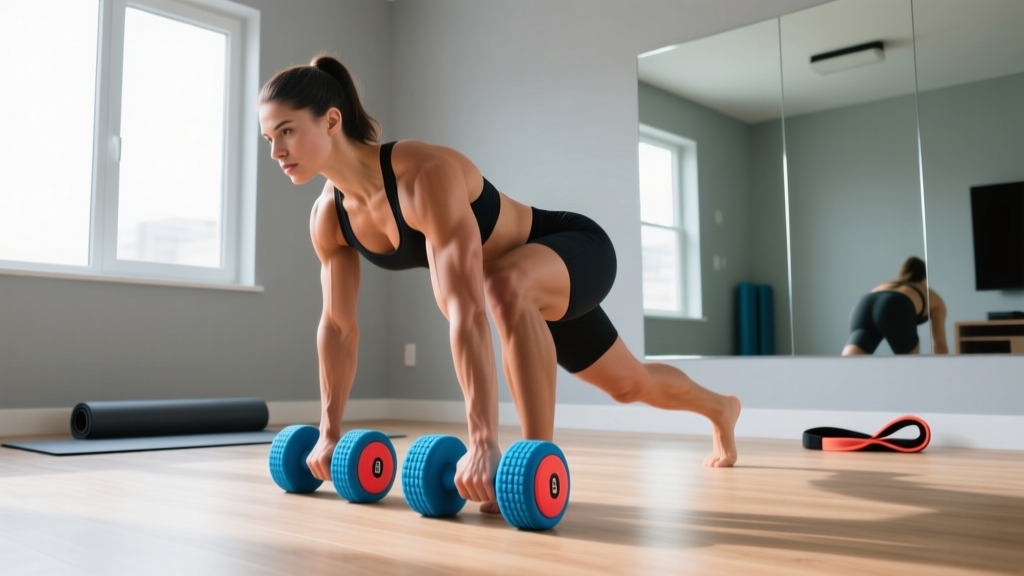
Troubleshooting Dumbbell RDL Form With Neoprene Weights
Master your dumbbell RDL form at home. Troubleshoot common mistakes, grip issues, and balance flaws specific to neoprene-coated hex dumbbells.

The Neoprene Dumbbell Factor: How Equipment Dictates Form
When building a home gym, neoprene-coated hex dumbbells (like the ubiquitous CAP Barbell or Amazon Basics sets) are often the first free weights purchased. They are affordable, floor-friendly, and resist rust. However, when it comes to executing the Romanian Deadlift (RDL), the physical properties of neoprene hex dumbbells introduce unique biomechanical challenges that can silently ruin your dumbbell RDL form. Unlike a perfectly balanced Olympic barbell or a knurled steel dumbbell, neoprene weights feature thick, contoured handles, sharp hexagonal edges, and a strict weight ceiling that forces lifters to compensate with momentum.
According to ExRx.net's biomechanical breakdown of the dumbbell Romanian deadlift, the primary function of the RDL is to load the hamstrings and glutes through a deep hip hinge while maintaining a neutral spine. When your equipment fights against this movement pattern, the stimulus shifts from your posterior chain to your lower back, forearms, and connective tissue. Below, we troubleshoot the most common form breakdowns specific to neoprene home weights and provide actionable fixes to reclaim your hinge.
4 Common Dumbbell RDL Form Mistakes (And Neoprene-Specific Fixes)
Mistake 1: The 'Thick Grip' Forearm Burnout
Standard Olympic barbells have a shaft diameter of 28mm to 29mm. In contrast, the contoured, cast-iron-core handles of most neoprene dumbbells (especially in the 25 lb to 50 lb range) measure between 33mm and 36mm at their thickest point. This 5mm to 7mm increase in diameter drastically reduces your mechanical leverage. During a slow, controlled eccentric RDL, your grip will fail long before your hamstrings reach muscular failure.
The Fix: Stop treating grip strength as the limiting factor for your posterior chain. Invest in a pair of figure-8 lifting straps or standard cotton lifting straps (like the Rogue Harbinger). Loop the strap tightly around the thick neoprene handle and your wrist. This bypasses the thick-grip penalty, allowing you to focus entirely on pushing your hips back and feeling the hamstring stretch.
Mistake 2: Hex-Edge Shin Scraping and Bar Path Deviations
A core tenet of proper RDL form is keeping the weight as close to your center of mass as possible to minimize shear force on the lumbar spine. With a round urethane dumbbell or a barbell, the weight glides smoothly down the thigh and shin. Neoprene hex dumbbells, however, have sharp corners. If you hold them with the flat side perfectly parallel to your leg, the bottom corner will inevitably dig into your patella or scrape your shin as you pass the knee, causing you to subconsciously swing the weight forward to avoid the pain.
Warning: Swinging the dumbbell forward to avoid shin-scraping shifts the load directly onto your lumbar erectors. According to ACE Fitness exercise library guidelines for the hip hinge, any deviation of the weight away from the body's midline exponentially increases lower back torque.The Fix: Rotate the dumbbells 45 degrees in your hands so the flat sides face your thighs at an angle, presenting a smoother edge to your leg. Alternatively, adopt a slightly wider, sumo-style stance (feet just outside shoulder-width) and let the dumbbells track down the *outside* of your legs rather than the front. This maintains a tight bar path without the hex corners colliding with your shins.
Mistake 3: Asymmetrical Loading and Shoulder Rotation
Neoprene dumbbell sets are often dropped, tossed, or stored improperly, leading to micro-dents in the neoprene coating or slight shifts in the internal cast-iron core. While unnoticeable during a bicep curl, holding a slightly off-balance 40 lb dumbbell in each hand during an RDL forces your lats and rhomboids to work asymmetrically to prevent the weights from twisting. This often results in one shoulder hiking up toward the ear, breaking thoracic extension.
The Fix: Before initiating the hinge, actively 'break the dumbbell' by trying to bend the handle in half. This engages the lats, pulls the scapulae down and back, and locks the shoulder joint into a stable, symmetrical position, neutralizing any minor weight imbalances inherent to budget neoprene gear.
Mistake 4: The 'Light Weight' Momentum Trap
Most neoprene dumbbell sets max out at 50 lbs per hand (100 lbs total). For an intermediate lifter, a 100 lb RDL is a warm-up. To chase a hypertrophic stimulus, lifters often resort to 'bouncing' out of the bottom position or using a rapid, uncontrolled eccentric phase to generate stretch-reflex momentum.
The Fix: Embrace stretch-mediated hypertrophy techniques. Since you cannot increase the load, you must increase the time under tension. Use a strict 4-second eccentric descent, a 2-second dead-stop pause at the bottom (where the dumbbells hover just below the knee), and an explosive concentric drive. This turns a 'light' 40 lb set into a brutal hamstring builder without requiring heavier equipment.
Biomechanics Matrix: Neoprene Hex vs. Urethane Round vs. Barbell
Understanding how your specific equipment alters the movement is critical for troubleshooting. Use the matrix below to identify where your neoprene gear is forcing compromises.
| Equipment Type | Handle Diameter | Bar Path / Clearance | Grip Fatigue Factor | Max Home Load |
|---|---|---|---|---|
| Neoprene Hex Dumbbell | 33mm - 36mm (Contoured) | Poor (Corners catch on legs) | High (Thick, smooth rubber) | 50 lbs / hand |
| Urethane Round Dumbbell | 28mm - 30mm (Knurled) | Excellent (Glides on shins) | Moderate (Standard grip) | 100+ lbs / hand |
| Olympic Barbell | 28mm (Aggressive Knurl) | Perfect (Center of mass) | Low (Optimal leverage) | 300+ lbs total |
Step-by-Step Setup for the Perfect Neoprene Dumbbell RDL
Follow this exact sequence to mitigate the physical limitations of your equipment and lock in flawless dumbbell RDL form:
- The Stance: Stand with feet hip-width apart. Point toes straight ahead or slightly outward (10 degrees).
- The Grip: Apply lifting straps. Hold the dumbbells in front of your thighs. Rotate the weights 45 degrees so the sharpest hex corners point forward and backward, not directly into your femurs.
- The Brace: Take a deep diaphragmatic breath. Pull your belly button toward your spine to create intra-abdominal pressure.
- The Hinge: Unlock your knees slightly (about a 15-degree bend). Push your hips backward as if trying to close a car door with your glutes. Do not squat down.
- The Descent: Lower the dumbbells at a 3-second tempo. Keep the weights practically shaving your legs. Stop the descent the moment your hips stop moving backward (usually just below the knee).
- The Reversal: Pause for 1 second. Drive your hips forward to return to the top, squeezing the glutes hard. Do not hyperextend the lower back at the top.
Expert Insight: 'The RDL is not a back exercise; it is a hamstring stretch disguised as a lift. If your lower back is pumped and your hamstrings are fresh, your equipment's bar path has forced you into a squat-hinge hybrid.'
When to Upgrade: The Limits of Neoprene Sets
Neoprene dumbbells are excellent for beginners, but their 50 lb ceiling and thick handles will eventually cap your posterior chain development. If you have mastered the 4-second eccentric pause with 50 lb neoprene dumbbells and are still not achieving progressive overload, it is time to transition to adjustable steel or urethane options.
In 2026, the gold standards for home gym RDLs are the Nuobell 80 lb Adjustable Dumbbells (retailing around $349) or the PowerBlock Elite USA series. Both feature standard 28mm knurled steel handles that perfectly mimic the grip of a commercial gym dumbbell, eliminating the thick-handle grip fatigue. Furthermore, their cylindrical or block-straight profiles eliminate the hex-corner shin scraping, allowing for a flawless, frictionless bar path down the leg. Upgrading your equipment is often the fastest 'form fix' when your biomechanics are sound but your gear is holding you back.
Frequently Asked Questions
Should my neoprene dumbbells touch the floor during an RDL?
No. The Romanian Deadlift is a constant-tension exercise. Touching the floor unloads the hamstrings and resets the stretch reflex. Stop the movement when your hips stop hinging backward, which is typically mid-shin for most lifters.
Why do my feet leave the ground or my toes lift during the descent?
This indicates your center of gravity is shifting too far backward onto your heels. While you should feel the weight in your heels, your entire foot must remain planted. Imagine gripping the floor with your toes to maintain a tripod foot position.
More gear to consider
All reviews
Bumper vs Iron Plates: Layouts & Dumbbell Squats Muscles Worked

Storing Dumbbell Barbell Weights: 2026 Rack Market Trends

Power Rack vs Squat Rack vs Stand: Seated Dumbbell Shoulder Press Muscles Worked
Olympic Barbell Guide: Weight, Knurling & Forearms Workout Dumbbells

Bumper vs Iron Plates: Space Layouts & Standing Dumbbell Calf Raise
