
Olympic Barbell Knurling Mistakes and Front Deltoid Dumbbell Exercises
Discover common Olympic barbell weight and knurling mistakes. Learn grip troubleshooting for heavy presses and front deltoid dumbbell exercises.

The Hidden Mechanics of Olympic Barbell Selection
When outfitting a serious training space in 2026, the Olympic barbell remains the undisputed centerpiece of strength development. Yet, a staggering number of lifters sabotage their progress by fundamentally misunderstanding barbell weight tolerances and knurling profiles. This isn't just about comfort; it is a biomechanical necessity. The wrong knurl can cause micro-tears that derail your heavy pressing cycles, while improper weight calibration ruins progressive overload tracking. Furthermore, lifters frequently encounter a frustrating plateau when transitioning from heavy barbell overhead presses to targeted front deltoid dumbbell exercises. The root cause? A failure to troubleshoot grip mechanics and equipment matching across different movement patterns.
Common Mistake #1: Ignoring Weight Tolerances and Bar Whip
Not all 20kg (44lb) Olympic barbells are created equal. A frequent purchasing mistake is assuming that any bar stamped with '20KG' meets competition standards. In reality, budget barbells often carry a weight tolerance of +/- 50g to 100g, whereas elite competition bars adhere to strict International Weightlifting Federation (IWF) or International Powerlifting Federation (IPF) tolerances of +/- 10g to 15g.
The Impact on Progressive Overload
While a 50-gram discrepancy sounds negligible, it compounds when paired with 'bar whip'—the elastic deformation of the shaft under heavy loads. Powerlifting bars (29mm diameter, high carbon) are designed to be stiff, minimizing whip to ensure stability during bench presses. Conversely, Olympic weightlifting bars (28mm diameter) are engineered to store and release kinetic energy, aiding in the clean and jerk. Using a whippy weightlifting bar for heavy, low-rep bench pressing introduces a dangerous oscillation at the bottom of the lift, compromising shoulder stability.
Troubleshooting Alert: If your barbell oscillates violently at the lockout of a heavy press, you are likely using a weightlifting bar for powerlifting movements. Switch to a 29mm stiff shaft immediately to protect your rotator cuff.Common Mistake #2: Misunderstanding Knurling Profiles
The knurl—the diamond-patterned machining on the shaft—is your only physical connection to the load. According to the comprehensive Rogue Fitness Bar Guide, knurling is generally categorized into three distinct geometric profiles. Choosing the wrong profile for your specific training split is a primary cause of hand tearing and grip fatigue.
- Hill Knurl: The peaks of the diamonds are rounded off. This provides a mild grip that is comfortable for high-rep work but can feel 'slippery' during heavy, sweaty max-effort lifts.
- Mountain Knurl: The peaks are sharp and pointed. This offers an aggressive, almost sandpaper-like grip. Ideal for heavy deadlifts, but it will shred your hands during high-volume accessory work.
- Volcano Knurl: The peaks are sharp, but the center of the diamond is carved out, creating a crater. This provides the sharp bite of a mountain knurl but with more surface area and less skin tearing. It is the gold standard for multipurpose bars in 2026.
The Transition Trap: Barbell Presses vs. Front Deltoid Dumbbell Exercises
One of the most complex troubleshooting scenarios arises when lifters rotate between heavy compound barbell movements and isolation work. A classic example is pairing heavy barbell overhead presses with front deltoid dumbbell exercises like seated dumbbell front raises or alternating Arnold presses.
According to biomechanical data from ExRx Anterior Deltoid Anatomy, the anterior deltoid acts as a primary shoulder flexor and medial rotator. When you perform a heavy barbell press, your hands are locked in a fixed, pronated position, and you rely heavily on the aggressive bite of a volcano or mountain knurl to prevent the bar from rolling backward onto your wrists.
Troubleshooting the Grip Transfer
When you immediately transition to front deltoid dumbbell exercises, lifters often make two critical mistakes:
- Over-Gripping: Accustomed to squeezing the aggressive barbell knurl, lifters apply the same crushing grip force to smooth or mildly-knurled dumbbell handles. This causes premature forearm flexor fatigue, meaning your grip fails before your anterior deltoid reaches true muscular failure.
- Wrist Extension Errors: The fixed path of a barbell allows for slight wrist extension to stack the joints. Dumbbells require active stabilization. If you carry over a rigid, barbell-style wrist stack to a dumbbell front raise, the lack of a center knurl reference point often leads to micro-deviations in the wrist, placing undue shear force on the AC joint.
'The transition from barbell to dumbbell requires a conscious down-regulation of grip tension. You must let the dumbbell rest in the calluses, not the fingertips, to isolate the front deltoid without forearm interference.'
Equipment Matching Matrix: Knurl vs. Movement
To avoid these troubleshooting nightmares, use this matrix to align your equipment with your programming.
| Equipment Profile | Knurl Type | Ideal Use Case | Common Mistake to Avoid |
|---|---|---|---|
| Stiff Power Bar (29mm) | Aggressive Mountain | Low-rep Bench, Heavy Deadlifts | Using for high-rep curls or front raises (causes severe skin tearing) |
| Multipurpose Bar (28.5mm) | Volcano | Olympic Lifts, Moderate Pressing | Expecting zero whip on heavy squats |
| Bearing Weightlifting Bar (28mm) | Mild Hill | Snatch, Clean & Jerk | Using for heavy bench press (slippage risk) |
| Hex Dumbbells | Medium/Smooth | Front Deltoid Dumbbell Exercises | Applying barbell-level grip tension (causes forearm burnout) |
2026 Buying Framework: What to Look For
If you are in the market for a new Olympic barbell, apply this strict troubleshooting checklist before purchasing:
- Verify the Tolerance: Demand a written specification of +/- 15g or better. If the manufacturer lists '+/- 50g', walk away.
- Inspect the Center Knurl: For powerlifting, a pronounced center knurl is mandatory for back squat traction. For Olympic lifting or general fitness, a passive or absent center knurl prevents neck abrasion during front squats and cleans.
- Check the Bushing vs. Bearing Setup: Bronze bushings are ideal for slow, heavy power movements. Needle bearings are strictly necessary for the rapid bar rotation required in Olympic weightlifting.
- Price Reality Check: In 2026, a legitimate, high-quality Olympic barbell with precision volcano knurling and proper weight calibration will cost between $295 and $450. Anything under $180 is likely cutting corners on shaft straightness and knurl depth.
Frequently Asked Questions
Can I use a power bar for front deltoid dumbbell exercises?
No. Power bars are 7.2 feet long and designed for two-handed, heavy axial loading. Front deltoid dumbbell exercises require independent, unilateral stabilization that a barbell cannot provide. Furthermore, the aggressive knurl of a power bar will unnecessarily damage your hands during the high-rep isolation work typical of anterior deltoid training.
Why do my wrists hurt when switching from barbell to dumbbell presses?
This is a classic troubleshooting scenario. The barbell locks your wrists into a fixed degree of extension. When you switch to dumbbells, your wrists must actively stabilize the load in three dimensions. If you lack wrist mobility or fail to adjust your grip depth, the stabilizing muscles fatigue rapidly, transferring the load to the wrist ligaments. Focus on neutral-grip dumbbell presses to mitigate this.
How do I maintain my barbell knurling without causing rust?
Use a stiff nylon brush (never wire, as it strips the finish) to remove chalk and dead skin after every session. In 2026, most premium bars feature Cerakote or hard chrome finishes that resist oxidation, but a light application of 3-in-One oil on the shaft once a month will preserve the knurl's bite and prevent corrosion.
More gear to consider
All reviews
Plate Care: Bumper vs Iron & Alternating Dumbbell Bicep Curls

Olympic vs Standard Plates Setup & 15 Minute Upper Body Workout Dumbbells
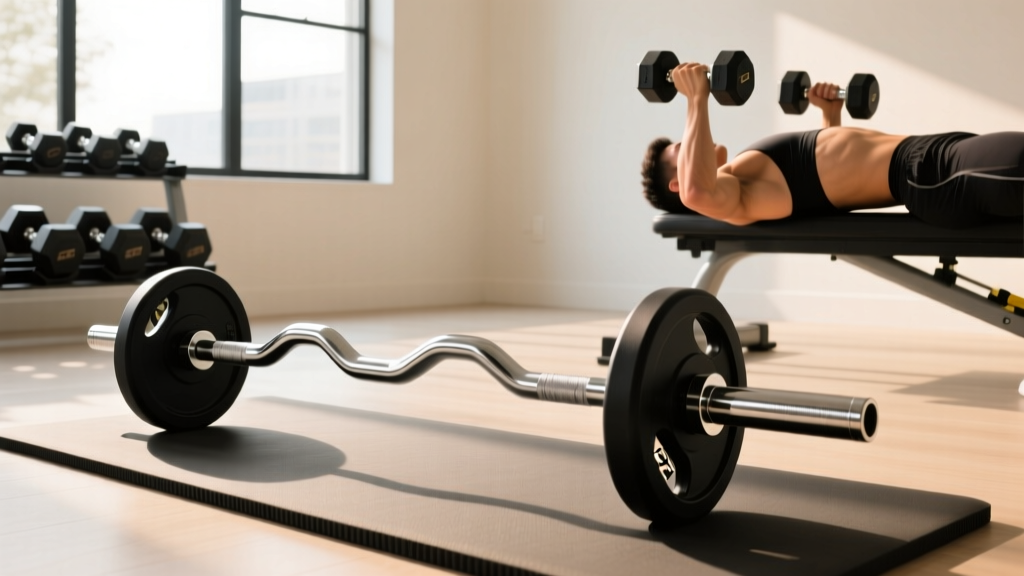
EZ vs Straight Bar Care & Correct Form for Dumbbell Bench Press
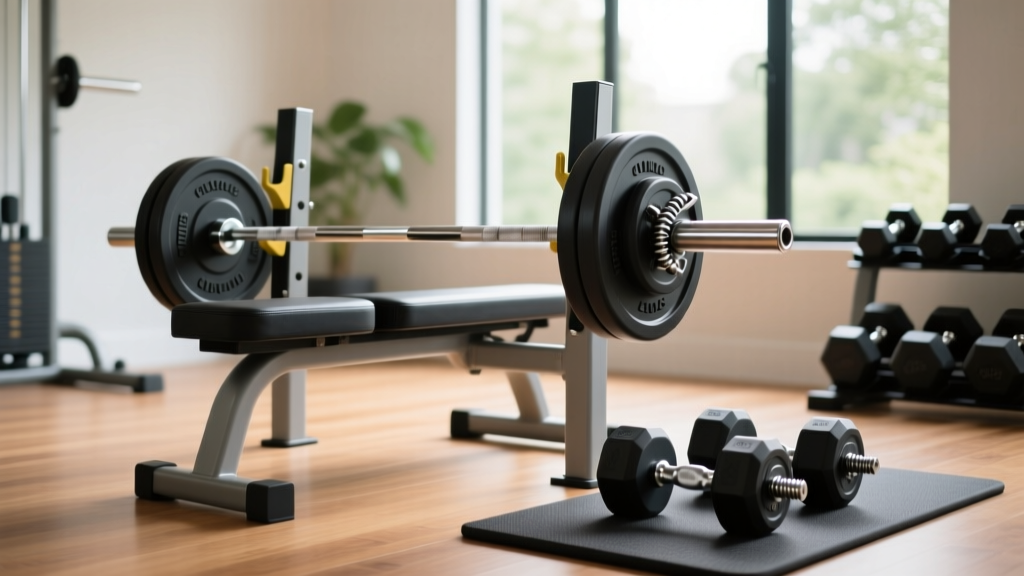
Barbell Bench vs Dumbbell: How Barbell Collar & Clamp Types Compare

Olympic vs Standard Plates: Setup Guide & Dumbbell Pic Layouts
