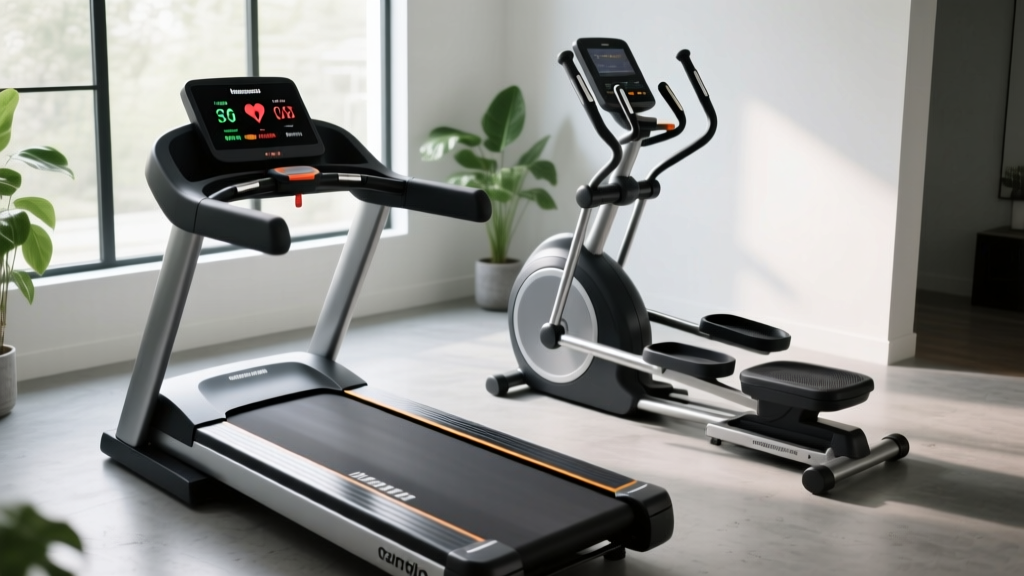
Treadmill vs Elliptical Machine: Beginner Feature Guide
Compare treadmill and elliptical machine features with our step-by-step beginner buying guide. Learn motor specs, stride lengths, and joint impact.

The Beginner's Dilemma: Choosing Your Cardio Anchor
Building a home gym in 2026 almost always starts with a single, critical decision: should you invest in a treadmill or an elliptical machine? Both are titans of cardiovascular health, but they serve vastly different biomechanical needs, spatial constraints, and long-term maintenance profiles. According to the National Institute on Aging, consistent aerobic exercise is non-negotiable for cardiovascular longevity, but the modality you choose must align with your joint health and fitness goals.
This step-by-step buying guide breaks down the exact technical specifications, feature comparisons, and real-world failure modes of both machines. By the end, you will know exactly which motor size, belt dimension, or stride length to look for when making your purchase.
Beginner Tip: Do not buy based on console screens alone. A 22-inch HD touchscreen is useless if the machine's motor overheats or the stride length causes knee pain. Focus on the mechanical foundation first.Step 1: Evaluate Your Biomechanics and Joint Health
Before looking at horsepower or incline percentages, you must assess the ground reaction forces your body can handle. Running on a treadmill generates impact forces equivalent to 2.5 to 3 times your body weight with every footstrike. Conversely, an elliptical machine provides a closed-kinetic-chain movement, meaning your feet never leave the pedals, reducing joint shear force to near zero.
- Choose a Treadmill If: You are training for outdoor road races, need to improve bone mineral density through impact loading, or prefer the natural biomechanics of walking and sprinting.
- Choose an Elliptical If: You have a history of plantar fasciitis, patellofemoral pain syndrome (runner's knee), or lower back issues that are aggravated by repetitive vertical impact.
According to calorie expenditure data from Harvard Health Publishing, a 155-pound person burns approximately 288 calories in 30 minutes on a general elliptical machine, compared to 360 calories running at a 10-minute-per-mile pace on a treadmill. While treadmills offer a slightly higher caloric ceiling, ellipticals allow for longer, sustained sessions with less central nervous system fatigue.
Step 2: Decode Treadmill Features (The Core Comparison)
If your biomechanics point toward a treadmill, you must navigate a sea of misleading marketing terms. Here is the exact feature checklist you need for a treadmill buying guide comparison.
Motor Sizing: Continuous vs. Peak Horsepower
Manufacturers often advertise 'Peak HP' to inflate their numbers. You must only look at Continuous Duty Horsepower (CHP), which measures the motor's ability to sustain output under load without overheating.
- 2.0 to 2.5 CHP: Acceptable only for walking or light jogging for users under 180 lbs.
- 3.0 to 3.5 CHP: The minimum requirement for runners, interval training, or users over 200 lbs.
- 4.0+ CHP: Required for heavy sprinting, commercial use, or users over 250 lbs.
Belt Dimensions and Deck Cushioning
A belt that is too short forces you to alter your natural gait, leading to hamstring strain. For walking, a 20-inch by 55-inch belt is sufficient. For running, you absolutely need a 22-inch by 60-inch belt to accommodate a full stride. Furthermore, look for multi-zone cushioning systems (like Sole's Cushion Flex or NordicTrack's Runners Flex) that absorb shock at the front of the deck but provide a firm push-off at the rear.
Incline and Decline Capabilities
Standard treadmills offer a 10% to 15% incline. However, premium 2026 models now feature incline trainers that reach up to 40% (simulating steep mountain trails) and -3% decline features to train the quadriceps and tibialis anterior for downhill running stability.
Step 3: Decode Elliptical Machine Features
If the zero-impact nature of an elliptical machine is more appealing, the buying criteria shift entirely from motors to geometry and flywheel dynamics.
Stride Length: The Most Critical Metric
A mismatched stride length is the number one cause of buyer's remorse with ellipticals. It dictates whether your movement feels like a natural run or a choppy stair-stepper.
- 18-inch stride: Best for users under 5'4".
- 20-inch stride: The universal standard, ideal for users between 5'4" and 6'0".
- 22-inch stride: Mandatory for users over 6'0" to prevent knee hyperextension at the back of the pedal stroke.
Flywheel Placement and Q-Factor
Front-drive ellipticals (where the flywheel is at the front of the machine) typically offer a more aggressive, forward-leaning posture, mimicking a running stance. Rear-drive models offer a more upright, natural walking posture. Additionally, pay attention to the Q-Factor (the horizontal distance between the pedals). A narrow Q-factor (under 5 inches) aligns your hips and knees properly, preventing IT band friction during long sessions.
Feature Comparison Matrix
| Feature Metric | Treadmill | Elliptical Machine |
|---|---|---|
| Impact Force | High (2.5x body weight) | Near Zero (Closed-chain) |
| Primary Muscle Focus | Calves, Hamstrings, Glutes | Quads, Glutes, Upper Body (if using arms) |
| Ceiling Clearance Needed | 8 to 10 inches above user height | 12 to 15 inches (due to pedal elevation) |
| Average Mid-Tier Price (2026) | $1,200 - $1,800 | $900 - $1,500 |
| Maintenance Requirement | High (Belt lubrication, tensioning) | Low (Joint inspection, dusting) |
Step 4: Anticipate Real-World Failure Modes
According to reliability analyses from the Consumer Reports Treadmill Buying Guide, understanding how cardio machines fail is just as important as knowing how they perform. Here is what actually breaks in the real world:
Treadmill Failure Modes
- Deck Delamination: If you fail to apply 100% silicone lubricant to the belt every 3 to 6 months, friction increases exponentially. This melts the phenolic coating on the deck, causing the belt to stick and ultimately frying the motor controller board.
- Motor Controller Board Failure: Often caused by dust buildup in the motor hood or running a 2.5 CHP motor with a 250 lb user, forcing the board to draw excessive amperage until it shorts out.
Elliptical Failure Modes
- Pivot Bearing Wear: The shoulder and pedal arm bearings take lateral stress. Over time, lack of greasing leads to a rhythmic 'squeak-click' that is notoriously difficult to isolate and fix.
- Ribbon Cable Pinching: The data cable running from the console down through the upright mast can easily get pinched between the steel frame and the plastic shroud during assembly or moving, resulting in a dead console.
Step 5: Budgeting and Space Allocation
Do not measure your space based solely on the machine's footprint; you must account for user clearance and safety zones.
- Treadmill Footprint: Typically 70" L x 30" W. You must leave at least 24 inches of clearance behind the treadmill to prevent severe friction burns if you fall off the back.
- Elliptical Footprint: Typically 75" L x 25" W. While they don't require rear clearance, their fixed length and high pedal stance mean they dominate vertical space and cannot be easily folded away.
2026 Pricing Tiers: Avoid sub-$500 treadmills; they utilize 1.5 CHP motors and 1-ply belts that will degrade within months. Aim for the $1,200 to $1,800 sweet spot for a 3.0 CHP treadmill with a lifetime frame warranty. For ellipticals, the $900 to $1,500 range secures a 20-inch stride, heavy-duty flywheel, and power-adjustable incline.
The Final Decision Framework
Ultimately, the choice between a treadmill and an elliptical machine comes down to your physiological needs and spatial reality. If your goal is sport-specific running preparation, bone density improvement, and high-intensity interval training, invest in a treadmill with a minimum 3.0 CHP motor and a 22" x 60" belt. If your priority is joint preservation, high-volume daily calorie burn, and low-maintenance mechanics, select an elliptical with a 20-inch stride and a narrow Q-factor. Use this feature comparison as your blueprint, and you will build a cardio setup that serves you flawlessly for the next decade.
More gear to consider
All reviews
ProForm Cadence 4.0 Treadmill Motor Troubleshooting & HP Guide

Walking Pads as Treadmill Alternatives: Setup & Review

Curved vs Motorized Treadmills: How Long Does a Stress Test Take?
Air Bike vs Assault Bike Care & HIIT Treadmill Routine for Beginners
Cardio Machine Noise: Home Gym vs Treadmill for Horses
