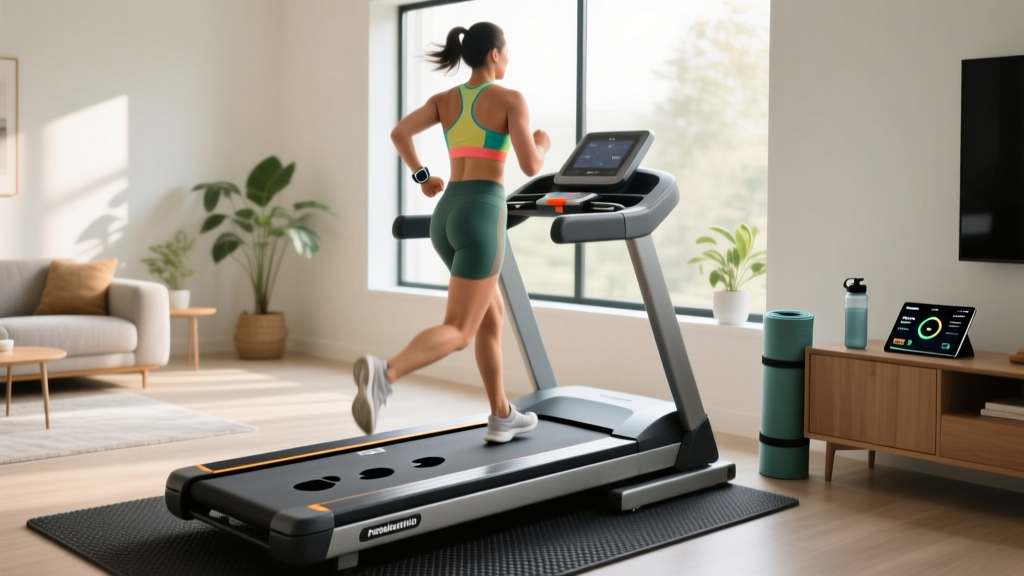
How Long Should You Run on a Treadmill? Beginner Buying Guide
Discover how long you should run on a treadmill as a beginner. Follow our step-by-step 2026 buying guide to compare features and find your perfect match.

Starting a fitness journey can feel overwhelming, especially when navigating the sea of home gym equipment. One of the most frequent questions we receive at FitGearPulse is, "how long should u run on a treadmill?" While the exact duration depends on your specific goals, the answer is deeply intertwined with the type of machine you purchase. A treadmill built for light walking will quickly break down if you use it for daily 45-minute runs.
This beginner-friendly, step-by-step guide will not only answer your workout duration questions but also teach you how to match your running habits to the right treadmill features in the 2026 market. Let's build your routine and find your perfect machine.
Step 1: Answering 'How Long Should You Run on a Treadmill?'
Before comparing motors and belt sizes, you need to establish your baseline workout duration. The American Heart Association recommends at least 150 minutes of moderate-intensity or 75 minutes of vigorous-intensity aerobic activity per week.
Beginner's 4-Week Treadmill Progression
- Week 1: 15-20 minutes (Walk/Jog intervals: 2 mins walk, 1 min jog)
- Week 2: 20-25 minutes (Walk/Jog intervals: 1 min walk, 2 mins jog)
- Week 3: 25-30 minutes (Continuous jogging at a conversational pace)
- Week 4: 30-35 minutes (Continuous running, introducing 1-2% incline)
If your goal is weight loss, aiming for 30 to 45 minutes of steady-state running or high-intensity interval training (HIIT) 4 times a week is optimal. If you are training for cardiovascular endurance, you will eventually push past the 45-minute mark. This planned duration dictates the treadmill motor and deck specs you must buy.
Step 2: Matching Your Run Time to Treadmill Motor Specs
The biggest mistake beginners make is buying a treadmill based on 'Peak Horsepower' rather than 'Continuous Horsepower' (CHP). Peak HP only measures the motor's maximum output in short bursts. CHP measures what the motor can sustain over a long run.
Real-World Failure Mode: If a 190 lb user buys a 2.0 CHP treadmill and runs for 40 minutes daily, the motor will overheat, the belt will stutter, and the motherboard will likely fail within 6 months. Here is how to match your run time to the correct motor size:
| Planned Run Duration | User Weight | Required Motor (CHP) | Recommended Use Case |
|---|---|---|---|
| Under 20 mins | Under 150 lbs | 2.5 CHP | Light jogging, walking |
| 20 - 45 mins | 150 - 200 lbs | 3.0 to 3.25 CHP | Daily fitness, weight loss |
| 45+ mins | 200+ lbs | 3.5 to 4.0 CHP | Marathon prep, heavy use |
Step 3: Belt Dimensions and Joint Cushioning
When researching treadmill buying guides, you will notice belt sizes vary wildly. For dedicated running, you must look for a belt that is at least 22 inches wide and 60 inches long. A 20" x 55" belt is strictly for walking; running on it will cause you to subconsciously shorten your stride, leading to hip and knee strain over time.
The Importance of Elastomer Cushioning
Running on outdoor asphalt sends a shockwave of up to 3 times your body weight through your joints. Premium treadmills utilize elastomer shock absorbers beneath the deck. For example, the Sole Cushion Flex Whisper Deck has been shown to reduce joint impact by up to 40% compared to outdoor running. If you plan to run longer than 30 minutes per session, variable cushioning (softer in the front for strike, firmer in the back for push-off) is a non-negotiable feature to prevent shin splints.
Step 4: Comparing Beginner-Friendly Treadmill Features
Once you have the motor and belt size locked in, it is time to evaluate the console and structural features. Here is a comparison matrix of what to expect at different price points in 2026:
| Feature | Budget ($400 - $699) | Mid-Range ($700 - $1,200) | Premium ($1,200+) |
|---|---|---|---|
| Incline | Manual or 10% Motorized | 12% - 15% Motorized | 15% Incline / -3% Decline |
| Top Speed | 8 - 10 MPH | 10 - 12 MPH | 12 - 14 MPH |
| Console | Basic LCD, Phone Holder | 7"-10" Touchscreen, Bluetooth | 20"+ HD Touch, iFIT/Peloton |
| Warranty | 1 Year Frame / 90 Days Parts | Lifetime Frame / 3 Years Parts | Lifetime Frame & Motor / 5 Yrs |
Step 5: Top 2026 Treadmill Recommendations for Beginners
Based on your run duration and the specs outlined above, here are three highly rated treadmills that offer the best reliability for beginners stepping into home cardio.
1. Best for 20-Minute Daily Jogs: NordicTrack T Series 10
- Price: ~$599
- Motor: 2.75 CHP
- Belt: 20" x 55"
- Why it works: If your answer to 'how long should you run' is a quick 20-minute morning sweat, this machine is perfect. It features a compact folding design and integrates seamlessly with basic fitness apps via Bluetooth. However, do not use this for 45+ minute runs, as the smaller belt and motor will struggle.
2. Best for 30-45 Minute Endurance Runs: Sole F63
- Price: ~$699
- Motor: 3.0 CHP
- Belt: 20" x 60"
- Why it works: The Sole F63 is the undisputed king of the beginner-to-intermediate category. The 3.0 CHP motor runs cool even during hour-long sessions, and the Whisper Deck cushioning is a lifesaver for your knees. It lacks a massive touchscreen, but the trade-off is a significantly longer lifespan and a lifetime warranty on the frame and motor.
3. Best for Heavy Runners & Long Distances: Horizon 7.4
- Price: ~$999
- Motor: 3.5 CHP
- Belt: 22" x 60"
- Why it works: If you are over 200 lbs or plan to push your runs past the 45-minute mark, the Horizon 7.4 provides commercial-grade stability. The 22-inch width gives you plenty of lateral room, preventing the anxiety of stepping off the edge during a fatigued long run.
Frequently Asked Questions
Is it bad to run on a treadmill every day?
Running every day can lead to overuse injuries like plantar fasciitis or IT band syndrome, especially for beginners. We recommend running 3 to 4 days a week, utilizing the treadmill's incline feature to simulate outdoor resistance, and taking active recovery days (walking or cycling) in between.
Should I hold the handrails while running?
No. Holding the handrails ruins your natural running posture, disengages your core, and can reduce your calorie burn by up to 20%. If you feel the need to hold on, your speed or incline is set too high. Slow down until you can pump your arms naturally.
How much space do I need for a running treadmill?
While the machine footprint might be 70" x 30", you must account for safety clearance. Always leave at least 24 inches of clearance on both sides of the belt, and a minimum of 36 inches behind the treadmill. If you trip and fall off the back, you need that space to avoid hitting a wall or furniture.
FitGearPulse Final Tip: Always plug your treadmill directly into a dedicated 120V wall outlet. Using an extension cord or a power strip shared with other appliances can cause voltage drops, which will prematurely kill your treadmill's motor control board.
More gear to consider
All reviews
How a 3 Incline on Treadmill Impacts Belt Maintenance Costs
ProForm Sport 3.0 Treadmill vs Stair Climber: Home Use Guide
Temu Treadmill Belt Maintenance: True Cost & Value Analysis

The Ultimate Treadmill Purchase Guide: Motor Size & Setup Walkthrough

Treadmill Belt Sticking? Motor Size & Horsepower Guide
