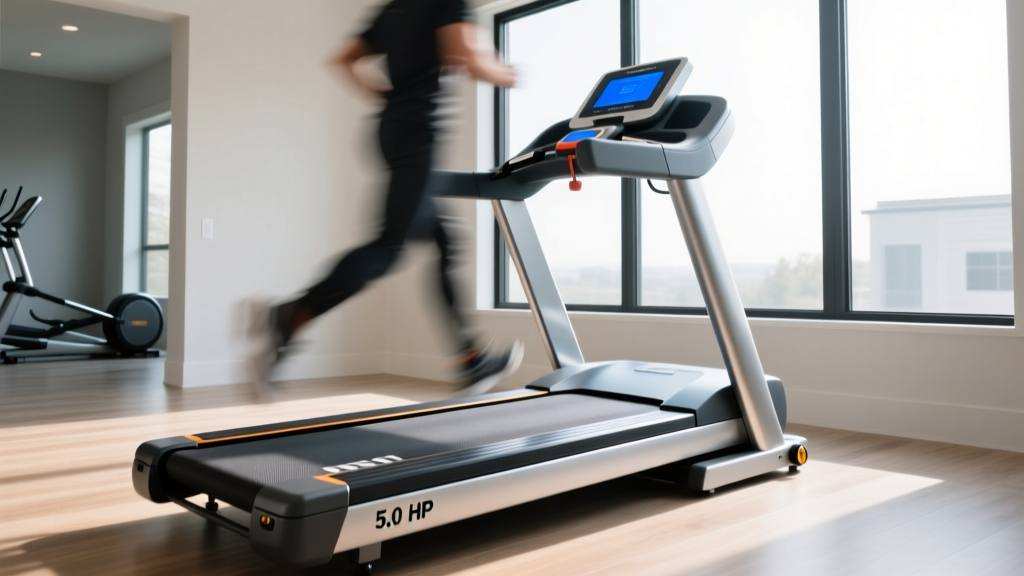
Treadmill Stress Test Interpretation: Motor HP Setup Guide
Master treadmill stress test interpretation during setup. Our installation walkthrough covers motor HP sizing, belt calibration, and load testing.

The Setup Walkthrough: Why Motor Verification Matters
Unboxing and assembling a premium home treadmill is only the first half of the installation process. While most users simply plug the machine in and press start, professional fitness equipment technicians perform a rigorous evaluation to ensure the drive system can handle real-world biomechanical forces. In clinical cardiology, a stress test evaluates heart function. However, in the commercial and home fitness equipment industry, treadmill stress test interpretation refers to the critical process of analyzing a machine’s drive system, amp draw, and thermal output under maximum physical load during the initial installation walkthrough.
As of 2026, with high-end home models like the Sole F80 ($1,199) and the NordicTrack Commercial 1750 ($1,999) featuring increasingly complex incline motors and interactive software, verifying the main drive motor's true capability is essential. An improperly calibrated deck or an over-tensioned belt can artificially inflate motor strain, leading to premature failure. This complete setup and installation walkthrough will guide you through physical calibration, load testing, and accurate data interpretation to guarantee your machine is ready for years of heavy use.
Decoding the Specs: HP vs. CHP Before You Unbox
Before you even begin tightening bolts, you must understand the motor specifications listed on your box. The fitness industry has historically relied on misleading marketing terms. To properly conduct a stress test later, you need to know what baseline you are testing against.
- Peak Horsepower (HP): This is the maximum output the motor can achieve for a fraction of a second before stalling or tripping a thermal breaker. It is a useless metric for daily training.
- Continuous Duty Horsepower (CHP): This is the power the motor can sustain indefinitely during a rigorous workout without overheating. According to Consumer Reports, CHP is the only metric that matters for evaluating treadmill longevity and performance.
- AC vs. DC Motors: Most home treadmills use DC (Direct Current) motors, which are quieter but require more cooling. Commercial gym treadmills (like the Life Fitness Run CX, priced around $4,500) use AC (Alternating Current) motors, which run cooler under continuous 24/7 load but are louder and heavier.
The 2026 Motor Sizing Matrix
Use this matrix to verify if the treadmill you are installing actually matches your household's biomechanical requirements. The American College of Sports Medicine (ACSM) notes that the ground reaction forces during running can exceed 2.5 times a user's body weight, placing massive torque demands on the drive roller and motor.
| User Weight | Walking (Up to 4.0 MPH) | Jogging (4.0 - 6.0 MPH) | Running (6.0+ MPH) |
|---|---|---|---|
| Under 150 lbs | 2.0 CHP Minimum | 2.5 CHP Minimum | 3.0 CHP Minimum |
| 150 - 200 lbs | 2.5 CHP Minimum | 3.0 CHP Minimum | 3.5 CHP Minimum |
| 200 - 250 lbs | 3.0 CHP Minimum | 3.5 CHP Minimum | 4.0 CHP Minimum |
| 250+ lbs | 3.5 CHP Minimum | 4.0 CHP Minimum | 4.25+ CHP (Commercial) |
Phase 1: Physical Installation and Belt Calibration
You cannot accurately perform a motor stress test if the physical installation is flawed. Friction is the enemy of the treadmill motor. If the belt is too tight, the motor will work 15% to 20% harder just to turn the deck, skewing your stress test interpretation.
- Level the Deck: Use a carpenter's level across the width and length of the running deck. Adjust the rear leveling feet until the bubble is perfectly centered. An unlevel deck causes uneven roller wear and lateral belt drift.
- Check Belt Tension: With the machine off, reach under the center of the belt and lift. You should be able to lift the belt exactly 1.5 to 2.0 inches off the deck. If it is lower, use the provided Allen wrench to loosen the rear roller bolts counter-clockwise by one-quarter turn.
- Lubrication Verification: Even if the manual claims the belt is 'pre-lubricated,' verify it. Slide your hand under the belt; it should feel slightly slick with 100% silicone lubricant. If it feels dry, apply 15ml of silicone treadmill lube in a zig-zag pattern.
Phase 2: Executing the At-Home Load Test
With the machine physically calibrated and plugged into a dedicated 15-amp circuit (never use an extension cord or a shared outlet), it is time to execute the load test. For safety and accuracy, use a smart plug with an integrated ammeter, or a digital clamp meter on the power cord, to monitor real-time electrical draw.
Callout: The 15-Minute Stress Protocol1. Minutes 1-3: Walk at 3.0 MPH, 0% incline. (Establishes baseline no-load amp draw, typically 2-4 amps). 2. Minutes 4-8: Increase speed to 6.0 MPH, 0% incline. (Simulates standard jogging). 3. Minutes 9-13: Increase incline to 15%, speed to 3.5 MPH. (Simulates maximum torque and gravitational resistance). 4. Minutes 14-15: Return to 3.0 MPH, 0% incline for cool-down and thermal recovery observation.
Treadmill Stress Test Interpretation: Reading the Data
This is where technical expertise separates a standard user from a seasoned technician. Proper treadmill stress test interpretation requires analyzing three distinct data points during and immediately after the 15-minute protocol.
1. Amp Draw and Electrical Hesitation
During the maximum incline phase (Minutes 9-13), monitor your ammeter. A healthy 3.5 CHP DC motor supporting a 200 lb user at a 15% incline should draw between 8 and 11 amps. If your meter spikes above 14 amps consistently, you have a severe friction issue (overtightened belt or dry deck) or an undersized motor. Furthermore, pay attention to the belt's movement. If you feel a micro-hesitation or 'stutter' in the belt right as your foot strikes the deck, the motor's internal PWM (Pulse Width Modulation) controller is failing to deliver adequate torque, a common failure mode in budget sub-$600 treadmills.
2. Thermal Cutoff Thresholds
Modern treadmill motors are equipped with internal thermal breakers, typically set to trip at 105°C (221°F). If your treadmill abruptly shuts down and displays an 'Error 1' or 'Overheat' code during the incline phase, the stress test has failed. This interpretation indicates either inadequate ventilation in the motor hood, blocked cooling fans, or a motor that is vastly underpowered for the user's weight. Always ensure the front motor hood has at least 4 inches of clearance from walls to allow for proper convective cooling.
3. Incline Motor Strain
Do not ignore the lift motor during interpretation. When transitioning from 0% to 15% incline, the lift motor should operate smoothly without grinding. If the deck shudders or the incline motor whines loudly, the lift screw drive lacks proper factory grease, a known issue in some early 2025 production runs of mid-tier folding treadmills that requires manual lithium-grease application.
'A treadmill is only as reliable as its worst day under load. Interpreting the electrical and thermal stress data during installation prevents catastrophic motor failure six months down the line.' — FitGearPulse Senior Equipment Technician
Electrical Requirements and Circuit Isolation
The U.S. Consumer Product Safety Commission (CPSC) frequently highlights electrical hazards associated with motorized fitness equipment. Your stress test interpretation is invalid if the machine is not receiving clean, dedicated power. A 3.5 CHP motor requires a dedicated 120V, 15-amp circuit with 14-gauge copper wiring. If the treadmill shares a circuit with a refrigerator, air conditioner, or space heater, voltage drops will occur during the motor's startup surge. This voltage drop forces the motor's control board to draw higher amperage to compensate for the lack of voltage, artificially inflating your stress test readings and potentially frying the lower control board.
Final Walkthrough Sign-Off
Completing a thorough installation walkthrough and executing a structured load test transforms you from a passive consumer into an informed equipment owner. By mastering treadmill stress test interpretation, you ensure that the horsepower claims on the box match the physical reality of your home gym. If your machine passes the 15-minute protocol with stable amp draw, zero belt hesitation, and no thermal trips, your setup is complete. Tighten the safety lanyard, calibrate your heart rate monitors, and enjoy a scientifically verified, rock-solid training platform.
More gear to consider
All reviews
Can You Ruck on a Treadmill? Noise and Impact Troubleshooting

AssaultRunner Pro Manual Treadmill vs Stationary Bikes: 2026 Trends

DIY Manual Treadmill vs Motorized: A Horsepower & Motor Size Guide

Evolve Compact Treadmill Maintenance: Portable Cardio Longevity Guide

Determining Chip for Treadmills vs. Rowing Machine Guide
