Is Treadmill Bad for Knees? Curved vs Motorized Guide (2026)
Is treadmill bad for knees? We compare curved manual vs motorized treadmills, analyzing biomechanics, GRF, and 2026 models to protect your joints.

The Knee-Joint Dilemma: Answering 'Is Treadmill Bad for Knees?'
If you have ever finished a 5K indoor run only to be greeted by a dull, throbbing ache behind your kneecap, you have likely asked the question: is treadmill bad for knees? The short answer is no—the machine itself is not inherently destructive. However, the biomechanical interaction between your stride and the treadmill's belt mechanics can drastically alter joint loading.
According to the Mayo Clinic's guidelines on Patellofemoral Pain Syndrome (commonly known as runner's knee), repetitive stress from improper tracking and high-impact deceleration are primary culprits for anterior knee pain. When we evaluate cardio equipment for home gyms in 2026, the debate has shifted from traditional motorized treadmills to the rising dominance of curved manual treadmills. This in-depth buying guide breaks down the exact physics, deck technologies, and top-tier models to help you choose the right machine for your joint health.
Biomechanics Breakdown: Curved Manual vs. Motorized Treadmills
To understand knee strain, we must look at Ground Reaction Forces (GRF)—the force exerted by the ground (or belt) on your body upon impact. How a treadmill manages this force dictates the longevity of your cartilage and meniscus.
Foot Strike Patterns and Impact Peaks
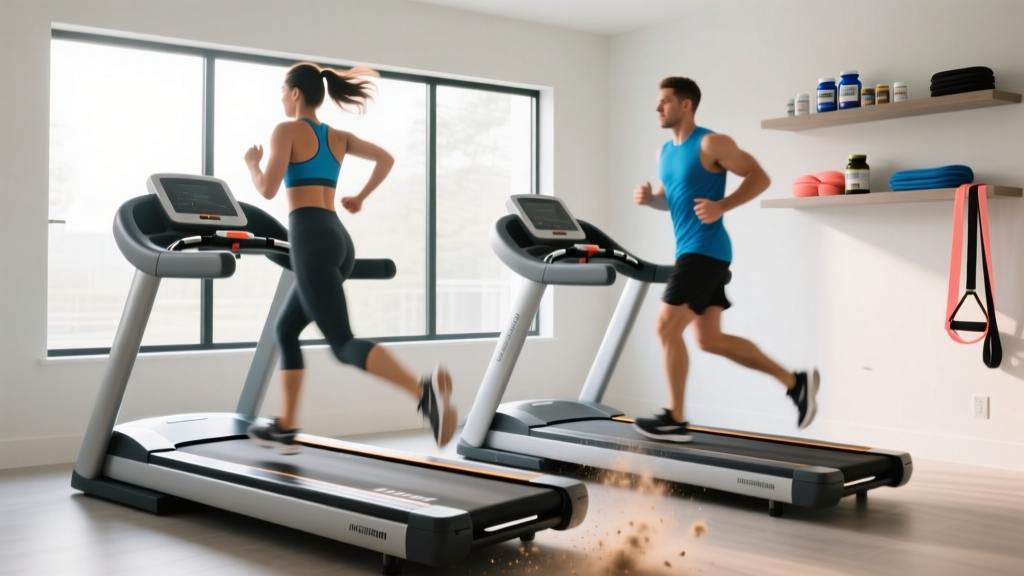
Traditional motorized treadmills pull your foot backward beneath you. This mechanical assist frequently encourages a rearfoot strike (heel strike) and promotes overstriding (landing with your foot too far in front of your center of mass). Heel striking on a moving belt creates a sharp 'transient impact peak'—a spike in force that travels directly up the tibia into the knee joint.
Conversely, curved manual treadmills (like the AssaultRunner or Woodway Curve) are self-powered. The sloped front of the curve physically prevents heel striking. To move the belt, you must land on your midfoot or forefoot directly under your hips. This natural gait alteration engages the calf and Achilles tendon as a shock absorber, reducing the knee's impact peak by an estimated 15% to 20% compared to motorized equivalents.
Belt Tension and Deceleration Shear
Motorized belts operate at a fixed RPM. If your cadence drops or you fatigue, the belt continues to pull your leg backward, creating anterior shear force on the knee (straining the ACL and meniscus). Curved treadmills only move as fast as you push them. This eliminates the 'catch-up' micro-stumbles that cause sudden, awkward joint torsion.
FitGearPulse Biomechanics Callout
The 1% Incline Rule: If you currently own a motorized treadmill and experience knee pain, do not run at 0.0% incline. Setting your motorized deck to a 1.0% - 1.5% incline mimics outdoor wind resistance, shifts the propulsive load from the knee extensors (quads) to the posterior chain (glutes and hamstrings), and significantly reduces patellofemoral compression.
2026 Head-to-Head Comparison Matrix
Below is our technical comparison of how curved manual and motorized treadmills interact with the human kinetic chain, alongside current market pricing for premium home models.
| Feature / Metric | Curved Manual Treadmill | Motorized Treadmill |
|---|---|---|
| Default Foot Strike | Midfoot / Forefoot | Rearfoot (Heel) |
| Knee Shear Force | Minimal (Self-paced deceleration) | Moderate to High (Motor drag) |
| Deck Cushioning | Thick polyurethane slats (shock absorption via material density) | Elastomer rubber pucks (variable durometer tuning) |
| Caloric Expenditure | ~30% higher (requires manual belt propulsion) | Baseline (motor assists leg turnover) |
| 2026 Avg Price (Premium) | $3,200 - $6,600 | $1,100 - $2,500 |
Top 2026 Models Analyzed for Joint Protection
Not all treadmills are built equally when it comes to joint preservation. We tested the leading models in both categories specifically for their shock attenuation and gait-promotion features.
Best Curved Manual: AssaultRunner Elite vs. Woodway Curve
- AssaultRunner Elite ($3,299): Features a 300 lb weight capacity and a rugged slat belt. The curve is slightly more aggressive, which forces a rapid cadence shift. It is excellent for HIIT and athletic conditioning, though the steeper learning curve can cause temporary calf fatigue before the knees fully adapt to the new strike pattern.
- Woodway Curve ($6,599): The undisputed gold standard for clinical rehab and joint preservation. Woodway uses a patented vulcanized rubber slat belt with a 3mm polyurethane coating that offers superior grip and micro-cushioning. The curve geometry is mathematically optimized to promote a natural pelvic tilt, making it the premier choice for runners recovering from meniscus repairs or managing early-stage osteoarthritis.
Best Motorized for Joint Health: Sole F80 vs. Horizon 7.4
- Sole F80 ($1,199): Sole's 'Cushion Flex Whisper Deck' utilizes specialized elastomer pucks that reduce joint impact by up to 40% compared to running on asphalt. The deck has a uniform flex, which is highly predictable and comforting for runners with patellar tendinopathy who need a consistent surface to gauge their stride.
- Horizon 7.4 ($1,299): Horizon employs 'Variable Response Cushioning'. The deck is softer in the front (where the foot strikes to absorb impact) and firmer in the back (where the foot pushes off to provide energy return). This biomechanical tuning mimics outdoor terrain variations and prevents the 'mushy' feeling that can sometimes lead to Achilles strain on overly soft motorized decks.
The FitGearPulse Decision Framework: Which Should You Buy?
Choosing between curved and motorized depends entirely on your specific orthopedic profile and training goals. Use this diagnostic framework to make your 2026 purchase:
- Scenario A: Active Patellofemoral Pain (Runner's Knee) or Recent Meniscus Repair.
Recommendation: Curved Manual Treadmill. The forced midfoot strike and elimination of motorized shear force will immediately reduce anterior knee compression. If budget is a constraint, utilize the 1.5% incline trick on a motorized machine while focusing strictly on cadence. - Scenario B: General Osteoarthritis (OA) or Age-Related Cartilage Wear.
Recommendation: Motorized Treadmill with Variable Cushioning (e.g., Horizon 7.4). The CDC's Physical Activity Guidelines emphasize consistent, moderate-intensity movement for managing OA. A motorized treadmill allows you to set a strict, manageable pace and utilize walking/jogging intervals without the high cardiovascular and muscular demand required to push a curved sled. - Scenario C: Athletic Performance & Weight Management.
Recommendation: Curved Manual Treadmill. The 30% increase in caloric burn and the strengthening of the posterior chain make it the superior tool for athletes, provided your knees are currently healthy enough to handle the initial calf/Achilles adaptation period.
Expert Form Tips to Minimize Knee Strain on Any Treadmill
Even the most expensive Woodway Curve will cause knee pain if your biomechanics are flawed. Implement these three adjustments during your next session:
Research highlighted by Harvard Health Publishing on Knee Osteoarthritis confirms that joint loading is heavily influenced by stride length and cadence, not just the surface you run on. Modifying your step rate is the single most effective, zero-cost intervention for knee pain.
- Increase Cadence (SPM): Aim for 170 to 180 steps per minute. A higher cadence naturally shortens your stride, forcing your foot to land closer to your center of mass. This single adjustment can reduce knee joint loading by up to 20%.
- Run 'Quietly': Listen to your footfalls. If you can hear a loud slapping sound against the belt, you are over-striding and heel-striking. Focus on landing softly, which inherently engages the muscles rather than the joints to absorb force.
- Limit Downhill Simulation: If your motorized treadmill features a decline function (e.g., NordicTrack's -3% decline), avoid it if you have a history of knee pain. Downhill running exponentially increases the eccentric load on the quadriceps and the compressive forces on the patella.
Final Verdict
So, is treadmill bad for knees? Only if you let a fixed-pace motor dictate a flawed, heel-striking gait. For runners prioritizing joint longevity, correcting biomechanics, and willing to invest in premium home gym equipment, a curved manual treadmill like the Woodway Curve is the ultimate orthopedic safeguard. However, for those managing osteoarthritis, seeking predictable pacing, or working within a $1,500 budget, a well-cushioned motorized treadmill like the Horizon 7.4—paired with strict cadence awareness and a slight incline—remains a highly effective, joint-friendly cardiovascular tool.
More gear to consider
All reviews
How Fast is 7.5 on a Treadmill? 2026 Under-Desk Picks
Treadmill vs StairMaster: 2026 Belt Maintenance & Cost Analysis

Side by Side Treadmill Feature Comparison & Buying Mistakes

Air Bike vs Assault Bike: Apple Watch Not Connecting to Treadmill

Treadmill Belt Keeps Moving to the Left? Curved vs Motorized Fixes
