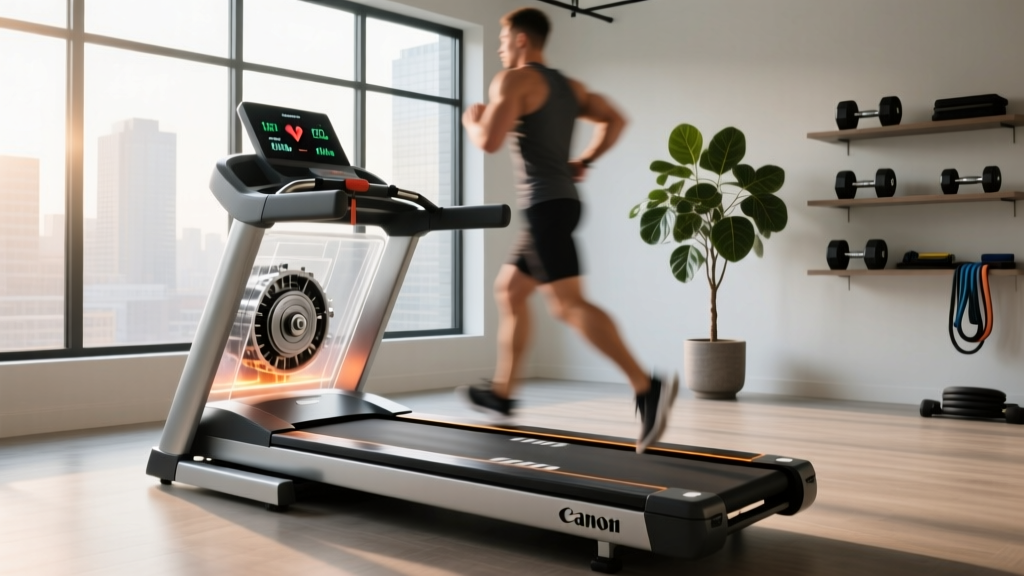
Troubleshooting Treadmill Routine Weight Loss: Motor HP Guide
Is your motor stalling your treadmill routine weight loss? Learn how to size CHP correctly, troubleshoot overheating, and fix belt friction issues.

The Hidden Saboteur of Treadmill Routine Weight Loss
When committing to a rigorous cardiovascular regimen, few things are more frustrating than hardware failure. If you are executing a high-volume treadmill routine weight loss program, your machine is subjected to sustained, high-load stress that casual walkers never encounter. According to the Mayo Clinic, effective weight loss often requires 150 to 300 minutes of moderate-to-vigorous aerobic activity per week. That translates to hours of continuous belt friction, high amp draw, and intense heat generation inside your treadmill's motor housing.
The most common mistake home users make is underestimating the relationship between user mass, workout duration, and motor sizing. A machine that performs flawlessly for a 30-minute jog at 130 lbs will violently stutter, overheat, and eventually fry its drive board when subjected to a 60-minute incline walk at 220 lbs. In this guide, we break down the exact engineering thresholds of treadmill motors, how to size them for heavy-duty weight loss routines, and how to troubleshoot the hardware when it starts to fail under pressure.
⚠️ Critical Warning: Peak HP vs. CHPNever base your purchase or troubleshooting on "Peak Horsepower." Peak HP measures the maximum output the motor can hit for a fraction of a second before failing. For sustained weight loss cardio, you must exclusively look at Continuous Horsepower (CHP), which measures the motor's ability to dissipate heat and maintain torque over 60+ minutes of continuous use.
Sizing Your Motor: The Weight-to-CHP Matrix
To prevent thermal shutdowns during long fat-burn zone sessions, your motor must operate at no more than 70% of its maximum thermal capacity. As of 2026, brushless DC motors have become more efficient, but the laws of thermodynamics still apply: more mass and higher inclines demand more continuous torque.
| User Weight | Walking / Light Jog | Sustained Running (Weight Loss) | HIIT / Heavy Incline |
|---|---|---|---|
| Under 150 lbs | 2.0 CHP | 2.5 CHP | 3.0 CHP |
| 150 - 200 lbs | 2.5 CHP | 3.0 CHP | 3.5 CHP |
| 200 - 250 lbs | 3.0 CHP | 3.5 CHP | 4.0 CHP |
| 250+ lbs | 3.5 CHP | 4.0 CHP | 4.0+ CHP (Commercial) |
Note: The Consumer Reports Treadmill Buying Guide consistently recommends a minimum of 3.0 CHP for any user planning to run regularly, regardless of weight, to ensure longevity of the drive belt and motor brushes.
Troubleshooting Motor Strain During Heavy Cardio
If your treadmill routine weight loss progress is being interrupted by a stuttering belt, sudden slowdowns, or a machine that abruptly powers off after 20 minutes, your motor system is in distress. Here is the step-by-step diagnostic protocol to identify the exact failure point.
1. The Amp Draw Test (The Gold Standard)
Before replacing a $600 motor, you must determine if the motor is failing or if it is simply being overworked by friction. Using a digital clamp multimeter, measure the amp draw on the red (positive) wire connecting the lower control board to the motor.
- Walking (3.0 mph): Normal draw is 3 to 5 amps.
- Running (6.0 mph): Normal draw is 6 to 10 amps.
- Danger Zone: If your running amp draw exceeds 15 amps, the motor is working too hard. This will trip the thermal overload switch or blow the MOSFETs on the drive board.
2. Isolating Belt and Deck Friction
If your amp draw is in the danger zone, 80% of the time the culprit is not the motor itself, but severe friction between the walking belt and the deck. A dry deck can increase amp draw by up to 50%, mimicking a dying motor.
- The Lift Test: Turn off and unplug the machine. Lift the walking belt in the dead center of the deck. It should rise exactly 2 to 3 inches. If it is tight against the deck, your tension is too high, choking the motor.
- The Slide Test: With the machine off, try to slide your hand under the belt. If you feel heavy resistance or dry, gritty spots, the deck is starved of lubrication.
- The Fix: Apply exactly two lines (approx. 1 oz total) of 100% pure silicone treadmill lubricant in a zig-zag pattern under the belt. Never use petroleum-based products like WD-40, which will melt the PVC belt backing and destroy the deck.
3. Inspecting Motor Brushes and the Commutator
If you have ruled out friction and your amp draw remains high (or the motor emits a high-pitched whining or burning ozone smell), the carbon brushes inside the DC motor may be worn down. Heavy, daily weight loss routines accelerate brush degradation.
"A treadmill used for 7+ hours a week by a user over 200 lbs will typically require motor brush replacement every 3 to 4 years. If the brushes wear down to less than 3/8 of an inch, they will arc against the commutator, scorching the copper windings and permanently killing the motor."
— Fitness Equipment Engineering Standards, 2025
How to check: Unplug the treadmill, remove the motor hood, and unscrew the two plastic caps on the sides of the motor cylinder. Pull out the springs and carbon blocks. If they are shorter than 1/2 inch, order a replacement brush kit specific to your motor model (e.g., Icon/NordicTrack uses specific 14mm or 18mm brushes depending on the year).
Real-World Case Study: Upgrading for Sustained Fat-Burn Zones
Consider the popular Horizon 7.4, which features a 2.5 CHP motor. For a 140 lb user walking at an incline, it is a phenomenal machine. However, we frequently see users attempting aggressive treadmill routine weight loss protocols—such as 45-minute 12% incline walks at 3.0 mph while weighing 230 lbs—on this exact model.
At a 12% incline, the gravitational load on the motor increases exponentially. A 2.5 CHP motor will hit 18+ amps, overheat the internal windings, and trigger a thermal shutoff mid-workout. For this specific user profile, upgrading to a machine like the Sole F80 (3.5 CHP) or the NordicTrack Commercial 1750 (3.5 CHP) is not a luxury; it is a mechanical necessity. The larger flywheels and heavier copper windings in 3.5+ CHP motors dissipate heat efficiently, allowing you to maintain your heart rate in the optimal fat-burn zone without hardware interruption.
Preventative Maintenance for Heavy Users
To protect your investment and ensure your American Heart Association recommended cardio minutes are never cut short, implement this strict maintenance schedule:
- Monthly: Check belt tension and alignment. A misaligned belt rubs against the side rails, creating drag that forces the motor to draw excess current.
- Quarterly: Vacuum the motor compartment. Dust and pet hair act as thermal insulators, trapping heat inside the motor casing and drastically reducing its lifespan.
- Bi-Annually: Lubricate the deck with 100% silicone, regardless of whether the manufacturer claims the belt is "pre-lubricated." Heavy users break down the factory wax layer within the first 100 miles.
Frequently Asked Questions
Can I replace a 2.5 CHP motor with a 3.5 CHP motor on my current treadmill?
No. Treadmill lower control boards (drive boards) are calibrated to the specific voltage and amp limits of the factory motor. Installing a larger motor will likely draw incompatible current, immediately blowing the board's capacitors and voiding any remaining warranty.
Is it worth replacing a burnt-out motor on an older treadmill?
As of 2026, a replacement OEM DC motor costs between $350 and $600, plus $150 for a new drive board if the short circuit fried it. If your treadmill originally cost less than $800, it is more economically sound to recycle the machine and invest in a commercial-grade 4.0 CHP unit built for heavy, sustained weight loss routines.
More gear to consider
All reviews
ST90 Treadmill Review: Small Space Care & Longevity Guide

Stationary Bike Types vs NordicTrack Commercial X22i Treadmill

Elliptical vs Treadmill Care: Life Fitness Treadmill User Manual

Freemotion Treadmill vs Elliptical: Space-Saving Home Gym Layouts
Elliptical vs Treadmill Space: Layouts and Treadmill Bicycle Lopifit
