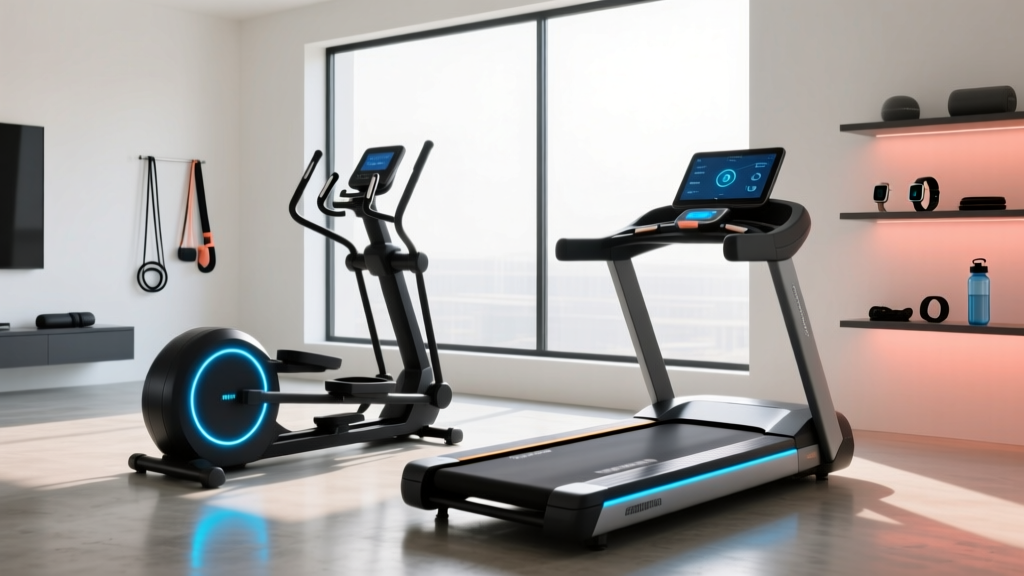
Elliptical vs Treadmill 2026: Is a Treadmill Payment Plan Worth It?
Compare elliptical vs treadmill for home cardio in 2026. We analyze biomechanics, ROI, and the surging treadmill payment plan market trends.

The home fitness equipment market has undergone a massive financial and technological shift as we move through 2026. While smart screens and AI-driven coaching are now baseline expectations, the most significant consumer trend is how these machines are purchased. High-end commercial-grade treadmills now routinely exceed the $3,000 mark, driving a massive surge in search volume and adoption for the treadmill payment plan. Meanwhile, premium ellipticals remain slightly more affordable upfront, creating a complex decision matrix for home gym builders.
If you are debating between an elliptical and a treadmill for your home cardio setup, the choice is no longer just about joint impact or caloric burn. It is about total cost of ownership, financing mathematics, spatial geometry, and long-term biomechanical ROI. This 2026 market analysis breaks down the exact data you need to make an informed purchase.
Biomechanics and Caloric ROI: The Physical Reality
Before analyzing the financials, we must establish the physiological differences between the two machines. The choice between an elliptical and a treadmill dictates your ground reaction forces (GRF) and muscle activation patterns.
Ground Reaction Forces and Joint Preservation
When running on a treadmill, the impact force on your knees, hips, and lower back ranges from 1.5 to 2.5 times your body weight with every footstrike. For a 180-pound runner, this means absorbing up to 450 pounds of force per step. Conversely, an elliptical machine maintains continuous foot contact with the pedals, reducing the GRF to near zero. As highlighted by Johns Hopkins Medicine, low-impact cross-training is critical for individuals with early-stage osteoarthritis or those recovering from meniscal tears, making the elliptical the undisputed champion for joint preservation.
Muscle Activation and Caloric Expenditure
If your primary goal is maximum caloric expenditure and posterior chain development, the treadmill wins. Running at a 5% to 10% incline heavily recruits the glutes, hamstrings, and calves. The American Council on Exercise (ACE) consistently ranks incline treadmill walking among the most efficient methods for targeting the gluteus maximus without the high impact of sprinting. However, modern ellipticals with adjustable stride lengths and moving arm poles (like the Bowflex Max Trainer series) can elevate heart rates to Zone 4 and Zone 5 thresholds just as effectively, engaging the upper body in a way treadmills cannot.
Financial Breakdown: Cash Elliptical vs. Financed Treadmill
Let us look at the real-world math of purchasing a premium treadmill via a financing plan versus buying a comparable elliptical outright. We will compare two 2026 market leaders: the NordicTrack Commercial 2450 Treadmill (Retail: $2,799) and the Sole E95 Elliptical (Retail: $1,999).
| Financial Metric | NordicTrack 2450 (Treadmill) | Sole E95 (Elliptical) |
|---|---|---|
| Base Retail Price | $2,799.00 | $1,999.00 |
| Purchase Method | 24-Month Treadmill Payment Plan (12% APR) | Upfront Cash / Debit |
| Monthly Payment | $131.65 / month | $0.00 (Paid in Full) |
| Total Interest Paid | $360.60 | $0.00 |
| Total Cost of Ownership (Year 1-2) | $3,159.60 | $1,999.00 |
The Financing Trap: While a treadmill payment plan makes a $3,000 machine feel accessible at $131 a month, consumers must factor in the mandatory iFIT or JRNY subscription fees required to unlock the machine's smart features and incline automation. This adds $39 to $49 per month ($468 to $588 annually) to your total cost of ownership, a fee rarely required to operate high-end ellipticals like the Sole E95.
Spatial Geometry and Installation Realities
Home gym space is a premium commodity. The physical footprint and clearance requirements of these machines often dictate the final purchase decision.
The Ceiling Height Factor
Ellipticals elevate the user significantly higher than treadmills. When standing on the pedals of a machine like the Sole E95, your center of gravity is raised by 12 to 15 inches. If you are 6 feet tall, you need a ceiling clearance of at least 7 feet 3 inches to avoid head strikes during vigorous pedaling. Treadmills, by contrast, only raise your deck height by about 5 to 8 inches. Unless you are utilizing a 40% incline feature, standard 8-foot ceilings are perfectly adequate for treadmill running.
Footprint and Folding Mechanics
- Treadmill Footprint: Typically 75 inches long by 35 inches wide. While many 2026 models feature hydraulic folding decks, the heavy 300-pound base still requires a permanent dedicated floor space.
- Elliptical Footprint: Typically 70 inches long by 30 inches wide. Ellipticals do not fold, but their narrower profile allows them to be tucked into corners or placed closer to walls, provided the front and rear pedal swing clearance is maintained.
Maintenance, Failure Modes, and Depreciation
From a market analysis perspective, the long-term depreciation and maintenance schedules heavily favor the elliptical.
Treadmill Failure Points
Treadmills rely on a high-friction environment. The running belt creates immense drag on the deck, requiring the user to apply 100% silicone lubricant every 150 miles. Failure to do so causes the motor to overwork, leading to premature control board failure—a repair that routinely costs $400 to $600 out of warranty. Furthermore, the continuous vibration of footstrikes loosens internal wiring harnesses and motor hood screws over time.
Elliptical Longevity
Ellipticals operate on sealed bearing pivot joints and magnetic resistance systems. There is no friction-based belt to degrade, and the magnetic flywheel generates no physical wear. The primary maintenance requirement is simply wiping down the rails and applying a drop of lithium grease to the exposed pivot arms annually. Consequently, high-end ellipticals routinely outlast treadmills by 3 to 5 years in heavy-use home environments.
The 2026 Verdict: Which Machine Fits Your Profile?
Choosing between an elliptical and a treadmill requires aligning your biomechanical needs with your financial strategy. Use this decision matrix to finalize your choice:
Opt for the Treadmill (and Utilize a Payment Plan) If:
- You are training for outdoor road races and need to replicate exact ground-strike mechanics and pacing.
- You have the budget to absorb the 12% to 15% APR of a treadmill payment plan without straining your monthly cash flow.
- You want to maximize posterior chain development through high-incline walking protocols.
- Your home gym has low ceilings (under 8 feet).
Opt for the Elliptical (Upfront Purchase) If:
- You are managing joint degradation, plantar fasciitis, or lower back pain and require zero-impact cardio.
- You want to avoid the long-term interest costs and mandatory monthly software subscriptions associated with smart treadmills.
- You prioritize upper-body engagement and full-body cardiovascular conditioning.
- You prefer a machine with a significantly lower mechanical failure rate and minimal ongoing maintenance.
Ultimately, the 2026 cardio market offers exceptional options on both fronts. If a treadmill payment plan is the only way to bring a commercial-grade runner into your home, ensure you read the BNPL terms carefully and budget for the hidden software costs. However, if joint longevity and total cost of ownership are your primary metrics, a premium elliptical purchased outright remains the smartest financial and physical investment you can make.
More gear to consider
All reviews
Elliptical vs Treadmill: Space Design & Kelsey Kane Treadmill Trail

Rowing Machine Setup & Technique: Beating 7 mph on a Treadmill

Elliptical vs Treadmill Longevity: A Complete Treadmill Routine Guide

5.5 Treadmill Pace on Under-Desk Models: 2026 Budget & Value Analysis

Spirit XT185 Treadmill Review: Home Office vs Under Desk Models
