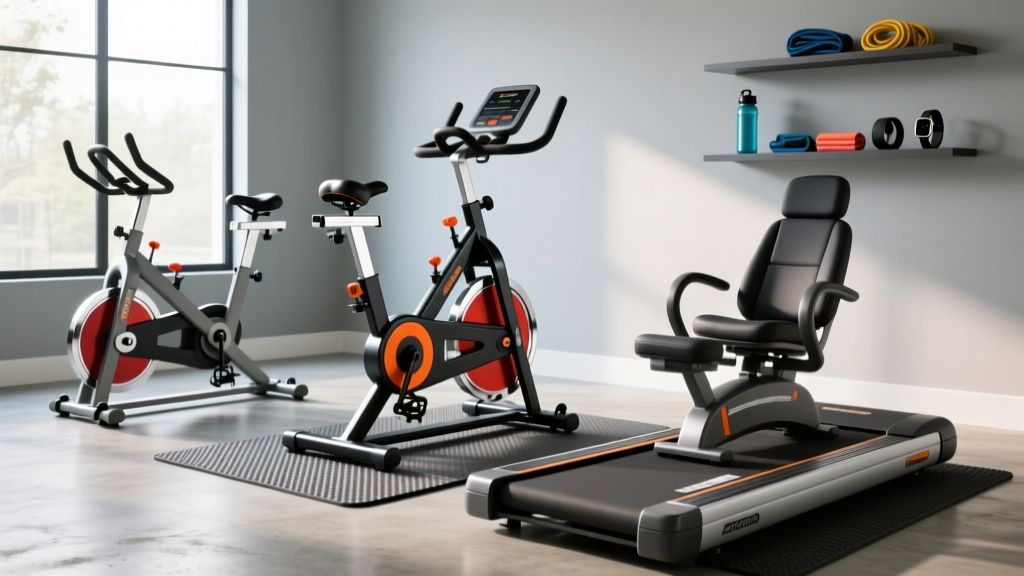
Treadmill Mat for Concrete Floor: Upright, Recumbent, Spin
2026 market analysis of upright, recumbent, and spin bikes on concrete. Learn why a heavy-duty treadmill mat for concrete floor setups prevents damage.

As the home fitness equipment market matures in 2026, basement and garage gym conversions have become the standard for dedicated cardio enthusiasts. However, placing high-end cardiovascular equipment directly on bare concrete slabs introduces severe mechanical and environmental risks. While consumers frequently search for a treadmill mat for concrete floor applications to dampen heavy motor vibrations, this exact same high-density flooring solution is the ultimate, often-overlooked necessity for stationary bikes. This market analysis breaks down how upright, recumbent, and spin bikes interact with concrete subfloors, and why repurposing heavy-duty treadmill mats is the superior strategy for protecting your investment.
The Concrete Subfloor Conundrum: Dust, Moisture, and Vibration
Concrete is a porous, alkaline material that continuously off-gasses microscopic dust and moisture. When human sweat—which has an acidic pH ranging from 4.5 to 7.0—drips onto bare concrete (pH 12+), it creates a corrosive salt slurry. Over time, this chemical reaction pits the concrete surface and rapidly rusts the metal leveling feet and bottom brackets of stationary bikes. Furthermore, concrete lacks acoustic dampening. The low-frequency vibration generated by heavy flywheels transfers directly through the slab, creating structural noise that travels through the home's foundation.
Stationary Bike Types: Biomechanics and Footprint Analysis
To understand flooring requirements, we must analyze the three primary stationary bike types and their unique force profiles. According to biomechanical data highlighted by the American Council on Exercise (ACE), out-of-saddle cycling and varying pedal strokes generate distinct lateral and vertical forces that cheap foam mats simply cannot absorb.
1. Spin Bikes (Indoor Cycles)
Market Leaders: Peloton Bike+, Schwinn IC8, NordicTrack S22i.
Spin bikes feature a narrow footprint (typically 22" x 54") and a heavy perimeter-weighted flywheel (30-45 lbs). The primary issue with spin bikes on concrete is dynamic vertical loading. When a rider transitions to an out-of-saddle climb, they generate up to 2.5 times their body weight in downward force. Thin PVC bike mats compress and bottom out against the concrete, transferring this shock directly back into the rider's joints and the bike's frame welds.
2. Upright Stationary Bikes
Market Leaders: Nautilus U618, Sole B94, ProForm Studio Bike.
Upright bikes simulate a traditional outdoor bicycle geometry. They possess a slightly wider stance and a higher center of gravity than spin bikes. While they generate less aggressive vertical impact (since riders rarely stand), they produce continuous lateral sway during high-cadence intervals. On an uneven concrete slab, this sway causes micro-shifts that eventually strip the threads on the bike's stabilizer bars.
3. Recumbent Bikes
Market Leaders: ProForm R35, Nautilus R618, Teeter FreeStep.
Recumbent bikes are the heavyweights of the cardio floor, often exceeding 100 lbs in machine weight alone and spanning massive footprints (up to 28" x 62"). The American Heart Association frequently recommends recumbent models for low-impact cardiovascular rehabilitation. Because the user's weight is distributed horizontally, vibration is minimal. However, the sheer static weight and wide stance require a large-format, high-compression mat to prevent the concrete's natural thermal cracking from shifting the bike's alignment over time.
Comparative Matrix: Bike Type vs. Flooring Requirements
| Bike Category | Avg. Machine Weight | Footprint (L x W) | Primary Force Profile | Ideal Mat Thickness & Material |
|---|---|---|---|---|
| Spin Bike | 120 - 145 lbs | 48" x 24" | High Vertical Impact (Out-of-saddle) | 3/8" Vulcanized Rubber |
| Upright Bike | 85 - 110 lbs | 55" x 26" | Moderate Lateral Sway | 3/8" High-Density PVC |
| Recumbent Bike | 100 - 135 lbs | 62" x 28" | High Static Load / Wide Stance | 1/2" Commercial Rubber (Custom Cut) |
Why Buy a 'Treadmill Mat' for a Stationary Bike?
In the 2026 fitness equipment market, mats labeled specifically as 'bike mats' are often manufactured from low-density EVA foam or thin 1/8" PVC. These are entirely inadequate for concrete slabs. Conversely, a heavy-duty treadmill mat for concrete floor setups is engineered to withstand 400+ lb dynamic loads, continuous motor vibration, and heavy sweat volumes. By purchasing a mat rated for treadmills, you are acquiring an over-engineered, high-density barrier (usually 3/8" to 1/2" thick) that provides superior compression resistance for spin and upright bikes.
WARNING: Avoid Interlocking EVA Foam Tiles on ConcreteInterlocking puzzle mats (typically 1/2" EVA foam) trap alkaline concrete dust in their seams and compress permanently under the narrow leveling feet of a spin bike. For concrete subfloors, always use a single-piece, non-porous high-density PVC or vulcanized rubber mat to create a true moisture and dust barrier.
2026 Buyer's Specification Guide
When selecting a treadmill mat to serve as a base for your stationary bike, look for these specific material properties:
- Material Composition: Opt for High-Density PVC (Polyvinyl Chloride) or Vulcanized Rubber. Avoid TPE (Thermoplastic Elastomer) and EVA (Ethylene-Vinyl Acetate) for heavy spin bikes.
- Thickness: 3/8" (approx. 9.5mm) is the sweet spot. It provides enough density to prevent the bike's feet from piercing the mat, while remaining rigid enough to support a recumbent bike's wide wheelbase without warping.
- Dimensions: Standard treadmill mats measure 3' x 6.5' (36" x 78"). This perfectly accommodates the elongated footprint of recumbent and upright bikes, ensuring the rider's sweat drip-zone is fully covered.
- Surface Texture: A ribbed or diamond-plate top surface prevents the bike's rubber feet from creeping during high-resistance sprints.
Concrete Prep Protocol: Maximizing Mat Lifespan
Even the best treadmill mat will fail if the concrete beneath it is improperly prepared. Follow this 4-step protocol before unboxing your cardio equipment:
- Alkaline Dust Removal: Sweep the concrete, then mop with a mild acid solution (like a 1:10 white vinegar to water mix) to neutralize surface alkalinity. Let dry completely for 24 hours.
- Moisture Testing: Tape a 2x2 foot square of clear plastic sheeting to the concrete. Check after 48 hours. If condensation forms under the plastic, your slab is emitting moisture vapor, and you must apply a penetrating concrete sealer before laying down any rubber or PVC mat.
- Leveling the Slab: Use a 4-foot spirit level to check the equipment zone. Concrete slabs often have a 1/4" per 10-foot slope for drainage. Use the bike's adjustable leveling feet to compensate, ensuring the mat sits flush without air pockets.
- Mat Acclimation: Unroll your heavy-duty treadmill mat and let it acclimate to the basement or garage temperature for 12 hours. Cold concrete makes PVC mats brittle; allowing them to reach room temperature prevents edge-curling and cracking when the heavy bike is rolled into place.
Final Market Verdict
The segmentation of 'treadmill mats' and 'bike mats' is largely a marketing construct. For home gyms built on concrete slabs, the structural demands of the subfloor dictate the flooring solution, not the machine. By leveraging a premium, high-density treadmill mat for concrete floor applications, owners of upright, recumbent, and spin bikes secure superior vibration dampening, total moisture isolation, and long-term protection for both their foundation and their 2026 cardio investment.
More gear to consider
All reviews
Compact Cardio Maintenance: Walking Pads & The Disney Treadmill
Bifanuo Treadmill E 7 & Air Bike Assault Bike Comparison

Trimup Treadmill Review: Walking Pad Comparison & Setup Guide

Miniature Treadmill vs Compact Elliptical: Best Home Cardio 2026
2026 Market Report: 12 3 30 Treadmill in KM and Belt Wear
