Before Watching a Video on Treadmills Care: Belt Lubrication Guide
Skip the blurry tutorial video on treadmills maintenance. Learn exact belt lubrication steps, silicone types, and tension metrics to save your deck.

If you have ever typed 'best video on treadmills maintenance' into a search engine, you have likely encountered dozens of well-meaning creators spraying random aerosols onto their running belts or aggressively cranking rear roller bolts with oversized wrenches. While visual tutorials can be helpful for basic cleaning, relying on a generic video on treadmills care for critical drivetrain maintenance is one of the fastest ways to destroy your machine's deck, fry the lower control board (LCB), and void your warranty.
At FitGearPulse, we test and teardown dozens of cardio machines annually. In our 2026 lab evaluations, improper lubrication and over-tensioning remain the leading causes of premature motor failure in home treadmills. This comprehensive guide replaces the guesswork of amateur video tutorials with exact, manufacturer-grade protocols for belt maintenance and lubrication.
⚠ Critical Warning: The WD-40 Myth
Never use WD-40, silicone spray aerosols, or petroleum-based oils on a treadmill belt. Aerosol propellants and petroleum solvents will immediately degrade the cotton/polyester underside of the walking belt and dissolve the phenolic resin coating on the MDF deck. Always use 100% pure liquid silicone oil specifically formulated for fitness equipment.
The 2026 Landscape: Silicone vs. Wax-Impregnated Decks
Before you uncap a bottle of silicone, you must identify your deck type. The treadmill industry has shifted significantly over the last few years. While traditional decks require manual liquid silicone application, many premium 2025 and 2026 models feature advanced wax-impregnated or 'maintenance-free' belts.
Applying liquid silicone to a wax-impregnated belt creates a gummy residue that increases friction rather than reducing it. According to Sole Fitness Support, mixing lubricant types is a primary reason for warranty claim denials regarding deck delamination.
| Deck / Belt Type | Lubrication Requirement | Common Models (Examples) |
|---|---|---|
| Standard MDF w/ Phenolic Coat | 100% Liquid Silicone (Every 130 miles or 3 months) | Sole F80, Horizon 7.4, ProForm Pro 9000 |
| Wax-Impregnated Belt | No manual liquid lube; periodic wax board replacement | Precor TRM 731, Life Fitness Club Series |
| Reversible Commercial Deck | Liquid Silicone; flip deck after 1,500 miles | Matrix T7xe, NordicTrack Commercial 2450 |
The 0.5-Ounce Protocol: Step-by-Step Lubrication
Industry experts at the Treadmill Doctor emphasize that over-lubrication is just as damaging as under-lubrication. Excess silicone will sling off the belt at high speeds, coating your motor housing and creating a dust-magnet that chokes the cooling fan. Follow this exact protocol for standard silicone-requiring decks.
Step 1: The 'Lift and Slide' Friction Test
Turn off and unplug the treadmill. Reach under the walking belt at the midpoint of the deck. You should be able to lift the belt approximately 1.5 to 2.0 inches off the deck. Slide your hand across the deck surface. If it feels completely dry, gritty, or you hear a dry scraping noise when spinning the belt by hand, lubrication is required. If your fingers come away with a slick, oily residue, your deck is adequately lubricated.
Step 2: Precise Silicone Application
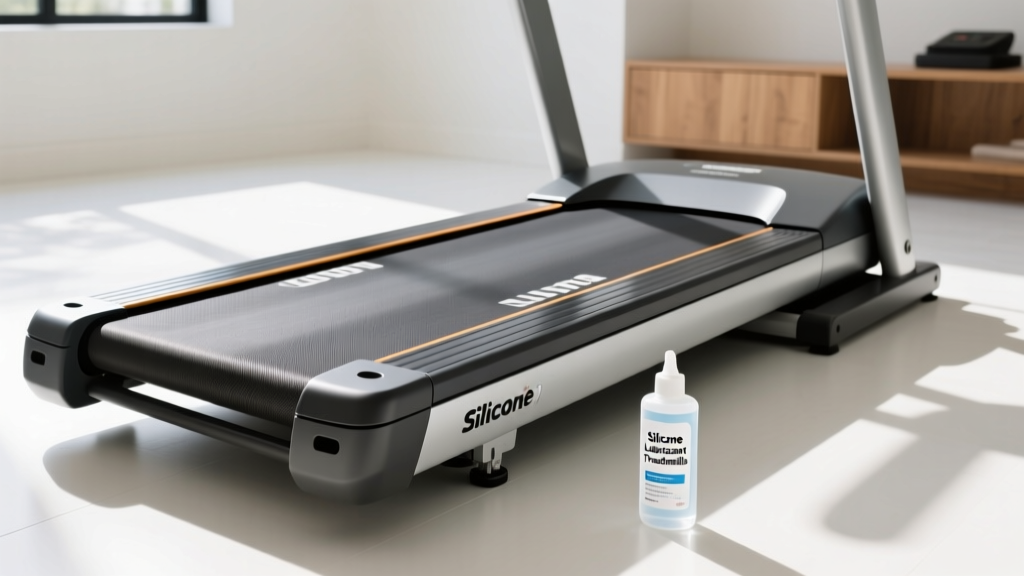
Using a specialized treadmill lubricant bottle with an extended wand (typically holding 0.5 oz or 15 ml of 100% silicone):
- Lift the edge of the walking belt on one side near the front roller.
- Insert the wand as close to the center of the deck as possible.
- Squeeze exactly half of the bottle (approx. 0.25 oz) while pulling the wand out in a slight zig-zag pattern toward the rear roller.
- Repeat on the opposite side with the remaining 0.25 oz.
Step 3: The Distribution Walk
Plug the machine in, start it at 2.0 MPH, and walk on the belt for exactly 3 minutes. Step deliberately on the left and right edges to spread the silicone evenly across the entire phenolic surface. Increase the speed to 4.0 MPH for another 2 minutes to generate mild heat, which helps the silicone bond to the deck's microscopic pores.
'The biggest mistake consumers make after watching a quick tutorial video on treadmills is assuming more lube equals better performance. A standard deck only requires 0.5 oz total. Any excess will migrate to the motor compartment and attract abrasive dust.'
Tension Calibration and the 'Quarter-Turn' Rule
Many online videos incorrectly advise tightening the rear roller bolts until the belt 'stops slipping.' This is catastrophic advice. Over-tensioning places massive lateral stress on the rear roller bearings and forces the drive motor to work up to 40% harder to overcome the artificial friction.
The Proper Tension Metric: Using a 3/16-inch Allen wrench, adjust the left and right rear roller bolts. The rule of thumb is the Quarter-Turn Protocol. Never turn the bolt more than one-quarter (90 degrees) at a time. After a quarter-turn on both sides, walk on the treadmill at 3.0 MPH. If the belt slips under your foot strike, perform one more quarter-turn on both sides. The belt is properly tensioned when it moves in unison with the front roller without slipping, yet can still be lifted 1.5 inches at the midpoint.
Advanced Diagnostics: Amp Draw and Motor Stress
How do you know if your maintenance routine is actually working? Professional repair technicians use a clamp multimeter to measure the AC amp draw of the treadmill. According to Consumer Reports testing methodologies, monitoring electrical draw is the most accurate way to assess deck health.
- No-Load Amp Draw (Belt running empty at 3.0 MPH): Should be between 1.5A and 3.0A. If it exceeds 4.5A, the deck is dry or the belt is over-tensioned.
- Under-Load Amp Draw (175 lb user walking at 3.0 MPH): Should remain under 6.0A. If the draw spikes above 10.0A, the friction is generating excessive heat, which will eventually trigger the lower control board's thermal shutdown or blow the motor's internal capacitor.
Real-World Failure Modes and Costs
Neglecting the specific lubrication and tension metrics outlined above leads to a predictable cascade of mechanical failures. Here is what it costs when you rely on guesswork instead of precision maintenance:
| Failure Mode | Root Cause | Estimated 2026 Repair Cost |
|---|---|---|
| Deck Delamination | Friction heat melts the glue binding the phenolic top layer to the MDF core. | $150 - $250 (Parts) |
| Rear Roller Bearing Seizure | Over-tensioning crushes the bearing housing, causing metal-on-metal grinding. | $85 - $120 (Parts) |
| LCB Thermal Failure | High amp draw from a dry deck overloads the motor controller's MOSFETs. | $200 - $400 (Parts) |
Frequently Asked Questions
Can I use a silicone spray from an automotive store?
No. Automotive silicone sprays contain petroleum distillates and propellants that will eat through the walking belt's backing. You must use 100% pure liquid silicone oil designed specifically for fitness equipment, which typically costs between $12 and $18 for a multi-pack.
How do I clean the deck before applying new silicone?
If your deck has accumulated a thick, black, gummy residue (a mix of old silicone, dust, and belt rubber), you must clean it first. Loosen the belt, slide a microfiber cloth dampened with a mild, non-abrasive degreaser under the belt, and wipe the deck clean. Allow it to dry completely for 2 hours before applying fresh 100% silicone.
My treadmill has a 'maintenance-free' belt. Do I ever need to service it?
'Maintenance-free' is a slight misnomer. While you do not apply liquid silicone, the belt still requires periodic vacuuming underneath to remove dust and debris. Furthermore, the tension and tracking still need to be checked every 6 months using the quarter-turn protocol described above.
More gear to consider
All reviews
Elliptical vs Treadmill: Space Layouts & Treadmill Pack Sizes

Woodway Curve Treadmill Setup & Noise Level Comparison

2026 Market Report: Compact Cardio vs. The Treadmill Mile Pace Chart

Prep for a Good Treadmill Interval Workout: Belt Maintenance & Costs
How Much to Walk on Treadmill to Lose Weight: Portable Pad Care