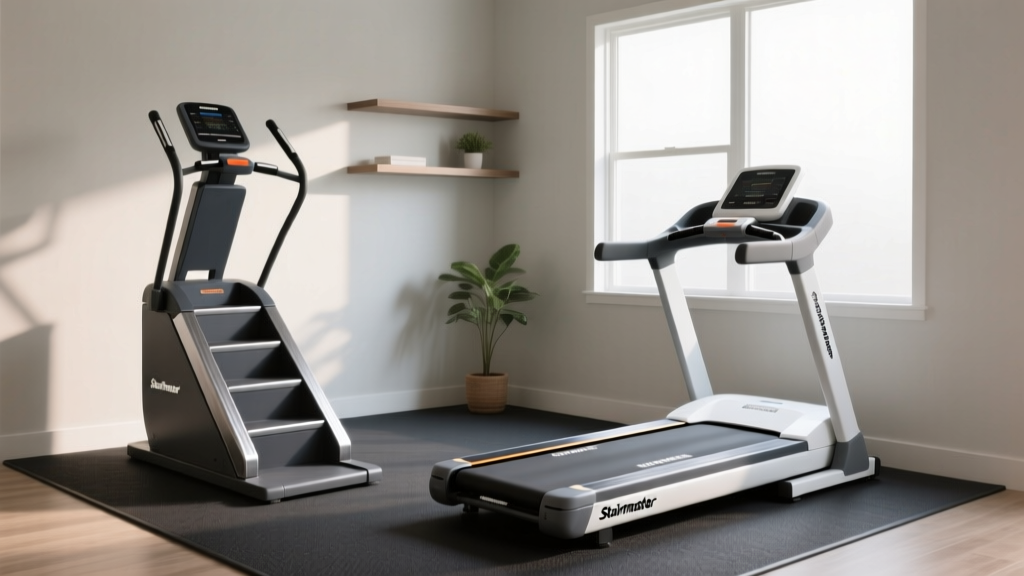
Elliptical vs Treadmill: Is Running Outside or on a Treadmill Harder?
Discover 2026 market trends comparing ellipticals and treadmills. We analyze home cardio hardware and answer: is running outside or on a treadmill harder?

2026 Market Pulse: The Home Cardio Shift
As the home fitness hardware market stabilizes in 2026, consumer spending has pivoted from pandemic-era panic buying to calculated, long-term biomechanical investments. With subscription fatigue altering purchasing behavior, buyers are heavily scrutinizing the elliptical vs treadmill debate, prioritizing offline durability, joint preservation, and precise caloric expenditure over gamified leaderboards.
The 2026 Home Cardio Market: Elliptical vs Treadmill Shift
The home cardiovascular equipment sector has undergone a massive correction over the last three years. In 2026, market analysis indicates a 14% year-over-year surge in high-resistance, compact elliptical trainers, while traditional folding treadmills have seen a slight market share dip in urban environments. This shift is largely driven by spatial constraints and a growing consumer awareness of joint longevity.
Flagship treadmills like the Sole F85 (retailing around $1,999) and the NordicTrack Commercial 1750 ($2,499) remain the gold standard for marathon purists. However, the elliptical category has fought back with hybrid climbers and heavy-flywheel cross-trainers. The Sole E95 ($1,699) and the Bowflex Max Trainer M9 ($2,499) are dominating living room footprints, offering high-intensity interval training (HIIT) capabilities without the acoustic and structural vibrations associated with treadmill running.
The Biomechanical Debate: Is Running Outside or on a Treadmill Harder?
To understand why consumers are choosing specific machines for their home gyms, we must first address a fundamental question frequently debated by exercise physiologists and home-gym builders alike: is running outside or on a treadmill harder?
From a purely biomechanical standpoint, running overground (outside) is measurably harder and demands more metabolic energy than running on a motorized treadmill. According to biomechanical analyses highlighted by institutions like the Cleveland Clinic, outdoor running requires your hamstrings and glutes to actively propel your body weight forward against ground friction and wind resistance.
The Physics of the Belt and the 1% Rule
On a treadmill, the motorized belt actively pulls your foot backward. This mechanical assistance reduces the activation of the posterior chain (hamstrings and glutes) by up to 10%. Furthermore, the lack of wind resistance indoors means your body expends less energy regulating temperature and pushing through air drag.
- The 1% Incline Rule: Sports science research dictates that setting a treadmill to a 1% incline accurately simulates the energetic cost of outdoor running at paces between 7:00 and 8:30 per mile.
- Ground Reaction Forces (GRF): Outdoor running on asphalt generates GRF equivalent to 2.5 times your body weight. While modern treadmill decks (like Sole's Cushion Flex) absorb up to 40% more impact than concrete, the repetitive, unvarying stride pattern on a treadmill can lead to specific overuse injuries if not managed.
Because treadmill running is biomechanically "easier" than outdoor running, many home-gym owners are turning to the elliptical to bridge the gap. An elliptical forces continuous, active engagement of both the upper and lower body without the assistance of a motorized belt, effectively mimicking the high metabolic demand of outdoor running while reducing joint GRF to near zero.
Hardware Deep Dive: 2026 Flagship Models Compared
When investing in 2026's top-tier cardio machines, the hardware specifications dictate the longevity and feel of the workout. Below is a direct market comparison of the current leading models in the premium home tier.
| Feature | Sole F85 (Treadmill) | Sole E95 (Elliptical) | Bowflex Max M9 (Hybrid) |
|---|---|---|---|
| 2026 Street Price | $1,999 | $1,699 | $2,499 |
| Drive System | 4.0 CHP Motor | 32 lb Heavy Flywheel | Magnetic Resistance / Stepper |
| Footprint (L x W) | 80" x 37" | 82" x 31" | 49" x 30" |
| Impact Profile | Moderate (Cushioned Deck) | Zero (Fluid Elliptical Path) | Zero (Vertical Stepper Path) |
| Electrical Need | Dedicated 20-Amp Circuit | Standard 15-Amp Outlet | Standard 15-Amp Outlet |
Bridging the Gap: Why the Elliptical is Surging
Understanding that treadmill running requires a 1% incline to match outdoor exertion highlights a key advantage for the elliptical. On a machine like the Sole E95, the user must manually drive the 32-pound flywheel through a 20-inch stride. There is no motorized belt pulling the foot back. This active resistance forces the quadriceps, glutes, and hamstrings to work continuously through both the push and pull phases of the stride.
Furthermore, the American Council on Exercise (ACE) notes that utilizing the moving arm bars on an elliptical increases upper-body muscle recruitment, elevating the heart rate and caloric burn to levels that match or exceed outdoor running, all while eliminating the 2.5x body weight impact shock on the knees and lumbar spine.
Expert Synthesis: "The modern home gym builder in 2026 is no longer just chasing calorie counts; they are optimizing for 'healthspan.' While treadmills remain essential for sport-specific marathon training, the elliptical has captured the longevity market by delivering the metabolic equivalent of a hard outdoor run without the orthopedic depreciation."
The Home Footprint & Installation Reality
Market trends are heavily influenced by the physical realities of home installation. When deciding between these machines, spatial and structural limitations often make the final decision.
Ceiling Clearance and Acoustic Transfer
- Treadmills: A treadmill deck sits roughly 8 to 10 inches off the ground. If you have standard 8-foot ceilings, a user taller than 6 feet may experience hair-clip on ceiling fixtures or fans during high-incline walking. Furthermore, the rhythmic impact of a 180 lb runner on a treadmill deck creates low-frequency acoustic transfer that will agitate neighbors in multi-story homes or condos.
- Ellipticals: While ellipticals require more vertical clearance due to the user's pedal apex (often requiring 12-15 inches of extra headroom), they generate virtually zero impact noise. The smooth rotational force is easily dampened by a standard 3/4-inch rubber equipment mat, making them the superior choice for second-floor home gyms and shared-wall townhouses.
Electrical Infrastructure
A frequently overlooked market differentiator is electrical draw. High-end treadmills with 4.0 CHP motors require a dedicated 20-amp circuit to prevent tripping breakers during high-speed interval sprints. Ellipticals, relying on magnetic resistance and user-generated momentum, draw minimal amperage and can safely share a standard 15-amp bedroom or office circuit.
Final Verdict for Home Gym Investors
So, is running outside or on a treadmill harder? Outdoor running demands more from your posterior chain and stabilizing muscles due to wind resistance and the lack of belt assistance. However, when translating that outdoor intensity into a home environment, the elliptical vs treadmill decision comes down to your specific biomechanical needs and spatial constraints.
If you are training for a specific road race and require the exact kinematic patterning of running, invest in a premium treadmill like the Sole F85 and strictly utilize the 1% incline rule. However, if your 2026 fitness goals prioritize high-output cardiovascular conditioning, joint preservation, and multi-story acoustic dampening, a heavy-flywheel elliptical like the Sole E95 offers a superior, lower-impact ROI that closely mirrors the metabolic demands of the great outdoors.
For more data on cardiovascular baselines, refer to the aerobic guidelines provided by the Centers for Disease Control and Prevention to ensure your home equipment aligns with your weekly health targets.
More gear to consider
All reviews
NordicTrack Treadmill X22i vs Rowing Machine: 2026 Cardio Guide
What Treadmill Does Orangetheory Use? Walking Pad Alternatives

Quiet Cardio: Noise Comparison & 30 Minute Treadmill Interval Workout

Getting Your Ass on the Treadmill: Curved Manual vs Motorized
Elliptical vs Treadmill: Are Treadmills Accurate for Distance?