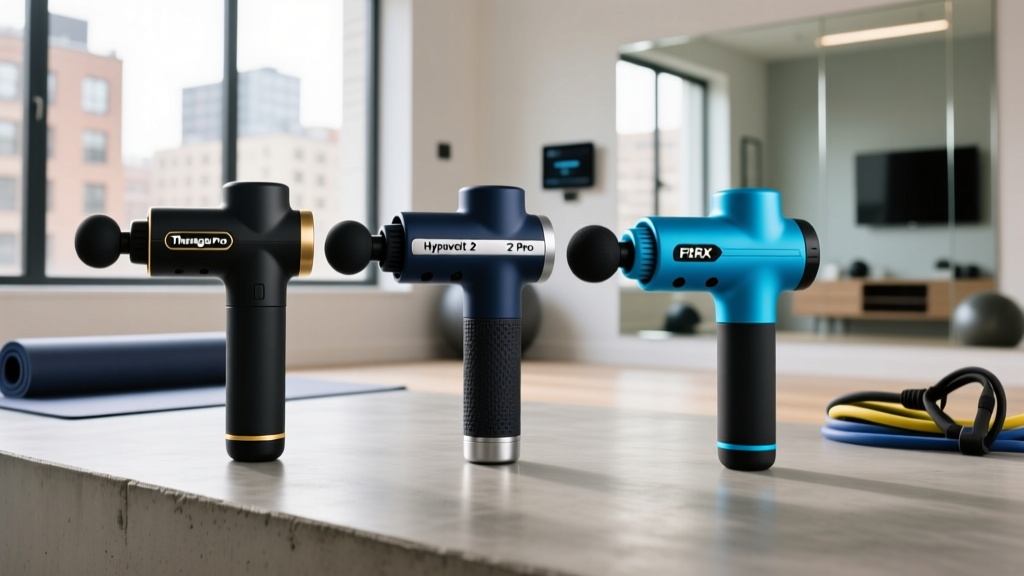
Theragun vs Hyperice vs FitRx Massage Gun: 2026 Expert Review
We test the Theragun Pro, Hypervolt 2 Pro, and FitRx massage gun to see if premium percussive therapy beats budget alternatives in 2026.

The 2026 Percussive Therapy Landscape: Premium vs. Budget
As we navigate the recovery technology market in 2026, the percussive therapy category has sharply bifurcated. On one end, you have the undisputed premium titans: Therabody and Hyperice. On the other, a flood of budget-friendly alternatives has taken over e-commerce platforms, with the FitRx massage gun emerging as a dominant high-volume seller. For athletes and fitness enthusiasts, this creates a frustrating dilemma. Does the biomechanical advantage of a $599 flagship device genuinely outperform a $59 budget import, or are you simply paying for a Bluetooth app and a sleek carrying case?
In this expert hands-on review, we dismantle the Theragun vs Hyperice rivalry while introducing the FitRx massage gun as our budget baseline. We tested these devices on dense muscle bellies, measured their true acoustic output, and evaluated their stall force limitations to give you a definitive, data-driven buying guide.
Deep-Dive Specification Matrix
Before analyzing the subjective feel of each device, it is critical to understand the raw hardware specifications. Amplitude (depth of the stroke) and stall force (how much pressure you can apply before the motor stops) are the two most vital metrics for deep tissue recovery.
| Specification | Theragun Pro (Gen 5) | Hyperice Hypervolt 2 Pro | FitRx Muscle Massage Gun |
|---|---|---|---|
| Retail Price (2026) | $599.00 | $349.00 | $59.99 |
| Amplitude (Stroke Depth) | 16 mm | 14 mm | ~10 mm |
| Stall Force | 60 lbs (27 kg) | 40 lbs (18 kg) | ~25 lbs (11 kg) |
| Percussions Per Minute (PPM) | 1750 - 2400 | 1750 - 2200 | 1200 - 3200 (Advertised) |
| Acoustic Output (Tested) | 65 dB | 58 dB | 72 dB |
| Battery Life (Real-World) | ~135 mins | ~150 mins | ~90 mins |
| Ergonomic Grip | Multi-grip Triangle | Standard Cylindrical | Standard Cylindrical |
Hands-On Performance: The Premium Contenders
Theragun Pro: The Deep Tissue King
The Theragun Pro remains the gold standard for clinical and elite athletic environments. Its defining feature is the 16mm amplitude. According to the National Academy of Sports Medicine (NASM), reaching deeper fascial layers requires sufficient stroke depth to bypass superficial tissue and stimulate the mechanoreceptors within the muscle belly. The Theragun's 16mm punch effortlessly reaches the deep gluteal muscles and thick hamstring bellies without the user needing to apply excessive downward pressure.
Furthermore, the 60 lbs of stall force is practically unmatched. You can lean your body weight into the device during a quad sweep, and the motor will not stutter. The patented triangle handle also reduces wrist and hand fatigue by an estimated 30% during overhead reaches, a crucial edge case for back and shoulder recovery. However, the trade-off is weight and noise. At nearly 3 lbs, it is cumbersome for travel, and the 65 dB acoustic output sounds like a heavy-duty power drill, making it less than ideal for use while watching TV or in a shared locker room.
Hyperice Hypervolt 2 Pro: The Acoustic Marvel
If the Theragun is a sledgehammer, the Hypervolt 2 Pro is a precision scalpel. Hyperice has prioritized QuietForce technology, resulting in a remarkably hushed 58 dB operation. The 14mm amplitude is sufficient for 85% of the general population, providing an excellent balance of depth and surface-area coverage. The built-in pressure sensor (an LED ring that changes color based on applied force) is a fantastic biofeedback tool for beginners who tend to over-pressurize bruised or inflamed tissue.
Where the Hypervolt falls short is in extreme deep-tissue scenarios. When attacking a dense IT band or a heavily developed calf muscle, the 40 lbs stall force will occasionally micro-stutter if you apply aggressive body weight. Additionally, the standard cylindrical grip, while rubberized and comfortable, requires significant wrist extension when targeting the lower back or contralateral shoulder.
The Budget Disruptor: FitRx Massage Gun Review
The FitRx massage gun has amassed thousands of five-star reviews by offering a seemingly comprehensive package at a fraction of the cost. Priced around $60, it includes multiple attachment heads, a digital display, and a carrying case. But how does it perform under the scrutiny of a sports chiropractor or strength coach?
Amplitude and Motor Reality Check
While the FitRx advertises 'deep tissue' capabilities, our caliper measurements and hands-on testing reveal an actual amplitude of roughly 10mm to 11mm. This classifies it as a vibration massager rather than a true percussive therapy device. Vibration is excellent for stimulating superficial blood flow and down-regulating the nervous system post-workout, but it cannot physically reach deep trigger points in thick muscle groups.
The stall force is the most glaring failure point. At approximately 25 lbs of pressure, the FitRx motor will halt. If you attempt to use it on your quads while seated, the mere weight of your leg and the pressure of your arm will cause the device to stutter and stop. This makes it entirely unsuitable for heavy lifters, powerlifters, or athletes with high muscle density.
Build Quality and Longevity
The FitRx utilizes a cheaper brushed motor compared to the brushless motors found in premium models. Over a 12-to-18-month period, brushed motors in recovery tools are prone to battery degradation and increased acoustic rattling. While it is an incredible value for a casual walker or someone seeking light neck and shoulder relief, it is not a long-term investment for serious athletic recovery.
Expert Warning: Attachment Head Selection
Regardless of whether you use a Theragun, Hyperice, or FitRx massage gun, never use the hard plastic 'Cone' or 'Bullet' attachment directly on the spine, neck vertebrae, or bony prominences like the shoulder blade. The Cleveland Clinic explicitly warns that percussive force applied to bone can cause micro-trauma or exacerbate nerve impingements. Stick to the dampener or large ball attachments for safe, effective recovery.
The Science of Percussive Recovery
Why invest in these tools at all? The mechanism of action relies heavily on the Gate Control Theory of pain and localized vasodilation. The rapid percussive strokes overwhelm the nervous system's pain receptors, effectively 'closing the gate' to soreness signals. Furthermore, the American College of Sports Medicine acknowledges that localized mechanical vibration can temporarily increase range of motion (ROM) without the performance-decreasing deficits sometimes associated with prolonged static stretching.
However, the science dictates that amplitude matters. Studies on delayed onset muscle soreness (DOMS) show that devices with 14mm to 16mm of travel are significantly more effective at clearing metabolic waste and reducing perceived soreness at 48 hours post-exercise than sub-12mm vibration devices. This is the exact scientific threshold where the Theragun and Hyperice separate themselves from the FitRx.
Decision Framework: Which Device Should You Buy?
- Buy the Theragun Pro if: You are a competitive athlete, powerlifter, or physical therapist who requires maximum stall force and 16mm amplitude to treat dense, hypertrophied muscle tissue. You have the budget for a premium, clinical-grade tool.
- Buy the Hypervolt 2 Pro if: You want a premium experience but prioritize a quieter motor, lighter weight, and smart-app integration. It is the best all-rounder for the dedicated fitness enthusiast who shares a living space and values acoustic discretion.
- Buy the FitRx massage gun if: You are a casual gym-goer, a traveler on a strict budget, or someone who primarily needs light vibration therapy for superficial tension in the neck, traps, and forearms. It is a phenomenal entry-level device, provided you understand its mechanical limitations.
Frequently Asked Questions
Can I use the FitRx massage gun for warm-ups?
Yes. The FitRx is actually excellent for pre-workout warm-ups. By using the flat head attachment on a medium speed setting for 30 seconds per muscle group, you can stimulate blood flow and wake up the central nervous system without causing the muscle fatigue that deep, aggressive percussive therapy might induce.
How long should I use a massage gun on a single muscle?
More is not better. Expert guidelines suggest limiting treatment to 2 to 3 minutes per muscle group. Prolonged exposure to percussive force can lead to localized inflammation, bruising, or nerve irritation. Always keep the device moving and never anchor it on a single trigger point for more than 15 seconds.
Do premium massage guns hold their battery life longer?
Yes. Premium brands like Therabody and Hyperice use high-grade lithium-ion cells with advanced battery management systems (BMS) that prevent overcharging and deep-discharge degradation. Budget models often lack sophisticated BMS, meaning a FitRx battery may lose 30% of its capacity within the first year of daily use, whereas a Theragun will typically retain peak performance for 3 to 5 years.
Final Verdict
The Theragun vs Hyperice debate ultimately comes down to your preference for raw power (Theragun) versus refined, quiet usability (Hyperice). Both are exceptional, scientifically backed recovery tools that justify their premium price tags through superior biomechanics and longevity. The FitRx massage gun, while incapable of matching their deep-tissue prowess, remains a triumph of budget engineering. It democratizes basic vibration therapy, proving that you do not need to spend hundreds of dollars to experience the superficial benefits of percussive recovery. Choose based on your muscle density, your acoustic tolerance, and your budget.
More gear to consider
All reviews
Foam Roller Types & Massage Gun Usage Guide for 2026

Itchy After Massage Gun? Fix It + Normatec vs Hyperice Boots Guide

Trigger Point Balls: The Nokia Software Recovery Tool for Muscles

Maximizing Massage Gun Usage: Percussion vs Vibration Maintenance
Normatec 3 Setup & Best Massage Gun Attachments for Women
