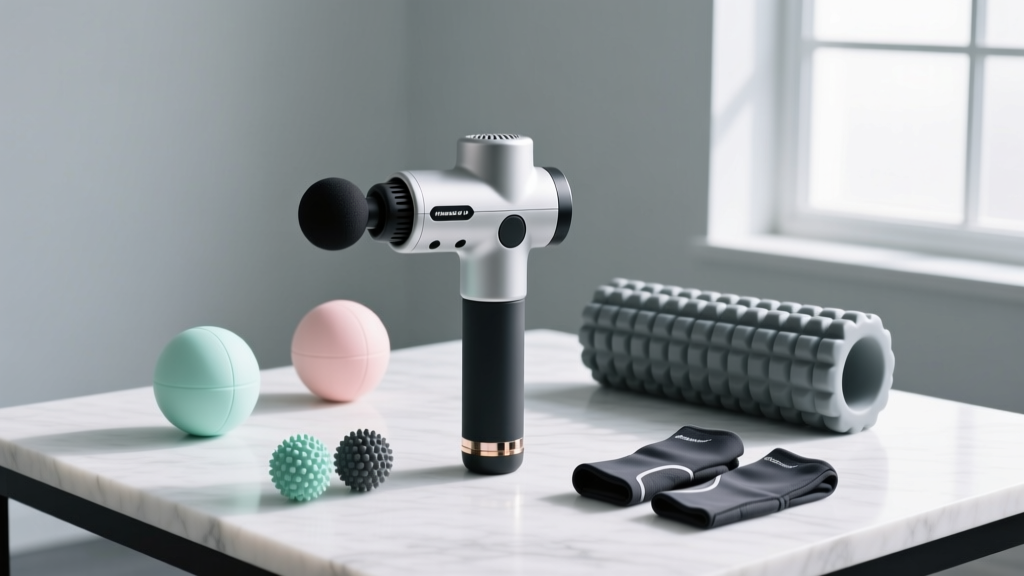
8 Head Massage Gun vs Trigger Point Balls: 2026 Value Breakdown
Is a budget 8 head massage gun better than dedicated trigger point therapy tools and balls? We break down the cost, efficacy, and ROI for 2026.

The Great Recovery Debate: Percussion vs. Precision
In the budget fitness recovery market of 2026, few products generate as much debate as the ubiquitous 8 head massage gun. Priced aggressively between $45 and $75 on major e-commerce platforms, these devices promise comprehensive percussive therapy and targeted myofascial release through a suite of interchangeable attachments. But how do they actually stack up against dedicated trigger point therapy tools and balls—like the Theracane, Acuball, or a simple high-density lacrosse ball—when it comes to true clinical efficacy and long-term value?
As consumers become more educated on myofascial release, the question is no longer just about what feels good. It is about biomechanical accuracy, tissue adaptation, and return on investment. In this comprehensive value analysis, we deconstruct the real-world utility of multi-head percussive devices versus specialized manual therapy tools to help you build the most effective, budget-friendly recovery kit this year.
Deconstructing the Budget 8 Head Massage Gun
When you purchase a generic or entry-level 8 head massage gun (often from brands like Achedaway, Bob and Brad, or various Amazon white-labels), you are typically getting a device with a 10mm to 12mm amplitude and a stall force ranging from 25 to 35 pounds. The value proposition hinges entirely on the eight included attachments:
- Large Round / Air Cushion: For broad muscle groups and sensitive flushing.
- Flat Head: For dense tissue like the quads and IT band.
- Fork / U-Shape: Designed to glide alongside the spine and Achilles tendon.
- Bullet / Cone: Marketed specifically for pinpoint trigger point therapy.
- Shovel / Scraper: Mimics Graston-style fascia scraping.
- Heated Head: A newer 2025/2026 addition in some models for thermal vasodilation.
- Soft Foam / Cushion: For bony prominences and joint proximity.
- Thumb / Wedge: For directional fiber stripping.
At an average cost of $55, the cost-per-attachment ratio seems unbeatable. The 'bullet' head, in particular, is heavily marketed as a replacement for manual trigger point therapy tools and balls. However, marketing claims often ignore the fundamental differences in force application.
The Gold Standard: Dedicated Trigger Point Therapy Tools and Balls
Dedicated trigger point therapy tools and balls rely on a completely different physiological mechanism. Rather than rapid percussive strikes, these tools utilize ischemic compression—the application of sustained, static pressure to a myofascial trigger point to temporarily restrict blood flow, followed by a reactive hyperemic flush upon release.
Key Contenders in the 2026 Market
- The Theracane ($39.95): A 24-inch fiberglass hook featuring six pressure knobs. It provides unparalleled mechanical leverage, allowing users to apply up to 40+ pounds of direct, static pressure to the thoracic spine and rhomboids without fatiguing their hands.
- TriggerPoint GRID Foam Roller & CORE Ball ($14.99 - $34.99): Constructed with multi-density EVA foam wrapped around a rigid ABS plastic core. The GRID pattern mimics the varying pressure of human thumbs and palms.
- The Acuball ($29.99): A high-density, heatable rubber ball with patented nodules designed to grip the fascia and separate muscle fibers without slipping on sweat.
- Standard Lacrosse Ball ($5.00 - $8.00): The ultimate budget staple. Solid vulcanized rubber provides zero-give compression, ideal for deep gluteal and piriformis trigger points.
Head-to-Head Value Matrix
To understand where your money is actually going, we must compare the physical output and longevity of these tools.
| Feature | Budget 8 Head Massage Gun | Premium Trigger Point Tools (e.g., Theracane) | Trigger Point Balls (e.g., Acuball/Lacrosse) |
|---|---|---|---|
| Average Cost | $45 - $75 | $35 - $45 | $5 - $30 |
| Force Mechanism | Dynamic Percussion (10-12mm) | Static Leverage Compression | Static Bodyweight Compression |
| Target Accuracy | Moderate (Vibration causes drift) | High (Precision knobs) | Very High (Direct tissue contact) |
| Durability (Est.) | 1.5 - 2 Years (Battery degradation) | Lifetime (Fiberglass/Plastic) | 3 - 5 Years (Rubber/EVA wear) |
| Best Use Case | Pre-workout flushing, broad DOMS relief | Deep cervical, thoracic, and scapular knots | Glutes, piriformis, plantar fascia |
Biomechanics: Why the 'Bullet Head' Fails as a True Trigger Point Tool
The most common misconception among budget recovery enthusiasts is that the bullet attachment on an 8 head massage gun can replace a lacrosse ball or a Theracane for stubborn knots. According to research published by the National Center for Biotechnology Information (NCBI), the deactivation of a myofascial trigger point requires sustained ischemic compression. This static pressure down-regulates nociceptors (pain receptors) and forces the contracted sarcomeres within the muscle knot to release.
A percussion gun, even on its lowest setting, delivers between 1,200 and 2,000 strikes per minute. While this is excellent for stimulating the Golgi tendon organ and increasing local blood flow—making it a superior tool for pre-workout warmups—it fails to provide the sustained 30-to-90-second static hold required to mechanically 'unwind' a chronic trigger point. Furthermore, the rapid vibration often causes the hard plastic bullet head to skitter across the skin, bruising the superficial fascia rather than sinking into the deep muscle belly.
Expert Insight: The American Council on Exercise (ACE) emphasizes that effective myofascial release requires finding the point of tension and holding static pressure until the tissue releases. Percussive therapy masks the pain via the gate control theory of pain, but it does not always resolve the underlying sarcomere contraction.
Real-World Failure Modes & Edge Cases
When conducting a budget breakdown, you must factor in how and why these tools fail. Cheap tools cost more in the long run if they break or cause tissue damage.
⚠️ Warning: The 8-Head Gun Battery Trap
Most $50 multi-head massage guns utilize low-grade 18650 lithium-ion battery cells. When users attempt to use the 'bullet' or 'fork' heads to dig deep into dense tissue like the IT band or gluteus medius, the motor draws excessive current. This triggers the gun's over-current protection, causing it to stall out. Repeated stalling degrades the battery cells rapidly, often resulting in a dead device within 14 to 18 months.
💡 Pro-Tip: Trigger Point Ball Slippage
While a $5 lacrosse ball is incredibly durable, its smooth vulcanized surface is a major failure mode for athletes who sweat heavily or use massage oils. The ball will slip off the trigger point, potentially rolling into the spine or joints. This is where the $30 Acuball or a specialized trigger point therapy tool with grip-textured EVA foam proves its higher upfront value.
The FitGearPulse Verdict: Building a $65 Hybrid Recovery Kit
If your total budget for recovery equipment is under $70, do not spend it all on an 8 head massage gun. The marginal utility of having 8 attachments is vastly outweighed by the lack of precision and static pressure capabilities. Instead, we recommend a hybrid approach that maximizes both percussive flushing and ischemic trigger point release.
The Optimal 2026 Budget Loadout:
- Entry-Level 4-Head Percussive Gun ($39.99): Skip the 8-head gimmicks. Buy a reputable 4-head model (Flat, Round, Bullet, Fork) from a brand that offers a 1-year warranty and replacement batteries. Use this for broad tissue flushing and post-workout CNS down-regulation.
- Theracane or Generic Fiberglass Hook ($25.00 - $39.95): Essential for reaching the rhomboids, levator scapulae, and deep cervical trigger points that a massage gun cannot safely reach without risking spinal percussion.
- High-Density Trigger Point Ball / Lacrosse Ball ($5.00 - $10.00): Keep one in your gym bag for floor-based glute, piriformis, and plantar fascia release.
Final Thoughts on Value and Efficacy
The 8 head massage gun is a triumph of e-commerce marketing, offering a visually impressive array of tools for a remarkably low price. However, when evaluated strictly through the lens of trigger point therapy, it falls short of dedicated tools. Percussion and ischemic compression are complementary, not interchangeable, modalities. By understanding the biomechanical limitations of budget percussive devices and reallocating a portion of your budget toward specialized trigger point therapy tools and balls, you can build a recovery arsenal in 2026 that rivals the clinical setups of professional physical therapists—without breaking the bank.
More gear to consider
All reviews
Bally Massage Gun vs Infrared Sauna Blanket: 2026 Guide

Boots Massage Gun Review: Renpho Recovery Gear Tested

Zongym Massage Gun vs Top Brands: 2026 Percussion Buying Guide

Space-Saving Home Ice Bath Setups & Leercon Massage Gun Integration

Normatec vs Hyperice Boots & Do Massage Guns Help With Cellulite?
