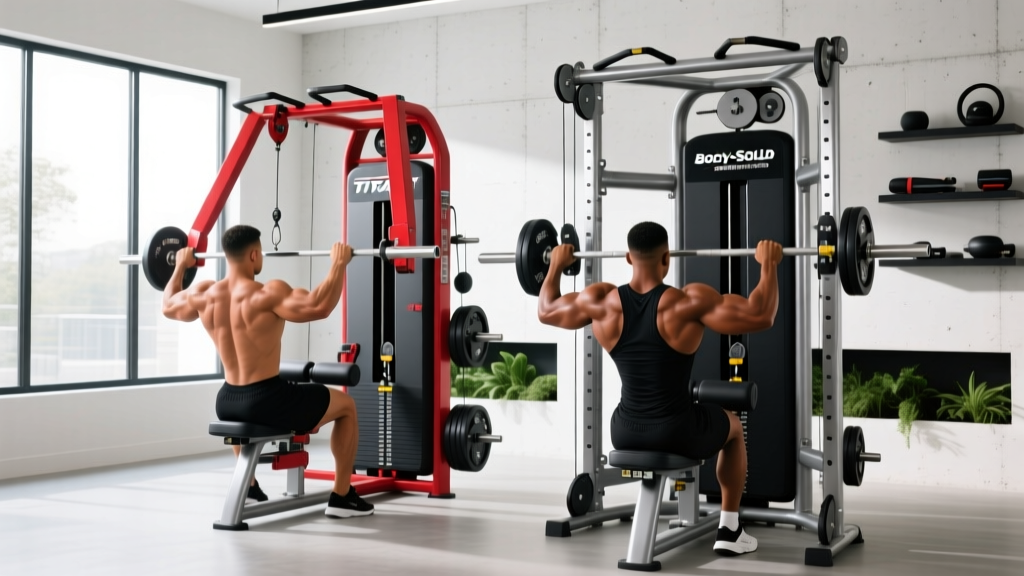
Beginner Guide: Using a Technogym Lat Pulldown Machine for Posture
Learn how to fix upper crossed syndrome and build natural spinal support with our beginner step-by-step guide to the Technogym lat pulldown machine.

When most beginners think about fixing rounded shoulders or a slouching spine, they immediately search for passive posture correctors, rigid clavicle braces, or biofeedback wearables. However, relying on external supports without strengthening the underlying musculature is a temporary fix that often leads to further muscle atrophy. True, lasting postural correction requires building the 'internal brace' of your back—specifically the latissimus dorsi, rhomboids, and lower trapezius.
This is where commercial-grade biomechanics shine. In this beginner-friendly, step-by-step guide, we will explore how to use a Technogym lat pulldown machine—specifically the industry-standard Selection PRO line—to actively correct upper crossed syndrome, build natural spinal support, and integrate supplementary lumbar equipment for a comprehensive back-health protocol.
The Biomechanics of Posture: Why Passive Braces Fail
Upper crossed syndrome (UCS) is characterized by tight pectorals and upper traps, paired with weak deep neck flexors, lower traps, and lats. According to the Mayo Clinic's guidelines on postural health, prolonged slouching alters the natural curvature of the thoracic spine, leading to chronic pain and reduced respiratory efficiency. While a $30 neoprene posture brace might pull your shoulders back temporarily, it forces your already-weakened mid-back muscles to 'turn off' because the brace is doing the work.
Expert Insight: To create permanent postural change, you must train scapular depression and thoracic extension under load. The converging movement path of a premium machine mimics the natural scapulohumeral rhythm, pulling the shoulder blades down and back without impinging the rotator cuff.Step 1: Assessing Your Baseline Support Needs
Before loading the weight stack, determine the severity of your postural deviation and whether you need supplementary back support equipment during your training.
- The Wall Test: Stand with your heels, glutes, and upper back against a wall. If the back of your head cannot touch the wall without you tilting your chin up, you have significant forward head posture and thoracic kyphosis.
- Core Stability Check: Sit on a flat bench. If you find your lower back rounding (posterior pelvic tilt) after 60 seconds, you will need external lumbar support during seated cable exercises to protect your intervertebral discs.
- Equipment Selection: For beginners with poor core endurance, pairing your machine work with a dedicated lumbar roll (like the Core Products D-Core Lumbar Support, approx. $35) ensures your spine remains neutral while your lats do the heavy lifting.
Step 2: Configuring the Technogym Lat Pulldown Machine
The Technogym lat pulldown machine (Selection PRO model, typically retailing between $4,250 and $5,100 depending on the weight stack and upholstery) is engineered with a converging axis of movement. This means the handles move closer together as you pull down, which is vastly superior for posture correction than a fixed straight bar.
Exact Setup Measurements for Posture Correction
- Seat Height & Thigh Pad: Adjust the thigh pad so there is exactly a 2-inch gap between your resting thigh and the pad. If the pad is too tight, your hip flexors will engage, pulling your pelvis into an anterior tilt and compromising your lumbar support. If it is too loose, your body will lift off the seat during the eccentric phase.
- Grip Width: Grab the converging handles at approximately 1.5 times your biacromial width (the distance between your shoulder joints). Research published in the Journal of Strength and Conditioning Research indicates that this specific width maximizes lower trapezius and latissimus dorsi activation while minimizing biceps brachii compensation.
- Weight Stack Selection: For postural endurance, you are not training for a 1-rep max. Select a weight that is roughly 35% to 40% of your estimated 1RM. For most untrained beginners, this is between 30 lbs and 50 lbs on the standard 180 lb Technogym stack.
Step 3: The 'Scapular Anchor' Execution Technique
Executing the pulldown for posture requires a completely different mindset than executing it for bodybuilding. We are focusing on thoracic extension and scapular downward rotation.
'Do not pull the bar to your chest. Pull your chest to the bar. Your sternum should rise to meet the converging handles, forcing the thoracic spine into extension.' — Biomechanics Principle for Kyphosis Correction.
Step-by-Step Rep Execution (3-1-2-0 Tempo)
- The Initiation (3 seconds): With arms fully extended, depress your scapulae (imagine pulling your shoulder blades into your back pockets). Do not bend your elbows yet.
- The Concentric Pull (1 second pause): Drive your elbows down toward your hips. Lean back exactly 15 degrees. Hold the bottom position for 1 second, squeezing the mid-back.
- The Eccentric Release (2 seconds): Slowly allow the weight to pull your arms up. Let your scapulae elevate naturally, but do not let your shoulders roll forward into internal rotation.
- Repetition Range: Perform 3 sets of 15 to 20 repetitions. Postural muscles are predominantly slow-twitch (Type I) fibers and respond best to higher time-under-tension protocols.
Step 4: Active vs. Passive Posture Correction Tools
To understand where the Technogym lat pulldown machine fits into your broader back-support ecosystem, review the comparison matrix below.
| Intervention Type | Example Equipment | Estimated Cost | Mechanism of Action | Long-Term Efficacy |
|---|---|---|---|---|
| Active Machine Training | Technogym Selection PRO Lat Pulldown | ~$4,250+ | Hypertrophies lats/traps to create a permanent muscular 'internal brace'. | High (Permanent structural change) |
| Biofeedback Wearables | Upright GO 2 | ~$99 | Vibrates when slouching to build neurological awareness. | Moderate (Requires conscious compliance) |
| Passive Braces | Neoprene Clavicle Support | $20 - $40 | Low (Can cause muscle atrophy) | |
| Ergonomic Lumbar Support | Memory Foam Lumbar Roll | $25 - $50 | Maintains lordotic curve during seated desk work or machine training. | High (Prevents disc compression) |
Step 5: Your 4-Week Beginner Back Support Protocol
To integrate the Technogym lat pulldown machine into a routine that actively fights daily slouching, follow this beginner-friendly weekly schedule. This protocol balances postural endurance with lumbar stabilization.
Workout A (Monday & Thursday)
- Technogym Converging Lat Pulldown: 3 sets x 15 reps (3-1-2-0 tempo). Focus on sternum elevation.
- Seated Cable Row (with Lumbar Roll): 3 sets x 12 reps. Place a 4-inch foam lumbar roll behind your lower back to prevent rounding during the reach phase.
- Face Pulls (Cable Crossover): 3 sets x 20 reps. Targets the rear deltoids and external rotators to combat internally rotated shoulders.
Workout B (Tuesday & Friday)
- Back Extension Bench (45-degree): 3 sets x 12 reps. Focus on the erector spinae to build the lower back 'pillars' that support the spine.
- Technogym Chest-Supported Row: 3 sets x 15 reps. Removes the lower back from the equation entirely to isolate the rhomboids.
- Dead Bugs (Core Stabilization): 3 sets x 10 reps per side. Teaches the core to maintain a neutral pelvis while the extremities move.
Final Thoughts on Building Your Internal Brace
Investing time on a biomechanically precise piece of equipment like the Technogym Selection PRO lat pulldown yields compounding returns for your spinal health. While external posture correctors and lumbar supports have their place in managing acute pain or providing ergonomic feedback during a desk shift, they cannot replace the necessity of muscular tension. By following this step-by-step guide, adjusting the machine to your exact anthropometric measurements, and prioritizing scapular control over sheer weight, you will build a resilient, naturally upright back capable of supporting you for decades to come. For more advanced biomechanics and machine calibration techniques, consult the official Technogym Selection PRO documentation or work with a certified corrective exercise specialist.
More gear to consider
All reviews
Inversion Table Maintenance: Longevity Beyond a Technogym Lat Pulldown Machine Image

Hyperextension Bench Errors vs Lat Pulldown Exercise Without Machine

2026 Titan vs Valor: Best Wall Mounted Lat Pulldown Machine

Machine Row vs Lat Pulldown: Home Gym Setup & Install Guide
Foam FAQ Answered: Expert Insights on Density, ILD, Durability, and Real-World Performance