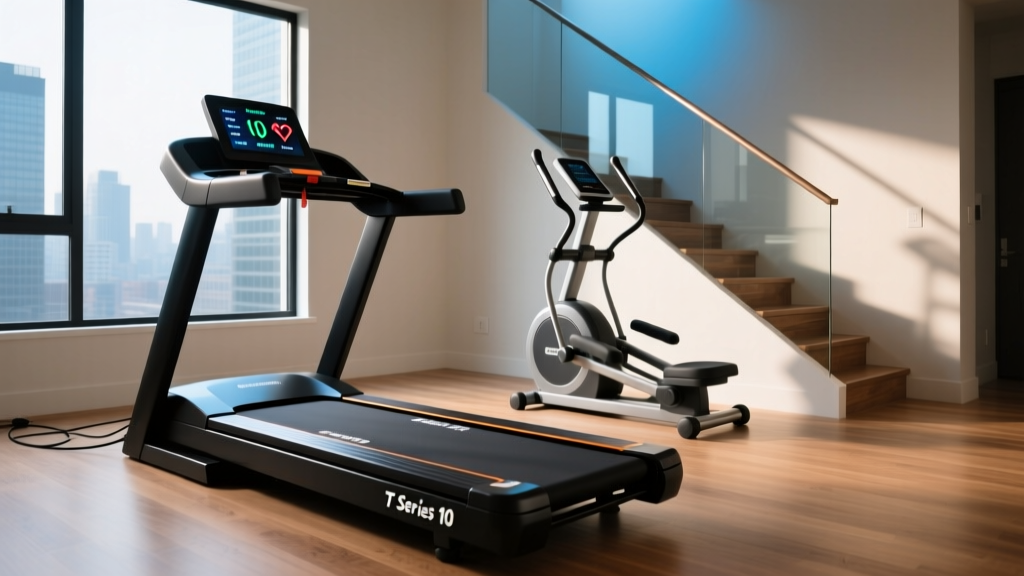
T Series 10 Treadmill Review & Stair Climber Guide
Read our T Series 10 treadmill review and home stair climber guide. Compare footprints, calorie burn, and ceiling clearance to build your 2026 home gym.

The Dilemma: Horizontal Walking vs. Vertical Climbing
When outfitting a home gym in 2026, buyers frequently cross-shop compact treadmills and vertical climbers. The debate usually centers around two wildly different movement patterns: the horizontal gait cycle versus vertical stair ascent. In this comprehensive T Series 10 treadmill review and home stair climber guide, we pit the budget-friendly, space-saving treadmill category against the high-intensity stair climber machine for home use. Whether you are trying to maximize glute activation, protect aging knees, or simply figure out if your ceiling is high enough for a stepmill, this head-to-head comparison will provide the exact measurements, biomechanical data, and pricing you need to make an informed purchase.
Baseline Analysis: T Series 10 Treadmill Review
To understand the stair climber's value proposition, we must first establish our baseline. The NordicTrack T Series 10 remains a dominant force in the entry-level cardio market. Priced consistently between $399 and $499, it offers a 20-inch by 55-inch running belt, a 2.65 CHP motor, and a top speed of 10 mph.
Where the T10 Excels
- Footprint: At 67.3 inches long and 28.7 inches wide, it folds down to a remarkably slim profile, making it ideal for apartments.
- Gait Naturalness: Walking or light jogging on a motorized belt mimics outdoor biomechanics, requiring less cognitive load and balance than a stepper.
- Incline Training: The 0-10% incline allows for moderate glute and calf engagement without the sheer vertical exhaustion of a stair climber.
The Limitations
However, the T10's 300-pound weight capacity and lightweight 130-pound frame mean it struggles with stability during aggressive sprint intervals. Furthermore, horizontal walking at a 10% incline yields a significantly lower metabolic equivalent of task (MET) compared to vertical climbing, meaning you must exercise longer to achieve the same caloric expenditure.
Home Stair Climber Machine Guide: The Vertical Advantage
Stair climbers force the body to work against gravity with every single step. According to ACE Fitness research on vertical climbing, stepping engages the gluteus maximus, quadriceps, hamstrings, and calves simultaneously, resulting in a higher heart rate response at lower perceived speeds. But 'stair climber' is a broad term. For home use, you are generally choosing between three distinct mechanical designs:
- True Stepmills (Revolving Stairs): An endless staircase that requires full range of motion (ROM). These are massive, heavy, and expensive.
- Hybrid Steppers (Pedal-based): Machines like the Bowflex Max Trainer series that use a shortened pedal stroke to simulate climbing in a much smaller footprint.
- Mini-Steppers: Compact hydraulic cylinder devices that offer partial ROM. Great for under-desk use, but poor for serious cardiovascular conditioning.
⚠️ Critical Failure Mode: The Ceiling Height Trap
The most common mistake home gym buyers make with stair climbers is ignoring ceiling clearance. A commercial-style stepmill like the Matrix Fitness ClimbMill stands 84 inches (7 feet) tall at its highest step. If a 6-foot-tall user (72 inches) stands on the top step, their head reaches 156 inches. Add the 8-inch step height and a mandatory 6-inch safety buffer, and you need a ceiling clearance of 170 inches (14 feet 2 inches). Standard 8-foot or 9-foot residential ceilings will result in immediate head strikes. Always measure your vertical clearance before ordering a revolving stepmill.
Head-to-Head Comparison Matrix
How do the top stair climbers stack up against our baseline T Series 10 treadmill? The data below highlights the stark differences in spatial requirements, pricing, and physical demands.
| Feature | NordicTrack T10 (Treadmill) | Bowflex Max Trainer M9 (Hybrid) | Matrix ClimbMill (True Step) | Sunny SF-S900005 (Mini) |
|---|---|---|---|---|
| 2026 Price Range | $399 - $499 | $1,999 - $2,199 | $3,500 - $4,200 | $110 - $140 |
| Footprint (L x W) | 67.3' x 28.7' | 49' x 30.5' | 51' x 31' | 16' x 12.5' |
| Machine Weight | 130 lbs | 150 lbs | 350 lbs | 20 lbs |
| Min. Ceiling Req. | User Height + 5' | User Height + 15' | User Height + 7'2' | User Height + 1' |
| Max User Weight | 300 lbs | 300 lbs | 300 lbs | 250 lbs |
| Joint Impact | Moderate (Belt cushion) | Low (Zero-impact pedals) | Moderate (Hard steps) | Low (Hydraulic) |
Biomechanics, Joint Impact, and Caloric Expenditure
When deciding between a treadmill and a stair climber, joint health is often the deciding factor. The Mayo Clinic's aerobic exercise guidelines emphasize selecting low-impact modalities for individuals with osteoarthritis or previous meniscus injuries.
While treadmills offer deck cushioning, the repetitive heel-strike of walking or running generates ground reaction forces equivalent to 1.5 to 3 times your body weight. Conversely, hybrid stair climbers (where your foot never leaves the pedal) eliminate this impact entirely. However, true revolving stepmills require you to step down onto a hard fiberglass stair, which can exacerbate patellofemoral pain syndrome if your form degrades during fatigue.
'To meet the CDC's physical activity recommendations of 150 minutes of moderate aerobic activity per week, a user walking on a flat treadmill at 3.0 mph will burn approximately 250 calories per hour. That same user on a stair climber at a moderate stepping rate (approx. 60 steps per minute) will easily exceed 450 calories per hour due to the vertical displacement of their body mass.'
Top Home Stair Climbers for 2026
If the T Series 10 treadmill review proved that horizontal walking isn't intense enough for your goals, here are the specific stair climber models we recommend for home use this year.
1. The Hybrid Solution: Bowflex Max Trainer M9
Best for: Small apartments requiring high-intensity interval training (HIIT).
The Details: The M9 combines an elliptical's zero-impact glide with a stair climber's steep 7-inch vertical step. It features a 10-inch incline range and magnetic resistance that goes up to 20 levels. Because the pedals are fixed to a track, you never step 'down,' saving your knees from eccentric loading. At roughly 5 feet long, it takes up 30% less floor space than the T10 treadmill, though the 65.5-inch height means you must verify your ceiling clearance.
2. The True StepMill: Matrix Fitness ClimbMill (Home Edition)
Best for: Dedicated garage gyms with high ceilings and serious endurance athletes.
The Details: This is the gold standard for vertical climbing. The 8-inch step height perfectly mimics standard architectural staircases. The 2026 model includes a 24-inch HD touchscreen and a self-generating power system, meaning you don't even need to route a 120V outlet to the center of your garage. The primary drawback is the 350-pound shipping weight and the massive vertical clearance required. Do not attempt to install this on a second-story floor without verifying the joist load-bearing capacity.
3. The Budget Mini-Stepper: Sunny Health & Fitness SF-S900005
Best for: Active recovery, under-desk use, and budgets under $150.
The Details: While it lacks the continuous motion of a stepmill, this hydraulic mini-stepper offers a surprising amount of utility. It features adjustable tension bands for upper body engagement and a digital monitor tracking step count and time. Expert Warning: Hydraulic cylinders generate significant heat. Limit continuous use to 15-20 minute intervals to prevent the fluid from degrading and the seals from blowing out—a common failure mode in budget steppers.
Maintenance Realities: Belt Lubrication vs. Chain Tension
A frequently overlooked aspect of home cardio equipment is long-term maintenance. The T Series 10 treadmill requires 100% silicone belt lubrication every 130 miles or 3 months to prevent motor strain and deck warping. Failure to do so will cause the 2.65 CHP motor to overheat and draw excessive amperage, eventually tripping your home's circuit breaker.
Stair climbers require a different maintenance protocol. True stepmills utilize heavy-duty drive chains and sprockets. In a humid garage environment, these chains are prone to stretching and surface rust. You must check chain tension bi-annually and apply dry Teflon-based chain lubricant (avoid wet lubes, which attract dust and grit). Hybrid steppers like the Bowflex rely on sealed bearings and magnetic resistance, making them virtually maintenance-free aside from occasional dusting of the optical sensors.
Final Verdict: Matching the Machine to Your Floorplan
Choosing between a treadmill and a stair climber ultimately comes down to your spatial constraints, joint health, and metabolic goals. The NordicTrack T Series 10 is an excellent, budget-conscious choice for users who prioritize natural walking mechanics, have low ceilings, and prefer steady-state, low-intensity cardio.
However, if your goal is maximum caloric burn in minimum time, and you want to heavily target the posterior chain without the joint impact of heel-strikes, a stair climber is the superior investment. For most residential spaces with standard 8-foot ceilings, the Bowflex Max Trainer M9 offers the perfect compromise: delivering the metabolic fury of a vertical climb within a footprint that won't dominate your living room. Measure your ceilings, check your floor joists, and choose the machine that aligns with your biomechanical reality.
More gear to consider
All reviews
Treadmill Motor Size Guide: Is the XTERRA TR300 Treadmill HP Enough?

Rowing Guide: Technique vs Life Fitness Treadmill Speed Sensor

Compact Water Treadmill for Dogs: 2026 Budget Guide
Matrix T5x Treadmill vs Under Desk Treadmills: Office Value Analysis

NFC Treadmill vs Stationary Bike Types: Upright, Recumbent & Spin
