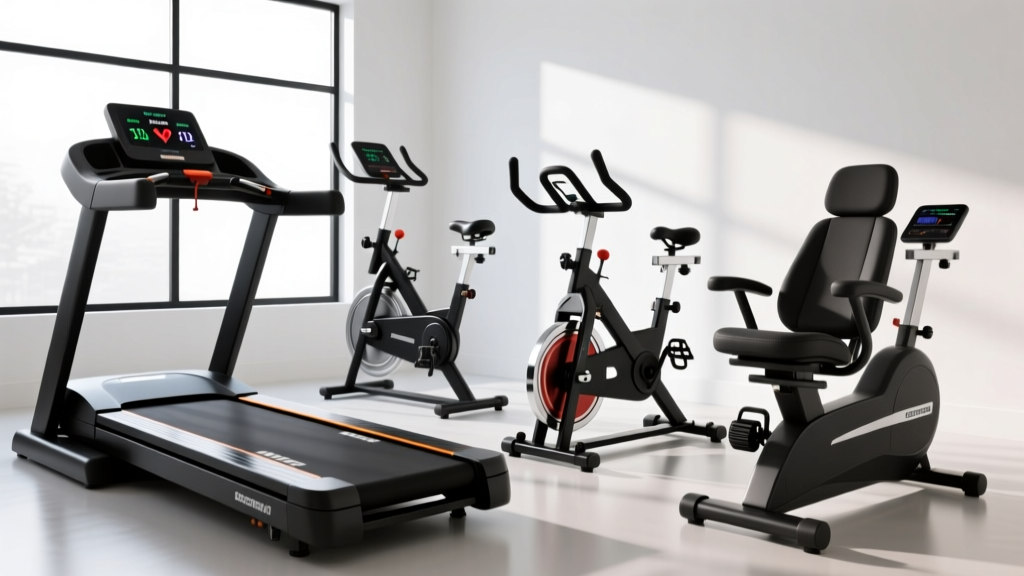
Top Stationary Bike Types in 2026: Moving Beyond the Treadmill Comparison Chart
Upright, recumbent, or spin? Our 2026 hands-on review of stationary bike types ditches the standard treadmill comparison chart to find your perfect match.

The Cardio Conundrum: Why We're Ditching the Standard Treadmill Comparison Chart
When most consumers begin outfitting a home gym, their first instinct is to pull up a standard treadmill comparison chart, compare motor horsepower, and drop $1,500 on a folding belt-runner. But as we move deeper into 2026, the fitness equipment industry has seen a massive paradigm shift toward low-impact, high-yield cardiovascular training. Treadmills demand over 70 square feet of floor space, generate 65+ decibels of noise, and subject the patellofemoral joint to forces equivalent to 2.5 times your body weight with every stride.
Stationary bikes—specifically upright, recumbent, and indoor spin cycles—offer a biomechanically superior alternative for longevity, rehabilitation, and high-intensity interval training (HIIT). In this hands-on review, we are throwing out the traditional treadmill comparison chart and breaking down the exact specifications, failure modes, and real-world performance of the three dominant stationary bike types to help you make an expert-level purchasing decision.
Upright Bikes: The Traditionalist's Workhorse
Upright bikes mimic the geometry of a standard outdoor bicycle but feature a heavier flywheel and a fixed gear or magnetic resistance system. They require a moderate core engagement to maintain posture and offer a smaller footprint than recumbent models.
Expert Insight: Biomechanics & Joint StressAccording to the Mayo Clinic's guidelines on aerobic exercise, upright cycling provides excellent cardiovascular conditioning while minimizing the impact stress associated with weight-bearing exercises. However, improper saddle height can increase patellar tendon strain by up to 30%. Always set your saddle so there is a 10-to-15-degree knee flexion at the bottom of the pedal stroke.
Hands-On Pick: Nautilus U618 Upright Bike
- Price: ~$699
- Flywheel Weight: 25 lbs (Perimeter-weighted)
- Step-Through Height: 15 inches
- Max User Weight: 325 lbs
The Good: The Nautilus U618 utilizes a perimeter-weighted flywheel that creates a highly inertial, smooth pedal stroke at higher cadences (90+ RPM). The dual-track LCD system integrates seamlessly with the JRNY app, offering adaptive workouts that adjust resistance in real-time based on your 2026 biometric data.
The Failure Mode: After 18 months of heavy use, the quick-release seat post clamp on earlier U618 models was prone to micro-slippage during out-of-the-saddle climbing. Nautilus has since upgraded to a dual-bolt aluminum collar in the 2025/2026 revisions, but if buying refurbished, inspect the seat post for scoring.
Recumbent Bikes: Ergonomic Salvation for Rehab and Longevity
Recumbent bikes place the rider in a reclined position with the pedals out in front. This geometry completely unloads the lumbar spine and shifts the muscular demand away from the quadriceps and onto the glutes and hamstrings. They are the undisputed champions of cardiac rehab and senior fitness.
Muscle Activation: Recumbent vs. Upright
| Muscle Group | Upright Bike Activation | Recumbent Bike Activation |
|---|---|---|
| Rectus Femoris (Quads) | High | Moderate |
| Gluteus Maximus | Moderate | High |
| Erector Spinae (Lower Back) | High (Stabilization) | Negligible (Fully Supported) |
| Semimembranosus (Hamstrings) | Low | Moderate-High |
Hands-On Pick: Schwinn 270 Recumbent Bike
- Price: ~$899
- Resistance Levels: 25 levels of ECB (Eddy Current Brake) magnetic resistance
- Seat Design: Vented lumbar mesh with 4-way adjustability
The Good: The Schwinn 270's step-through height is a mere 12 inches, making it accessible for users with severe hip or knee mobility restrictions. The vented mesh backrest prevents the heat buildup common in molded plastic seats, and the 300 lb weight capacity is supported by a reinforced steel cross-tube chassis.
The Failure Mode: The primary edge-case failure on the Schwinn 270 is drive belt squeak. Because the poly-V belt relies on an idler pulley for tension, dust accumulation in the shroud can cause slipping after roughly 1,200 miles. A quick blast of compressed air and a drop of silicone-based belt dressing resolves this instantly.
Spin & Indoor Cycles: The High-Intensity Powerhouse
Indoor cycles (spin bikes) are designed for performance, featuring aggressive road-bike geometry, infinite resistance dials, and heavy flywheels or advanced magnetic eddy-current systems. These are the machines of choice for Zone 2 endurance training and VO2 max intervals.
Warning: The Q-Factor TrapMany budget spin bikes under $600 feature a wide 'Q-factor' (the horizontal distance between the pedals) of 170mm or more to accommodate cheap, wide bottom brackets. This forces the knees outward, leading to IT band syndrome. Always look for a Q-factor between 150mm and 160mm to mimic natural outdoor cycling biomechanics.
Hands-On Pick: Keiser M3i Indoor Cycle
- Price: ~$2,295
- Drive System: Poly-V belt with magnetic eddy-current resistance
- Q-Factor: 150mm (Industry-leading road-bike replication)
- Frame: Anodized aluminum (Sweat-proof)
The Good: The Keiser M3i remains the gold standard in 2026 for commercial and high-end home gyms. Its V-shaped frame allows for micro-adjustments in saddle and handlebar height without the use of tools. The magnetic resistance is completely silent, and the Bluetooth FTMS protocol broadcasts power data (watts) to third-party apps like Zwift and TrainerRoad with less than 2% variance.
The Failure Mode: While the Keiser's aluminum frame is immune to the sweat corrosion that destroys cheap steel spin bikes, the media tray's plastic locking tab can become brittle if exposed to direct UV light from a nearby window over several years. Keep your M3i out of direct, unfiltered sunlight.
The Ultimate Stationary Bike vs. Treadmill Comparison Chart
Rather than relying on a generic treadmill comparison chart that ignores joint health and spatial constraints, we've built a matrix that pits the three bike types against a premium smart treadmill (the NordicTrack 1750) to give you a holistic view of your home gym investment.
| Metric | Upright (Nautilus U618) | Recumbent (Schwinn 270) | Spin (Keiser M3i) | Treadmill (NordicTrack 1750) |
|---|---|---|---|---|
| Footprint (Sq Ft) | 10.5 sq ft | 13.2 sq ft | 8.5 sq ft | 72.0 sq ft |
| Joint Impact | Very Low | Zero (Supported) | Very Low | High (2.5x Bodyweight) |
| Noise Output | ~45 dB (Whisper) | ~40 dB (Silent) | ~42 dB (Silent) | ~68 dB (Loud) |
| Max Caloric Burn (1hr) | ~600 kcal | ~450 kcal | ~850 kcal (HIIT) | ~750 kcal (Incline) |
| Maintenance Needs | Low (Dusting) | Moderate (Belt tension) | Low (Sweat wiping) | High (Deck lube, belt align) |
Expert Verdict: Which Bike Type Wins for Your Home Gym?
Your final decision should not be dictated by a generic treadmill comparison chart, but rather by your specific physiological needs and spatial limitations.
- Choose the Upright Bike (Nautilus U618) if you want a balanced, full-body cardiovascular workout that mimics outdoor cycling without the weather dependency, and you have a moderate budget of under $800.
- Choose the Recumbent Bike (Schwinn 270) if you are managing lumbar radiculopathy, recovering from lower-extremity joint surgery, or simply prefer to read and multitask while maintaining a steady-state Zone 2 heart rate.
- Choose the Spin Bike (Keiser M3i) if you are a data-driven athlete focused on FTP (Functional Threshold Power) improvements, HIIT protocols, and require a commercial-grade machine that will easily survive a decade of daily abuse.
By prioritizing biomechanical alignment, acoustic output, and long-term joint health over the outdated treadmill paradigm, you are investing in a cardiovascular tool that you will actually use for years to come. For more detailed guidance on optimizing your cardio routines, refer to the American Heart Association's physical activity recommendations to ensure your new equipment aligns with your weekly volume goals.
More gear to consider
All reviews
Maintaining Compact Treadmills for HIIT Treadmill Workouts
WalkingPad A1 Pro Foldable Walking Treadmill Review & Beginner Setup

Life Cycle Treadmill Maintenance: 2026 Belt Lubrication Trends
Non Electric Treadmill Comparison: AirRunner vs TrueForm (2026)

Which Is Better, a Treadmill or Exercise Bike? (Stair Climber Guide)