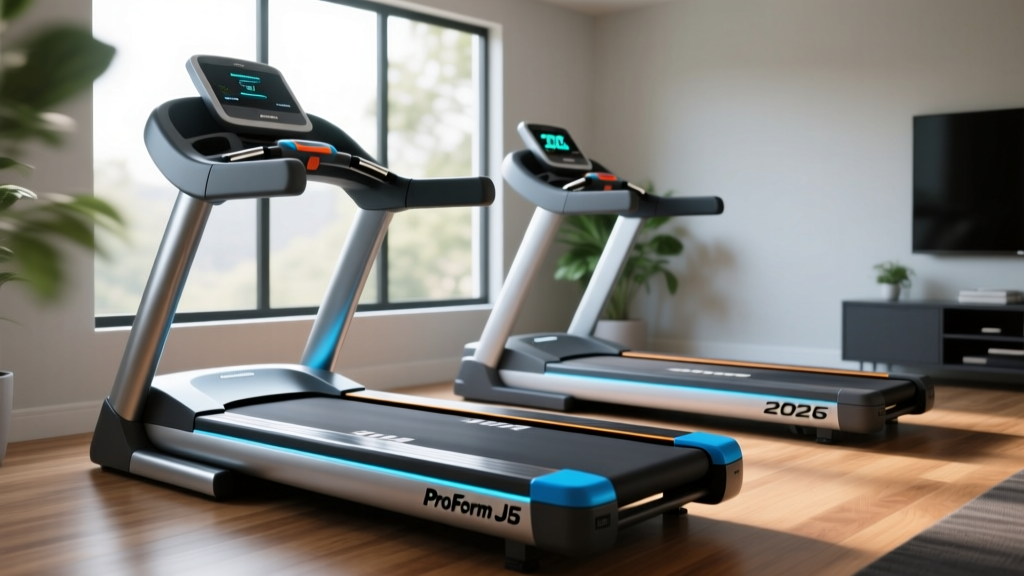
Curved vs Motorized: ProForm J6 Treadmill & 2026 Alternatives
Compare curved manual vs motorized treadmills. We benchmark the legacy ProForm J6 treadmill against 2026 alternatives to help you choose the right cardio machine.

The Great Debate: Curved Manual vs. Motorized Treadmills
The home cardio landscape in 2026 is defined by a distinct bifurcation: the biomechanical purity of curved manual treadmills versus the technological convenience of motorized decks. For buyers navigating this split, understanding the mechanical realities, long-term maintenance, and training specificity of each type is critical. To provide a grounded baseline for traditional motorized units, we are benchmarking against a legendary workhorse: the ProForm J6 treadmill. Though largely relegated to the secondary and refurbished markets today, the J6 remains the gold standard for evaluating budget-to-mid-tier motorized performance against modern curved alternatives like the AssaultRunner Elite and TrueForm Trainer.
Quick Decision Matrix
- Choose Curved Manual If: You prioritize HIIT, want zero motor maintenance, have a higher upfront budget ($2,500+), and prefer a natural, self-paced stride.
- Choose Motorized (ProForm J6 style) If: You are training for distance running (marathons), require exact pace enforcement, need automated incline/decline, or are working with a strict budget ($400–$800).
The Motorized Benchmark: Analyzing the ProForm J6 Treadmill Legacy
Released as a staple in the ProForm lineup, the ProForm J6 treadmill was engineered for steady-state cardio and accessible home fitness. To understand how it stacks up against modern curved machines, we must look at its exact hardware specifications, which remain highly relevant for anyone buying refurbished motorized units in 2026.
Core Specifications of the ProForm J6
- Motor: 2.5 CHP Mach Z Commercial Plus (continuous duty)
- Belt Dimensions: 18" x 55" (adequate for walking/jogging, tight for tall sprinters)
- Incline: 0% to 10% automated power incline
- User Capacity: 300 lbs
- Cushioning: ProShox shock absorption system
In 2026, a refurbished ProForm J6 treadmill typically sells between $400 and $650. Its modern equivalent, the ProForm Carbon TL, retails for around $599 new. The J6's 2.5 CHP motor is sufficient for users under 200 lbs engaging in moderate jogging (up to 8 mph). However, as noted in the Consumer Reports Treadmill Buying Guide, motors under 3.0 CHP often experience thermal throttling and premature belt wear when subjected to heavy users or sustained high-speed running. This is where the fundamental divergence from curved treadmills begins.
The Biomechanics of Curved Manual Treadmills
Curved manual treadmills, such as the TrueForm Trainer ($2,899) or the AssaultRunner Elite ($3,999), strip away the motor, relying entirely on human kinetics. The deck features a pronounced concave curve and a slatted rubber belt system. When you step forward and push down and back, gravity and the curve's geometry pull the belt downward and rearward.
Metabolic and Kinetic Advantages
Because there is no motor to assist with belt turnover, the user must overcome the inertia of the belt and their own body weight with every stride. Research into non-motorized curved treadmills indicates that users experience a significantly higher heart rate and greater caloric expenditure at the exact same perceived speed compared to motorized treadmills. According to Mayo Clinic guidelines on aerobic exercise intensity, maximizing muscle recruitment in the posterior chain (glutes and hamstrings) is vital for metabolic conditioning—a feat the curved deck naturally enforces by requiring a forceful push-off rather than a passive landing.
Expert Insight: On a motorized treadmill like the ProForm J6, the belt pulls your leg back, engaging the hip flexors. On a curved treadmill, you must actively drive the belt back, heavily recruiting the glutes and hamstrings. This makes curved decks superior for sprint mechanics and posterior chain development.
Head-to-Head Comparison Matrix
Below is a detailed structural and functional comparison between a legacy motorized unit, a modern smart motorized unit, and a premium curved manual treadmill.
| Feature | Legacy Motorized (ProForm J6) | 2026 Smart Motorized (NordicTrack 1750) | Curved Manual (AssaultRunner Elite) |
|---|---|---|---|
| Power Source | 2.5 CHP Electric Motor | 3.5 CHP Electric Motor | 100% Human Kinetic Energy |
| Top Speed | 10 mph (Motor limited) | 12 mph (Motor limited) | Unlimited (User limited) |
| Incline/Decline | 0% to 10% Incline | -3% to 15% Auto-Adjust | Fixed Curve (Simulates ~8%) |
| Belt Type | 1-ply PVC (Requires silicone lube) | 2-ply Commercial (Requires lube) | Rubber Slat (Zero lubrication) |
| 2026 Market Price | $400 - $650 (Refurbished) | $2,499 (New + Sub) | $3,999 (New) |
| Footprint | 73" L x 30" W | 80" L x 38" W | 63" L x 33" W (Compact) |
Failure Modes and Maintenance Realities
When investing in cardio equipment, understanding how the machine will eventually fail is just as important as its out-of-the-box performance. The maintenance profiles of motorized versus curved treadmills are diametrically opposed.
Motorized Treadmill Failure Points
On units like the ProForm J6 treadmill, the primary failure points are electrical and friction-based. The Motor Controller Board (MCB) is highly susceptible to voltage spikes and heat degradation. If a user consistently exceeds the 300 lb weight capacity or runs at high inclines for hours, the MCB will overheat and fry, a replacement that typically costs $150–$250. Furthermore, the traditional PVC belt requires quarterly silicone lubrication. Neglecting this increases the coefficient of friction between the belt and the wooden deck, forcing the motor to draw excess amperage, which accelerates motor burnout. Finally, the incline gear mechanism utilizes plastic cogs that can strip under heavy, dynamic load changes.
Curved Manual Treadmill Failure Points
Curved treadmills eliminate the motor, MCB, and incline gears, drastically reducing electrical failures. However, they introduce mechanical wear points. The slat belt rides on dozens of individual ball bearings. Over 3 to 5 years of heavy use, these bearings can degrade, leading to a gritty, uneven belt feel. Replacing a slat belt on an AssaultRunner or TrueForm is a labor-intensive process and the part alone costs upwards of $600. Additionally, the frame welds on cheaper curved knock-offs are known to micro-fracture under the extreme torque generated by repetitive heavy sprinting.
Training Specificity: Matching the Machine to Your Protocol
According to ExRx Treadmill Testing Protocols, the validity of cardiovascular testing and training relies heavily on pacing consistency and biomechanical translation. Your specific training goals should dictate your purchase.
1. Marathon and Distance Pacing (Winner: Motorized)
If you are training for a marathon or half-marathon, you must condition your body to hold an exact, unyielding pace for hours. A motorized treadmill enforces this pace. If you fatigue on a ProForm J6, the belt keeps moving, forcing you to maintain your cadence or step off. Furthermore, modern motorized units offer decline features to condition the quadriceps for downhill running—a physical demand a curved manual treadmill simply cannot replicate.
2. HIIT, CrossFit, and Sprint Intervals (Winner: Curved)
For high-intensity interval training (HIIT), curved treadmills are unmatched. On a motorized treadmill, sprint intervals require you to wait 5 to 10 seconds for the motor to spool up to 10 mph, and another 10 seconds to spool down. This ruins the work-to-rest ratio of a Tabata or sprint protocol. On a curved manual treadmill, acceleration and deceleration are instantaneous. You drive the belt to top speed in two strides and can stop it instantly by stepping on the side rails.
3. Zone 2 LISS and Walking Pads (Winner: Motorized)
For Low-Intensity Steady State (LISS) cardio, such as walking at 3 mph while working at a standing desk, a motorized treadmill or a dedicated under-desk walking pad is vastly superior. Walking on a curved treadmill requires an exaggerated forward lean and higher knee drive to keep the belt moving, which feels unnatural and fatiguing at very slow walking speeds.
Frequently Asked Questions
Is the ProForm J6 treadmill still worth buying in 2026?
Yes, but only on the secondary market. If you can find a well-maintained, refurbished ProForm J6 for under $500, it remains an excellent, no-nonsense motorized deck for walking and light jogging. For heavy running or smart-screen integration, you should look at modern equivalents like the ProForm Carbon TL or NordicTrack T Series.
Do curved treadmills really burn 30% more calories?
Yes, clinical studies have shown that the lack of motor assistance and the slight uphill geometry of the curve force greater muscle recruitment, resulting in up to a 30% higher caloric burn at the same perceived exertion level compared to a flat motorized deck.
Can I do downhill running training on a curved treadmill?
No. Curved treadmills only simulate an uphill grade (typically around 6% to 8% equivalent). For downhill eccentric quad conditioning, you must use a motorized treadmill with an active decline feature (usually -3% to -6%).
More gear to consider
All reviews
Under Desk Treadmill Office Review & Curved Treadmill Pros and Cons

Cybex 625 Treadmill vs Portable Cardio: Top Compact Picks 2026

How to Start a Precor Treadmill & Review Under Desk Office Options
Air Bike vs Assault Bike: Weighing Treadmill Uses Advantages in 2026

Under Desk Treadmill in Living Room Spaces: 2026 Budget Guide
