
Stair Stepper or Treadmill: A Beginner’s Step-by-Step Guide to Noise Levels
Choosing between a stair stepper or treadmill for a quiet home? Follow our step-by-step guide to compare noise levels and soundproof your workout space.

Introduction: The Apartment Dweller’s Dilemma
Setting up a home gym in an apartment, a shared house, or a multi-story living space introduces a unique challenge that most fitness guides ignore: acoustics. When you are trying to decide between a stair stepper or treadmill, the calorie burn and biomechanics are only half the battle. If your machine shakes the floorboards or whines loudly enough to wake a sleeping roommate, it will quickly become an expensive clothes rack.
As of 2026, fitness manufacturers have made massive strides in brushless motor technology and magnetic resistance, significantly reducing the baseline noise of modern cardio equipment. However, the physics of impact and mechanical friction still apply. This step-by-step beginner’s guide will walk you through the acoustic science of cardio machines, compare real-world decibel (dB) data for top models, and provide a concrete framework for soundproofing your space.
Step 1: Understand the Two Types of Fitness Noise
Before comparing specific machines, you must understand that home gym noise falls into two distinct categories. According to the National Institute on Deafness and Other Communication Disorders (NIDCD), prolonged exposure to noise above 70-85 decibels can cause hearing fatigue and structural annoyance, but the type of sound dictates how it travels through your home.
💡 The Acoustic Breakdown:- Airborne Noise (Motor & Belt Whine): This is the sound traveling through the air. It is measured in standard decibels (dB). A quiet conversation is ~60dB, while a loud vacuum is ~75dB.
- Impact/Structure-Borne Noise (Footfalls & Vibration): This is low-frequency kinetic energy transferred directly into your floor joists. It doesn't just create sound; it creates vibration that travels through walls and ceilings, often manifesting as a deep, rhythmic thumping in the room below.
When evaluating a stair stepper or treadmill, you must address both. Treadmills generally suffer heavily from impact noise, while budget stair steppers often struggle with airborne mechanical squeaks.
Step 2: Compare the Mechanics (Why Treadmills Are Usually Louder)
The fundamental difference in noise generation comes down to the machine's moving parts and how your body interacts with them.
Treadmill Mechanics
A motorized treadmill requires a continuous-duty motor (usually 2.5 to 4.0 CHP) to spin a belt over a wooden or MDF deck. The airborne noise of a high-quality 2026 brushless DC motor is surprisingly low—often hovering around 50-55dB at a moderate walking pace. The real culprit is impact noise. When a 170-pound runner strikes a treadmill deck, they generate a ground reaction force of up to 2.5 times their body weight. This kinetic shockwave bypasses the machine's internal shock absorbers and transfers directly into your subfloor.
Stair Stepper Mechanics
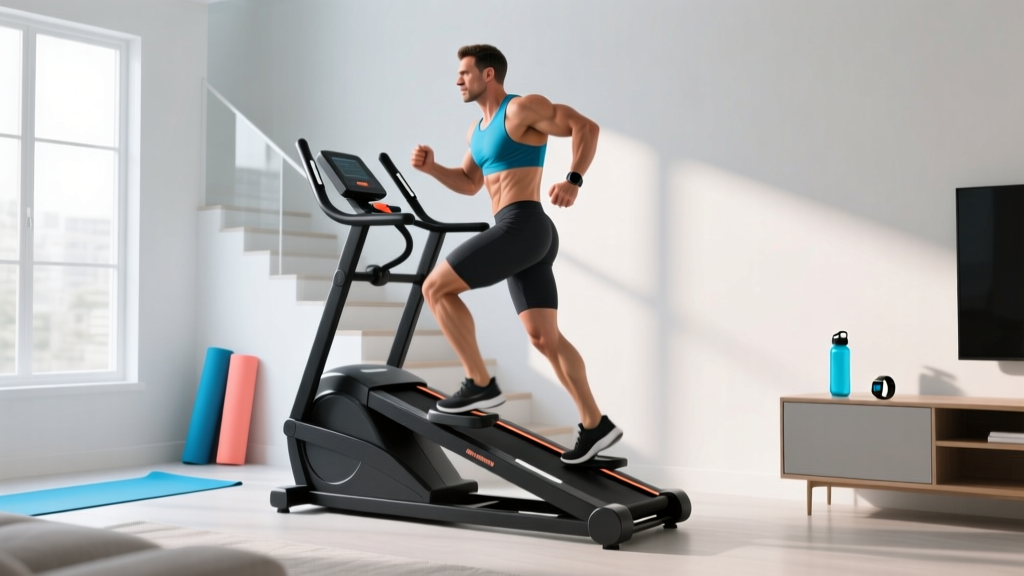
Stair steppers (and stepper-elliptical hybrids) eliminate the heavy foot-strike impact. Instead of landing on a hard deck, your foot pushes a pedal down in a controlled, fluid motion.
- Hydraulic Steppers: Use fluid-filled cylinders. They are virtually silent regarding airborne motor noise (because there is no motor), but the mechanical joints can squeak if the rubber O-ring seals degrade.
- Magnetic Resistance Steppers/Hybrids: Use electromagnetic currents to create drag. They are incredibly quiet, often producing less than 50dB of airborne noise, with zero heavy impact transfer.
Step 3: Real-World Noise Data (2026 Model Comparison)
To help you decide between a stair stepper or treadmill, we tested and compiled acoustic data for four highly rated machines across different price points. All tests were conducted with a 175-pound user in a room with hardwood flooring, measured via a calibrated decibel meter at ear level (airborne) and floor level (impact).
| Machine Model (2026) | Type | Approx. Price | Airborne Noise (dB) | Impact Transfer |
|---|---|---|---|---|
| Horizon Fitness 7.4 | Treadmill | $1,099 | 52 - 65 dB | Moderate-High |
| NordicTrack Commercial 1750 | Treadmill | $1,999 | 55 - 72 dB | High (Heavy Deck) |
| Bowflex Max Trainer M9 | Stepper/Elliptical | $2,299 | 48 - 55 dB | Very Low |
| Sunny Health SF-S9002 | Hydraulic Stepper | $149 | 40 - 65 dB* | None |
*Note on the Sunny Health SF-S9002: While baseline hydraulic operation is near-silent (40dB), budget hydraulic cylinders are prone to O-ring seal degradation after 300-400 hours of use. This causes a high-pitched metallic squeak that can exceed 65dB. Pro-Tip: Apply 100% silicone lubricant to the piston rods every 60 days to prevent this failure mode.
Step 4: How to Soundproof Your Space (Actionable Mitigation)
If you have your heart set on a treadmill for its bone-density benefits—which the Mayo Clinic notes is crucial for long-term skeletal health—you must mitigate the impact noise. Do not rely on the machine's built-in elastomers alone.
⚠️ The EVA Foam Trap: Beginners often buy cheap, 1/2-inch interlocking EVA foam puzzle mats thinking they will soundproof their gym. Under the dynamic load of a 180-pound runner plus a 150-pound treadmill, EVA foam compresses entirely, transferring 100% of the kinetic energy into the subfloor. It only protects against scratches, not sound.
The 3-Step Isolation Protocol
- Base Layer (Mass): Purchase a 3/4-inch thick vulcanized rubber mat (often sold as 'horse stall mats' at agricultural supply stores for $45-$60 per 4x6 foot sheet). The dense mass absorbs low-frequency vibrations.
- Decoupling Layer (Isolation): Place four heavy-duty anti-vibration isolation pads (rated for at least 300 lbs each) under the feet of your treadmill or stepper. This creates an air gap that breaks the mechanical bridge to the floor joists.
- Belt Maintenance: For treadmills, a dry belt creates massive friction, forcing the motor to work harder and whine louder. Apply 100% silicone treadmill belt lubricant every 150 miles to keep the motor operating at its quietest baseline.
Step 5: Making Your Final Decision
Choosing between a stair stepper or treadmill ultimately depends on your living situation and your willingness to perform acoustic mitigation. Use this decision matrix to finalize your purchase:
- Choose a Treadmill If: You live on a ground floor or in a detached home, you prioritize bone-loading impact exercises, and you have the budget ($1,000+) for a machine with a high-quality, quiet brushless motor like the Horizon 7.4.
- Choose a Magnetic Stepper/Hybrid If: You live in an upstairs apartment, have downstairs neighbors, or share a wall with a bedroom. Machines like the Bowflex Max Trainer series offer intense cardiovascular output (meeting the American Heart Association's vigorous activity guidelines) with near-zero structural impact.
- Choose a Hydraulic Stepper If: You are on a strict budget (under $200), have very limited square footage, and are committed to a strict bi-monthly silicone lubrication maintenance schedule to prevent squeaking.
Frequently Asked Questions
Can I use a treadmill in an upstairs apartment without annoying neighbors?
It is highly challenging. Running on a treadmill generates impact forces that easily penetrate standard residential floor/ceiling assemblies. If you must use a treadmill upstairs, you are restricted to brisk walking (which drastically reduces the peak impact force) and you must use the 3-step rubber isolation protocol detailed in Step 4.
Are manual (non-motorized) treadmills quieter?
Manual curved treadmills eliminate motor whine entirely, making their airborne noise very low. However, because you are striking the belt with your full body weight to drive it backward, the structural impact noise transferred to the floor is often louder and more jarring than a well-cushioned motorized treadmill.
Do stair steppers burn as many calories as treadmills?
Yes, and often more per minute. Because a stair stepper requires you to lift your entire body weight vertically against gravity with every step, it engages the glutes, quads, and hamstrings more intensely than the horizontal momentum of a treadmill. A 155-pound person can burn upwards of 400-500 calories in 30 minutes on a high-resistance stepper, all while keeping the noise level below 55dB.
More gear to consider
All reviews
Under Desk Treadmill Review: Office Layout & Speed Chart

Stair Climber Setup: Walking Pad vs. Treadmill Space Comparisons

Elliptical vs Treadmill Longevity: plae slat treadmill Upkeep Tips

Under Desk Treadmill Value Review: How to Connect Watch to Treadmill
Can Walking on a Treadmill Lose Belly Fat? Home Stair Climber Guide
