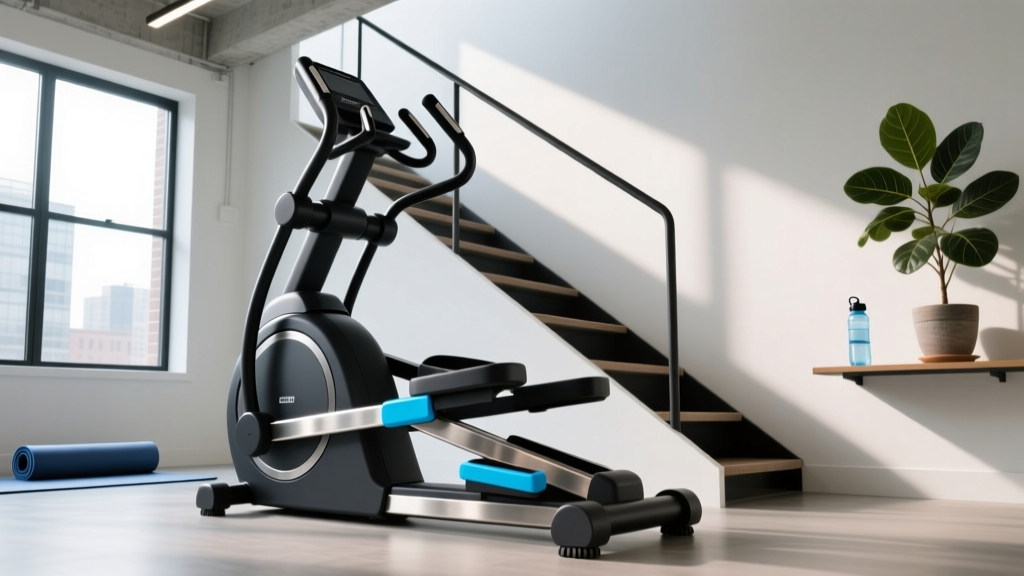
Stair Climber vs AFG 3.1 AT Treadmill: 2026 Home Guide
Compare top 2026 stair climbers with the AFG 3.1 AT treadmill. Discover which home cardio machine fits your space, budget, and fitness goals.

The 2026 Home Cardio Crossroads: Vertical vs. Incline Training
When designing a home gym in 2026, space optimization and biomechanical efficiency are paramount. Fitness enthusiasts frequently debate the merits of vertical stepping versus incline walking. Specifically, buyers often weigh the compact, high-intensity profile of a dedicated stair climber against the versatile, joint-friendly mechanics of an incline treadmill like the highly rated AFG 3.1 AT Treadmill. Both modalities satisfy the CDC physical activity guidelines for cardiovascular health, but they deliver vastly different physiological stimuli, spatial footprints, and long-term maintenance requirements.
This comprehensive buying guide dissects the biomechanics, real-world failure modes, and spatial demands of stair climbers compared to the AFG 3.1 AT Treadmill, providing a concrete decision framework for your home fitness investment.
Quick Decision Framework
- Choose a Stair Climber if: You have limited floor space (under 6 sq. ft.), prioritize aggressive glute/quad hypertrophy, and prefer high-intensity interval training (HIIT) over steady-state cardio.
- Choose the AFG 3.1 AT Treadmill if: You require a low-impact, steady-state walking/jogging surface, need to accommodate multiple users with varying fitness levels, and have at least 18 sq. ft. of dedicated floor space.
Biomechanical Breakdown: Step Mill vs. Incline Treadmill
To understand which machine yields better results, we must examine the kinesiology of the movements. According to the ExRx kinesiology database, stair climbing is a closed-kinetic-chain exercise that demands continuous concentric and eccentric muscle contractions against gravity.
The AFG 3.1 AT Treadmill Profile
The Horizon Fitness AFG 3.1 AT (Advanced Training) Treadmill is engineered for versatility. It features a robust 3.0 CHP Johnson Digital Drive motor and a 20-inch by 55-inch tread belt. Its standout feature for cardio purists is the 0-15% motorized incline. Walking at 3.5 mph on a 15% incline elevates the heart rate into Zone 3 or Zone 4 for most adults, closely mimicking the caloric expenditure of a light jog on a flat surface, but with significantly reduced ground reaction forces (GRF) on the tibiofemoral joint. The 3.1 AT's 55-inch belt length comfortably accommodates a full walking stride, which is critical for users over 5'10".
The Stair Climber Muscle Engagement
Stair climbers (both step mills and hydraulic mini-steppers) isolate the lower body posterior and anterior chains. The primary movers are the gluteus maximus, quadriceps (vastus lateralis and medialis), and the calf complex (gastrocnemius and soleus). Because the user must lift their entire body weight against gravity with every single step, the metabolic demand per minute is exceptionally high. A 2026 clinical review of cardio modalities shows that 20 minutes of vigorous stair climbing can match the caloric burn of 35-40 minutes of moderate incline treadmill walking. However, this comes at the cost of higher localized muscle fatigue and greater patellofemoral joint compression.
Top Stair Climbers for Home Use (2026 Market Matrix)
If your space constraints or hypertrophy goals dictate a stair climber, you must choose the right class of machine. Full-size step mills (like the commercial StairMaster FreeClimber) cost upwards of $4,500 and require 9-foot ceilings. For residential use, compact stair climbers and hybrid stepper-ellipticals dominate the 2026 market. Below is a comparison of the top residential models, contrasted against the AFG 3.1 AT Treadmill.
| Model | Type | Footprint (L x W) | Drive / Resistance | Max User Weight | 2026 Est. Price |
|---|---|---|---|---|---|
| AFG 3.1 AT Treadmill | Incline Treadmill | 73" x 34" | 3.0 CHP Motor / Belt | 325 lbs | $1,399 |
| Bowflex Max Trainer M9 | Hybrid Stepper | 49" x 30" | Magnetic Eddy Current | 300 lbs | $2,199 |
| Sunny Health SF-S911 | Hydraulic Mini-Stepper | 17" x 14" | Hydraulic Cylinders | 250 lbs | $429 |
| Xiser Commercial Mini Stepper | Cast Alloy Stepper | 21" x 14" | Pneumatic / Alloy | 300 lbs | $419 |
Real-World Maintenance and Failure Modes
Consumer reviews often ignore the mechanical realities of owning cardio equipment. As domain experts, we evaluate machines based on their 3-to-5-year failure modes and maintenance overhead.
Treadmill Maintenance: The AFG 3.1 AT
The AFG 3.1 AT Treadmill is a motorized belt system. The most common point of failure in any treadmill is the deck-belt friction interface. If the silicone lubricant dries out, the static friction increases, forcing the 3.0 CHP motor to draw excess amperage. This can trip the thermal overload switch or fry the lower control board. Pro Tip: You must lift the belt and apply 100% silicone lubricant to the deck every 150 miles or every 3 months. Additionally, the AFG 3.1 AT features a folding mechanism; the hydraulic shock assist cylinder should be inspected annually for seal leaks.
Stair Climber Maintenance: Hydraulic vs. Magnetic
Cheaper hydraulic mini-steppers (like the Sunny SF-S911) rely on fluid-filled cylinders. The most frequent edge-case failure is O-ring seal degradation. When the hydraulic fluid overheats during a prolonged 45-minute HIIT session, the internal pressure can blow the O-ring, resulting in fluid leaking onto your floor and a sudden loss of piston resistance. To prevent this, limit hydraulic stepper sessions to 20-25 minutes. Conversely, magnetic resistance climbers like the Bowflex M9 use an eddy current brake system. These are virtually maintenance-free, lacking the friction parts and fluids that degrade over time, justifying their premium $2,000+ price tag.
"The American Heart Association recommends at least 150 minutes of moderate-intensity aerobic activity per week. Whether you achieve this via the 15% incline on the AFG 3.1 AT or through daily 15-minute stair climbing intervals, consistency and joint preservation are the ultimate metrics of success." — American Heart Association Guidelines
Spatial and Acoustic Considerations for Home Gyms
Before purchasing, you must measure your space and consider acoustic transfer, especially in multi-story homes or apartments.
- Ceiling Clearance: The AFG 3.1 AT has a low step-up height of roughly 8 inches. A stair climber, however, adds significant vertical displacement. If you are 6'0" and using a step mill or hybrid stepper that elevates you 14 inches at the peak of the stride, you need a minimum ceiling height of 7'6" to avoid head strikes.
- Acoustic Footprint: The AFG 3.1 AT's motor produces a low-frequency hum (around 55-60 dB), but footfalls on the deck can transmit impact noise to the floor below. A high-density rubber equipment mat is mandatory. Hydraulic stair climbers are virtually silent, producing only a faint 'whoosh' of fluid, making them the superior choice for shared-wall apartments or late-night workouts.
- Power Requirements: The AFG 3.1 AT requires a dedicated 120V, 15-amp circuit. Plugging it into a shared circuit with a space heater or microwave will trip the breaker. Most magnetic and hydraulic stair climbers are either self-generating or draw negligible power via standard AC adapters.
Expert Verdict: Which Machine Should You Buy?
The decision between a stair climber and the AFG 3.1 AT Treadmill ultimately hinges on your primary fitness objective and spatial constraints. If your goal is long-duration, low-impact fat oxidation, active recovery, or training for outdoor hiking and walking events, the AFG 3.1 AT Treadmill is the undisputed champion. Its 15% incline and 55-inch belt provide a safe, scalable, and highly effective training environment that accommodates users from beginners to advanced marathoners.
However, if your goal is rapid lower-body muscle endurance, aggressive glute activation, and maximizing caloric burn in under 20 minutes a day, a high-quality magnetic stair climber (like the Bowflex M9) or a heavy-duty cast-alloy mini-stepper will serve you better. They demand a fraction of the floor space, operate silently, and deliver a localized muscular burn that an incline treadmill simply cannot replicate.
Frequently Asked Questions
Q: Can I use the AFG 3.1 AT Treadmill for running?
A: Yes, the 3.1 AT reaches speeds up to 12 mph. However, the 55-inch belt length is optimized for walking and light jogging. Users over 6'1" may find their stride slightly restricted during all-out sprints compared to commercial 60-inch belts.
Q: Are hydraulic stair climbers bad for your knees?
A: Not inherently, but improper form can cause issues. Users often lean heavily on the handlebars, which shifts the center of gravity and alters the knee-tracking angle, increasing patellar tendon strain. Always stand upright and engage your core, using the handles only for balance.
Q: How often should I recalibrate the incline on the AFG 3.1 AT?
More gear to consider
All reviews
Rowing Machine Setup: Beating the Treadmill Test Singapore Standards

Is WellFit a Good Treadmill for Compact Spaces? Belt Care Guide

Can You Train for a Half Marathon on a Treadmill? A Noise Test

Stationary Bike Types Care & Silicone-Based Treadmill Lubricant Tips

Stair Climber Setup Guide: Pairing With a Dumbbell Rowing Machine