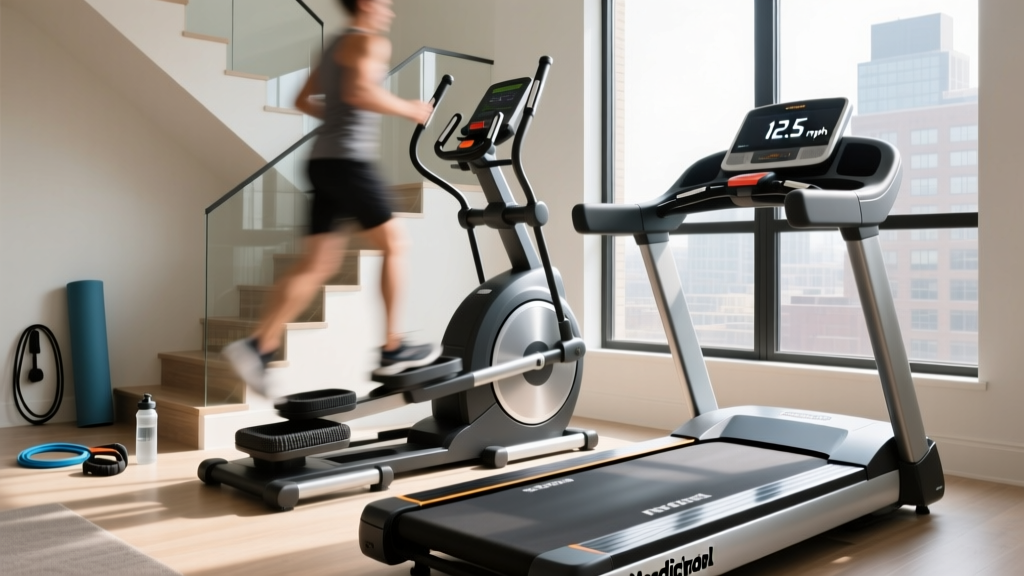
Sole F60 Treadmill vs Rowers: Beginner Buying & Technique Guide
Deciding between the Sole F60 treadmill and a rowing machine? Explore our beginner-friendly rowing buying guide, technique steps, and cardio comparison.

The Cardio Crossroads: Sole F60 Treadmill vs. Rowing Machines
When outfitting a home gym, beginners often gravitate toward the Sole F60 treadmill. It is a formidable piece of equipment, boasting a 3.0 CHP motor, a spacious 20-inch by 60-inch running belt, and a cushioned deck that reduces joint impact. Priced around $1,199, it is a staple for walkers and joggers. However, as fitness enthusiasts look for more time-efficient, full-body cardiovascular workouts, the rowing machine has emerged as a powerful alternative.
If you are weighing the benefits of the Sole F60 treadmill against investing in your first rowing machine, you are not alone. While treadmills excel at lower-body endurance and bone-density loading, rowing machines engage 86% of the body's musculature. According to the Cleveland Clinic, rowing provides a uniquely efficient combination of cardiovascular conditioning and muscular endurance without the repetitive impact forces associated with running.
This guide will help you decide if a rower is right for you, provide a comprehensive rowing machine buying guide, and break down beginner-friendly rowing technique step-by-step.
Quick Comparison: Sole F60 Treadmill vs. Mid-Range Rower (Concept2 RowErg)
| Feature | Sole F60 Treadmill | Concept2 RowErg (Standard) |
|---|---|---|
| Primary Muscle Focus | Lower Body (Calves, Quads, Glutes) | Full Body (60% Legs, 30% Core, 10% Arms) |
| Joint Impact | Low-Medium (Cushioned Deck) | Zero Impact (Seated, Fluid Motion) |
| Footprint (In Use) | 77' x 35' (Requires vertical clearance) | 96' x 24' (Can be stored vertically) |
| Average Price (2026) | $1,199 | $990 |
| Calorie Burn (155lb person, 30 min) | ~288 calories (5.0 mph jog) | ~252 calories (Moderate effort) |
Note: Calorie estimates based on Harvard Health Publishing metabolic equivalents. Rowing calorie burn scales exponentially with effort intensity.
The Ultimate Beginner Rowing Machine Buying Guide
If you decide that the full-body engagement of a rower outweighs the walking/jogging familiarity of the Sole F60 treadmill, you need to know what to look for. The rowing machine market is flooded with cheap, poorly engineered models that can cause lower back pain. Here is how to buy the right machine.
1. Choose Your Resistance Type
- Air Resistance: The gold standard for performance. The harder you pull, the more resistance the flywheel generates. They are virtually indestructible but can be noisy. Top Pick: Concept2 RowErg ($990).
- Magnetic Resistance: Uses magnets to create drag. These are nearly silent and offer precise, adjustable resistance levels, making them ideal for apartments. Top Pick: Echelon Smart Rower ($599).
- Water Resistance: Uses a water-filled tank to simulate the feel and sound of rowing on a lake. They offer beautiful aesthetics and smooth catch phases, but require water purification tablets and lack digital drag precision. Top Pick: WaterRower Natural ($1,595).
2. Check the Rail Length and Inseam Limits
One of the most common beginner mistakes is buying a budget rower with a short slide rail. If you are taller than 5'10', you must check the maximum inseam capacity. Budget models under $300 often cap out at a 34-inch inseam, meaning your knees will hit the monitor before you reach the full 'catch' position. The Concept2 RowErg accommodates up to a 38-inch inseam on the standard rail, and offers an extended rail option for up to a 40-inch inseam.
3. Understand the Performance Monitor
Do not buy a machine based on 'preset workout programs.' Instead, look for a monitor that tracks Split Time per 500m and Stroke Rate (SPM). These two metrics are the universal language of rowing and will allow you to follow along with thousands of free online workouts.
Expert Buying Tip: Ignore the 'calories per hour' metric on rowing monitors. It is notoriously inaccurate across different brands. Focus strictly on your 500m split time and wattage output to measure true progress.
Step-by-Step Rowing Technique for Beginners
Unlike the Sole F60 treadmill, where you simply step on and press start, rowing requires technical proficiency. Poor form on a rower will quickly lead to lumbar strain. According to the Concept2 technique guide, the stroke is broken down into four distinct phases. Memorize this sequence: Legs, Core, Arms (on the drive) and Arms, Core, Legs (on the recovery).
Step 1: The Catch (The Setup)
- Sit with your shins completely vertical (do not let your knees travel over your toes).
- Hinge forward from the hips so your torso is at an 11 o'clock angle.
- Keep your arms completely straight, shoulders relaxed, and grip the handle lightly with your fingers (not a death grip).
Step 2: The Drive (The Power Phase)
- Legs: Push explosively through your heels. Your arms and core remain locked in the 'Catch' position.
- Core: Once your legs are about 75% extended, swing your torso from 11 o'clock to a 1 o'clock angle.
- Arms: Finally, draw the handle into your lower ribs (just below the sternum), keeping your elbows tucked close to your body.
Step 3: The Finish
- Your legs are fully extended (but not locked out).
- Your torso is leaning back slightly at 1 o'clock.
- The handle is resting lightly against your lower ribs.
Step 4: The Recovery (The Reset)
- Arms: Extend your arms fully forward first.
- Core: Hinge forward from the hips, returning your torso to the 11 o'clock angle.
- Legs: Once the handle has cleared your knees, bend your knees and slide back to the Catch position.
Common Form Mistakes to Avoid
1. Shooting the Slide
This happens when you push with your legs but forget to engage your core, causing your hips to shoot forward while your upper body stays behind. This puts massive shear force on your lower back. Fix: Ensure your torso and hips move together during the first half of the drive.
2. Rowing at Too High of a Stroke Rate
Beginners often think faster is better, rowing at 28-32 Strokes Per Minute (SPM) with tiny, weak movements. Fix: Slow down. Set your target to 18-22 SPM. Focus on applying maximum wattage during the Drive, and use the Recovery to rest. Rowing is about power per stroke, not stroke frequency.
3. Setting the Damper to 10
The damper lever on the side of an air rower is not a 'difficulty dial.' Setting it to 10 is like riding a bicycle in the heaviest gear; it will exhaust your muscles before your cardiovascular system gets a workout. Fix: Set the damper between 3 and 5. This mimics the drag factor (110-130) of a real racing shell on water.
Your First 4 Weeks: A Beginner Rowing Plan
Transitioning from a treadmill to a rower requires conditioning your back and grip muscles. Follow this 4-week progression to build endurance safely.
- Week 1 (Form Focus): 10 minutes continuous rowing at 18 SPM. Focus entirely on the 'Legs-Core-Arms' sequence. Rest for 2 minutes, then repeat once.
- Week 2 (Aerobic Base): 15 minutes continuous rowing at 20 SPM. Aim to hold a consistent 500m split time. Do not sprint.
- Week 3 (Introduction to Intervals): 5-minute warmup. Then, 5 rounds of: 1 minute hard effort (24 SPM), 1 minute easy paddling (18 SPM). 5-minute cooldown.
- Week 4 (The Benchmark): Row a single 2000-meter distance for time. Record your finish time and average split. This is your baseline to beat in the coming months.
Final Verdict: Which Machine Belongs in Your Home Gym?
If your primary goal is to train for a 5K, improve bone density through weight-bearing impact, or you simply prefer the passive nature of walking while watching TV, the Sole F60 treadmill remains an elite, reliable choice. Its heavy-duty frame and advanced cushioning make it a worthwhile long-term investment for lower-body cardio.
However, if you are short on time, suffer from joint pain, or want to build functional posterior-chain strength (glutes, hamstrings, and back) while elevating your heart rate, a rowing machine is the superior tool. By following the buying parameters and technique steps outlined above, you can safely harness the full-body power of the rower and transform your home fitness routine in 2026 and beyond.
More gear to consider
All reviews
2026 Portable Cardio Trends: Treadmill Speed for a 9 Minute Mile

Curved Manual vs Motorized: Is the Knox Treadmill Right for You?

Under Desk Treadmill Review: Maintenance & Air Treadmill Upkeep
What's Better a Treadmill or an Elliptical? 2026 Folding Reviews
Treadmill Versus Bike: Belt Maintenance Costs & Value Analysis