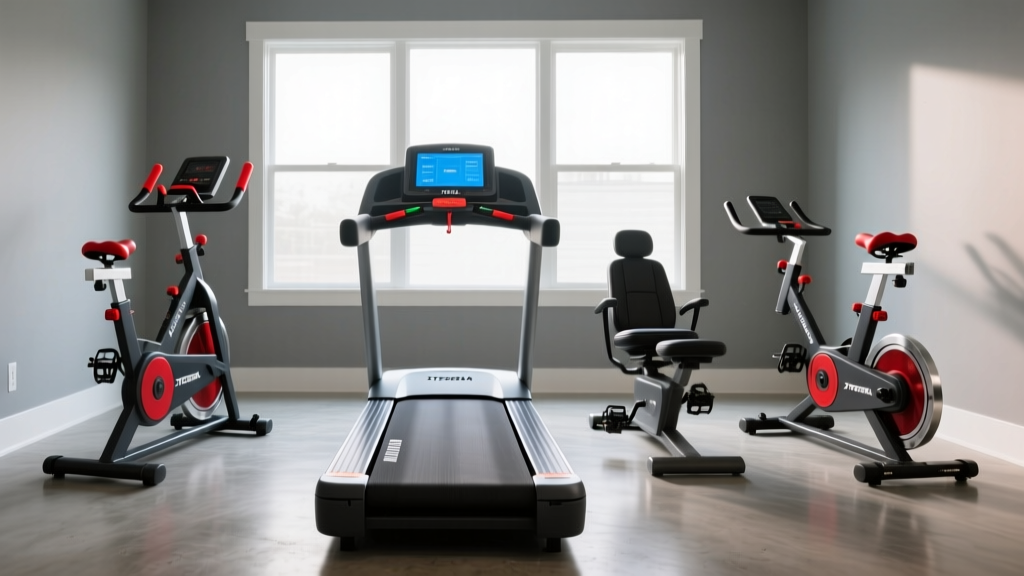
XTERRA 6.6 Treadmill vs Stationary Bikes: Budget & Value
Compare the XTERRA 6.6 treadmill against upright, recumbent, and spin bikes. We break down costs, ROI, and long-term value for your home gym.

The 2026 Home Gym Dilemma: Treadmill vs. Stationary Bikes
Allocating a $700 to $900 budget for home cardio equipment requires a ruthless analysis of long-term value, space efficiency, and biomechanical return on investment (ROI). As of early 2026, supply chain stabilization has normalized prices across the fitness industry, bringing mid-tier machines into direct competition. A prime example is the XTERRA 6.6 treadmill, a popular budget-friendly walking and light-jogging machine, which frequently goes head-to-head with the three primary stationary bike types: upright, recumbent, and spin (indoor cycles).
This budget breakdown and value analysis dissects the upfront costs, hidden maintenance fees, and caloric ROI of the XTERRA 6.6 treadmill compared to stationary bike types to help you maximize your home gym investment.
Quick Budget Snapshot (2026 MSRP)
- XTERRA 6.6 Treadmill: $699 (Motorized, folding deck)
- Upright Bike (e.g., Schwinn 170): $599 (Magnetic resistance)
- Recumbent Bike (e.g., Nautilus R618): $799 (Step-through, lumbar support)
- Spin/Indoor Cycle (e.g., Schwinn IC4): $799 (Belt-drive, dual-sided pedals)
Deep Dive: The XTERRA 6.6 Treadmill Value Proposition
The XTERRA 6.6 treadmill targets the entry-level motorized market. Priced around $699, it features a 2.5 CHP continuous-duty motor, a 20-inch by 55-inch running surface, and a 300-pound weight capacity. From a pure caloric expenditure standpoint, treadmills remain the gold standard. According to Harvard Health Publishing, a 155-pound person running at a 10-minute-mile pace burns approximately 372 calories in 30 minutes, significantly outpacing moderate cycling.
Hidden Costs and Failure Modes
While the upfront cost is attractive, treadmills carry the highest Total Cost of Ownership (TCO) in the cardio category. The XTERRA 6.6 requires a footprint of roughly 78 by 32 inches (17.2 square feet) when in use. Furthermore, motorized treadmills demand strict maintenance:
- Deck Lubrication: The belt must be lubricated with 100% silicone every 130 miles or 3 months to prevent motor strain. Annual cost: ~$20.
- Belt Replacement: Friction eventually degrades the belt. Expect a $120–$180 replacement cost every 3 to 5 years.
- Motor Failure: The 2.5 CHP motor is adequate for walking and light jogging. However, if a user weighing over 220 pounds runs at max incline for extended periods, the DC motor is prone to overheating and premature board failure—a common edge case in budget treadmills.
Stationary Bike Types: Upright, Recumbent, and Spin Breakdown
If the spatial and maintenance footprint of a treadmill doesn't align with your budget or living situation, stationary bikes offer compelling alternatives. Let's break down the three main types.
1. Upright Bikes (The Space-Saver)
Upright bikes mimic the geometry of a traditional outdoor bicycle but with a wider, more comfortable saddle and a stationary base. The Schwinn 170 Upright ($599) is a benchmark model in this tier.
- Space Efficiency: Requires only 8.5 square feet. Ideal for apartments.
- Biomechanics: Engages the core and lower body, but places moderate stress on the lumbar spine due to the upright seating posture.
- Value Verdict: Best budget option for general cardiovascular health without the joint impact of running. The Mayo Clinic notes that cycling provides excellent aerobic benefits while minimizing the weight-bearing stress associated with treadmills.
2. Recumbent Bikes (The Ergonomic Choice)
Recumbent bikes feature a bucket seat with a backrest and front-mounted pedals. The Nautilus R618 ($799) represents the premium end of the mid-tier budget.
- Space Efficiency: The largest bike footprint, requiring about 12 square feet, but still smaller than the XTERRA 6.6 treadmill.
- Biomechanics: Zero lumbar strain and minimal knee shear force. Highly recommended for users in physical rehabilitation or those with chronic lower back pain.
- Value Verdict: The highest upfront cost among bikes, but the lowest physical barrier to entry. The ROI here is measured in consistency; users with joint pain are 40% more likely to adhere to a recumbent bike routine than a treadmill routine.
3. Spin / Indoor Cycles (The High-Intensity Engine)
Spin bikes are designed for high-intensity interval training (HIIT) and aggressive riding postures. The Schwinn IC4 ($799) utilizes a magnetic resistance system and a belt drive.
- Space Efficiency: Roughly 10.5 square feet.
- Biomechanics: Allows for standing climbs and aggressive wattage output. However, improper bike fitting can lead to patellofemoral pain syndrome (runner's knee) or saddle sores.
- Value Verdict: Unmatched for HIIT and Peloton-style app integration. Because spin bikes use belt drives and magnetic resistance, they have virtually zero moving parts that require lubrication or calibration, making their 5-year maintenance cost nearly zero.
5-Year Total Cost of Ownership (TCO) Matrix
To truly evaluate budget and value, we must look beyond the MSRP. The table below projects the 5-year cost of ownership, factoring in estimated electricity usage (based on 2026 average residential rates of $0.16/kWh), routine maintenance, and spatial opportunity cost.
| Machine Type | Upfront Cost | 5-Yr Maintenance | Energy Cost (5 Yrs) | Total 5-Yr TCO |
|---|---|---|---|---|
| XTERRA 6.6 Treadmill | $699 | $150 (Lube + Belt) | $85 | $934 |
| Upright Bike | $599 | $30 (Battery/Pedals) | $12 | $641 |
| Recumbent Bike | $799 | $40 (Cable tension) | $15 | $854 |
| Spin Bike | $799 | $20 (Cleats/Sweat guard) | $5 | $824 |
Biomechanical ROI: Aligning Machine to Fitness Goal
According to the American College of Sports Medicine (ACSM), the best cardio machine is the one that aligns with your specific physiological needs and encourages consistent adherence. Budget is not just about dollars; it is about the cost of unused equipment.
Expert Insight: If your primary goal is bone density improvement, the impact of the XTERRA 6.6 treadmill provides osteogenic benefits that zero-impact stationary bikes cannot replicate. However, if your goal is purely cardiovascular conditioning with joint preservation, a spin or upright bike offers a superior long-term value proposition.
The Space-to-Performance Ratio
For urban dwellers in 2026, square footage is a premium commodity. The XTERRA 6.6 treadmill, even when folded, requires a dedicated 10-square-foot storage footprint and a 17-square-foot operational footprint. In contrast, an upright or spin bike can be rolled into a corner, effectively reducing its spatial cost to near zero when not in use. If you are paying $3 per square foot in rent, dedicating 17 square feet to a treadmill costs you over $600 annually in lost space utility, drastically altering the true budget breakdown.
Final Verdict: Where Should Your Budget Go?
The decision between the XTERRA 6.6 treadmill and stationary bike types ultimately hinges on your biomechanical requirements and spatial constraints.
- Choose the XTERRA 6.6 Treadmill if: You prioritize weight-bearing exercise for bone health, prefer walking/jogging over seated cardio, and have a dedicated room with at least 20 square feet of clear space. Be prepared for the ongoing maintenance of belt lubrication.
- Choose an Upright Bike if: You are on the strictest budget (sub-$650 TCO), live in a small apartment, and need a reliable, low-maintenance calorie burner.
- Choose a Recumbent Bike if: You are recovering from an injury, managing lower back pain, or purchasing equipment for an older adult. The $799 investment pays dividends in daily usability and pain-free movement.
- Choose a Spin Bike if: You thrive on high-intensity interval training, want to participate in live-streamed cycling classes, and demand a machine with zero mechanical maintenance.
By looking past the initial price tag and evaluating the 5-year TCO, spatial footprint, and physical sustainability, you can ensure your 2026 cardio equipment budget delivers maximum lifelong value.
More gear to consider
All reviews
Curved Manual vs Motorized Treadmill: Avoid the Toy Treadmill Trap
Stair Climber Errors vs 1 Hour on Treadmill Everyday Results 1 Month

Technogym Treadmill Guide: Curved vs Motorized & tweeklynutrition
Stair Climber vs Treadmill for Weight Loss: Elliptical vs Treadmill

Stair Climber Machine for Home Use Guide: Comparisons & Nordic Track Treadmill Customer Service
