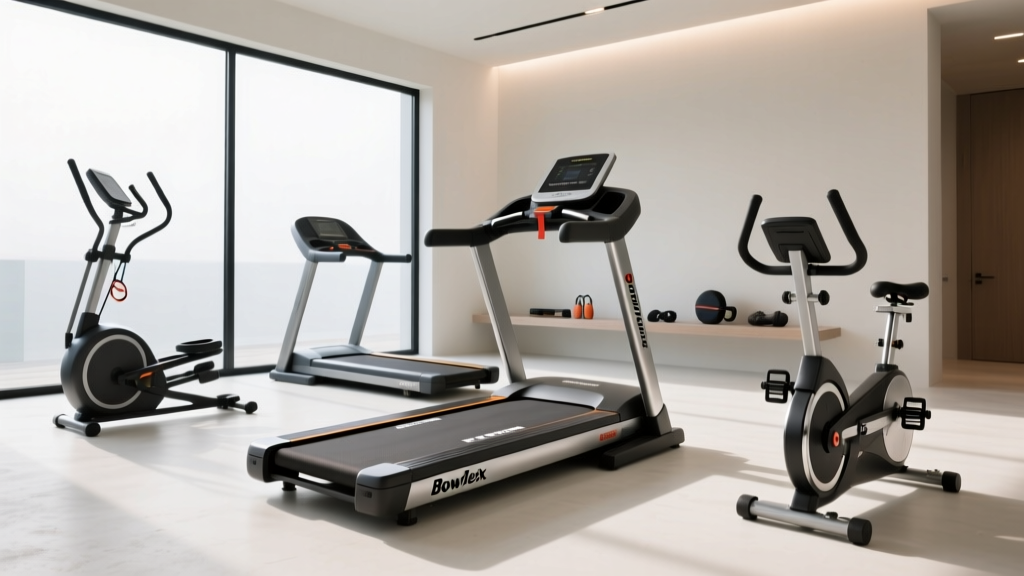
2026 Folding Treadmills for Small Spaces & Beginner Treadmill Workouts
Discover top 2026 folding treadmills for small spaces. We review compact models and share an effective treadmill workout for beginners.

The Architecture of Small-Space Cardio
Designing a home gym in an urban apartment or a compact suburban room requires balancing biomechanical needs with spatial constraints. The primary challenge with cardio equipment is not just the machine's operational footprint, but the required safety clearances, ventilation pathways, and storage geometry. In 2026, the folding treadmill market has evolved beyond simple hinge mechanisms; modern compact treadmills utilize hydraulic drop-folds, dual-axis articulation, and auto-folding bases to reclaim up to 60% of floor space when not in use.
However, a smaller footprint often dictates a shorter running deck and a lower continuous horsepower (CHP) motor. This directly impacts how you should approach a treadmill workout for beginners. Shorter decks (typically 45 to 50 inches compared to the standard 55 to 60 inches) require users to focus on cadence and posture rather than long, bounding strides. Below, we review the most effective space-saving treadmills on the market and provide a structured layout and workout guide tailored for compact environments.
Space Planning Rule of Thumb: Always measure your ceiling height before purchasing a vertical-folding treadmill. Most vertical folds require a minimum of 78 inches of vertical clearance to store safely without scraping drywall or catching on ceiling fans.2026 Folding Treadmill Reviews: Compact Footprints Tested
We evaluated the leading compact treadmills based on folded dimensions, motor reliability, deck shock absorption, and structural rigidity during use.
1. Echelon Stride-S: The Auto-Folding Apartment Hero
Price: $799 | Motor: 1.25 CHP | Deck: 50" x 18"
The Echelon Stride-S remains a top contender for small spaces due to its unique auto-folding mechanism. With the press of a button, the deck folds flat, reducing the footprint to just 12 inches high, 30 inches wide, and 65 inches long. This allows it to slide easily under a standard sofa or bed frame.
- Pros: True under-furniture storage; quiet 1.25 CHP motor ideal for multi-story buildings; integrated tablet shelf.
- Pros/Cons: The 1.25 CHP motor is strictly for walking and light jogging (up to 6.0 mph). It will overheat if used for high-intensity interval sprinting.
- Best For: Walkers and beginners focusing on daily step-count goals rather than marathon training.
2. Sole Fitness F63: Vertical Storage for Serious Beginners
Price: $1,199 | Motor: 3.0 CHP | Deck: 60" x 20"
If your space allows for vertical storage rather than under-bed sliding, the Sole F63 offers commercial-grade specs in a foldable frame. The hydraulic cushioning system reduces joint impact by up to 40% compared to outdoor asphalt, making it an exceptional choice for beginners carrying extra weight or recovering from minor joint issues.
- Pros: 3.0 CHP motor handles sustained running up to 10 mph; full 60-inch deck accommodates tall users; heavy-duty 325 lb weight capacity.
- Cons: Weighs 165 lbs, making it difficult to move on thick carpets without a specialized appliance dolly. Requires 78" vertical clearance.
- Best For: Users transitioning from walking to running who need a full-length deck but still need to fold the machine against a wall post-workout.
3. KingSmith WalkingPad X21: The Dual-Fold Stealth Option
Price: $899 | Motor: 1.5 HP (Peak) | Deck: 47" x 17.5"
The WalkingPad X21 utilizes a patented dual-fold hinge that collapses the treadmill into a remarkably compact 5.1" x 27" x 33" square. It is essentially the size of a large briefcase and can be stored in a closet or stood upright in a corner.
- Pros: Unmatched folded footprint; integrated handle for easy transport; sleek, minimalist aesthetic.
- Cons: No handrails (requires reliance on balance or a nearby desk for support); 47-inch deck causes heel-strike overhang for users over 6'0" at speeds above 3.5 mph.
- Best For: Under-desk walking, strict studio apartments, and users prioritizing absolute minimalism over running capabilities.
Compact Treadmill Comparison Matrix
| Model | Folded Footprint | Motor (CHP) | Deck Length | Max Speed |
|---|---|---|---|---|
| Echelon Stride-S | 12" H x 30" W x 65" L | 1.25 CHP | 50 Inches | 6.0 mph |
| Sole Fitness F63 | 73" H x 30" W x 30" L | 3.0 CHP | 60 Inches | 10.0 mph |
| WalkingPad X21 | 5.1" H x 27" W x 33" L | 1.5 HP (Peak) | 47 Inches | 3.7 mph |
Layout Design: Integrating Cardio into Compact Rooms
Placing a folding treadmill in a small room involves more than just finding an empty wall. Proper layout design ensures structural safety, electrical stability, and noise mitigation.
- Electrical Isolation: Treadmills draw between 10 to 15 amps during motor startup. Never plug your treadmill into a shared power strip with a space heater, window AC unit, or microwave. Dedicate a 15-amp or 20-amp wall circuit to prevent tripped breakers and voltage drops that can fry the treadmill's lower control board.
- Vibration Dampening: If you live in a multi-story building, impact noise transfers through the floor joists. Invest in a 3/4-inch thick PVC or vulcanized rubber equipment mat. This not only protects hardwood floors from sweat corrosion but reduces low-frequency vibration transfer to neighbors below by up to 30%.
- Visual Flow and Lighting: Avoid placing the treadmill facing a blank wall, which increases perceived exertion and boredom. Position the machine facing a window or a mounted monitor. Ensure overhead lighting does not cast a glare on the console display.
Adapting Your Treadmill Workout for Beginners on Short Decks
When designing a treadmill workout for beginners on a compact deck (45" to 50"), stride mechanics must be adjusted. On a standard 60-inch commercial treadmill, beginners naturally take long, reaching strides. On a compact deck, over-striding will cause your heel to strike the rear plastic motor cover, leading to shin splints and potential tripping hazards.
'Compact treadmill users must shift their focus from stride length to stride cadence. Aiming for 110 to 120 steps per minute at a moderate walking pace keeps your center of gravity directly over your hips, naturally shortening your stride and keeping you centered on a 48-inch belt.' — Biomechanics & Urban Fitness Report, 2025
The 20-Minute Compact-Deck Beginner Routine
This routine is optimized for machines like the Echelon Stride-S or WalkingPad X21. It focuses on postural alignment and cadence, adhering to the Centers for Disease Control and Prevention (CDC) guidelines for moderate-intensity cardiovascular health.
- Warm-Up (Minutes 0-5): Walk at 2.0 mph. Focus on keeping your shoulders relaxed and arms swinging naturally. Do not hold the handrails (if equipped), as holding on alters pelvic tilt and reduces caloric expenditure by up to 20%.
- Cadence Build (Minutes 5-10): Increase speed to 3.0 mph. Shorten your stride intentionally. Imagine walking on ice—take quicker, lighter steps rather than long, heavy ones. Target 115 steps per minute.
- Incline Simulation (Minutes 10-15): If your compact treadmill lacks an incline feature, increase the speed to 3.5 mph and actively pump your arms to simulate the cardiovascular demand of a 2% incline. Maintain a strict mid-foot strike.
- Cool Down (Minutes 15-20): Drop speed to 2.2 mph. Focus on deep diaphragmatic breathing. Allow your heart rate to gradually return to baseline before stepping off the moving belt.
Safety Clearances and Structural Limits
Space optimization must never compromise safety. According to the U.S. Consumer Product Safety Commission (CPSC), treadmills require specific clearance zones to prevent severe friction-burn injuries in the event of a fall.
Always maintain a minimum of 24 inches of lateral clearance on both sides of the treadmill belt. More importantly, you must leave at least 48 to 60 inches of clear space directly behind the rear roller. In a small apartment, this means you cannot place the back of the treadmill flush against a wall, a bookshelf, or a glass coffee table. If a user trips and falls backward, the clearance zone allows them to slide off the back of the belt safely rather than becoming pinned between the spinning belt and a solid object.
Furthermore, consult the American Council on Exercise (ACE) guidelines on home gym ergonomics, which recommend maintaining at least 12 inches of clearance above the highest point of the treadmill's elevation (or the user's head) to prevent overhead strikes and ensure adequate air circulation for the motor's cooling fan. By respecting these spatial boundaries, you can safely integrate high-quality cardio equipment into even the most restrictive floor plans.
More gear to consider
All reviews
Treadmill Pickup and Power: 2026 Motor Comparison Guide

Rowing Machine Setup: Beating 10k Steps on Treadmill Time

Air Bike vs Assault Bike: Space Layouts & Water Treadmill for Cats

Walking Pad Review & MPH Treadmill Chart: Fix Common Mistakes
What to Know About Treadmills for Small Spaces: 2026 Budget Guide