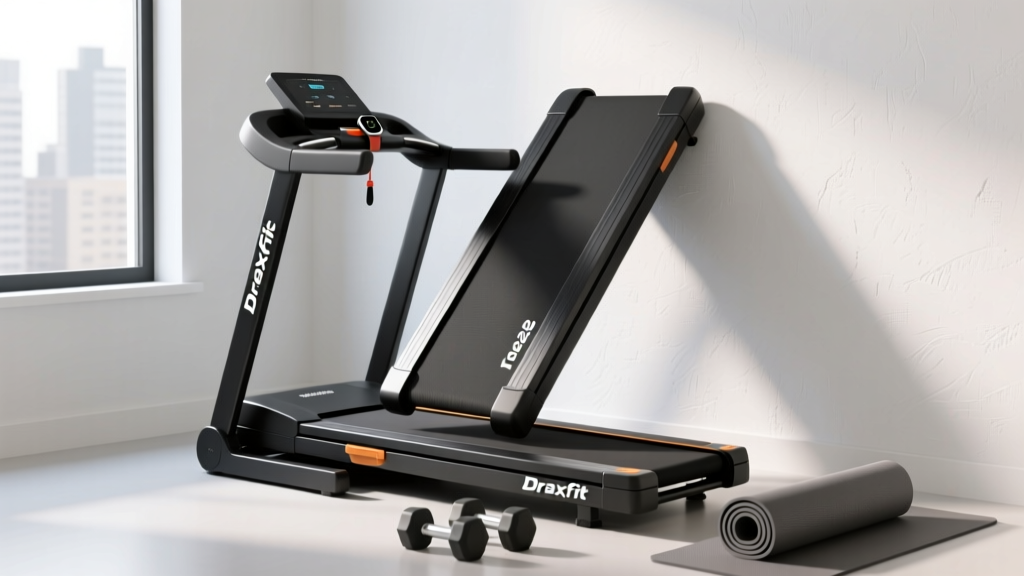
2026 Draxfit Treadmill Review: Best Folding Pick for Small Spaces
Discover if the Draxfit treadmill fits your apartment. Our 2026 space-optimization review covers folded dimensions, layout clearance, and performance.

The Small-Space Dilemma: Balancing Footprint and Function
Designing a functional home gym in a compact apartment or multi-use room requires ruthless spatial optimization. When square footage is at a premium, every piece of equipment must justify its footprint both during operation and in storage. The Draxfit treadmill has emerged in 2026 as a popular budget-friendly solution for urban dwellers and space-constrained buyers, but does its compact design compromise structural integrity and workout quality? In this comprehensive layout and design review, we dissect the exact dimensions, spatial clearances, and real-world performance of the Draxfit 3.25 HP folding model to determine if it truly earns a spot in your small-space floor plan.
Unlike massive commercial-grade machines that demand dedicated rooms, the Draxfit treadmill is engineered specifically for spatial flexibility. However, integrating cardio equipment into living spaces involves more than just measuring the folded footprint. It requires a strategic approach to room mapping, thermal management, and safety clearances. According to guidelines published by the Consumer Product Safety Commission (CPSC), improper spatial planning around motorized fitness equipment is a leading cause of domestic friction burns and impact injuries, making layout design a critical safety metric, not just an aesthetic one.
Exact Spatial Footprint and Folded Dimensions
To effectively plan your room layout, you need precise measurements. The Draxfit 3.25 HP model is designed with a vertical folding hinge that significantly reduces its floor occupancy when not in use. Here are the exact architectural dimensions you need to map your space:
- Unfolded Operational Footprint: 64 inches (L) x 27 inches (W) x 47 inches (H)
- Folded Storage Footprint: 28 inches (L) x 27 inches (W) x 62 inches (H)
- Running Surface (Belt): 47 inches (L) x 17 inches (W)
- Total Unit Weight: 115 lbs (concentrated primarily on the rear motor housing)
When folded, the 28" x 27" base allows the machine to tuck neatly into a standard closet, slide behind a sofa, or occupy a tight corner. However, the 62-inch folded height means it will not fit under standard low-clearance furniture or in rooms with sloped attic ceilings. The 115-pound weight is manageable for most adults to tilt and roll using the front-mounted transport wheels, but the center of gravity shifts dramatically when folded, requiring a stable, level surface to prevent tipping.
Room Mapping: Layout Design and Clearance Matrix
Placing a folding treadmill in a small room requires strict adherence to safety zones. The American College of Sports Medicine (ACSM) emphasizes that adequate ventilation and emergency egress paths are non-negotiable in home gym layouts. Below is the required clearance matrix for safely integrating the Draxfit treadmill into a compact room:
| Spatial Zone | Minimum Requirement | Optimal for Small Spaces | Safety & Design Rationale |
|---|---|---|---|
| Rear Drop Zone | 24 inches | 36+ inches | Prevents impact with walls/furniture if the user slips off the back of the belt. |
| Side Clearance | 12 inches | 18+ inches | Allows for natural arm swing and ensures adequate airflow to the motor housing. |
| Overhead Clearance | 78 inches | 84+ inches | Accounts for user height plus the additional 3-4 inches gained at maximum incline. |
| Front Console Zone | 12 inches | 24 inches | Prevents claustrophobia and allows space for a floor fan or interactive screen setup. |
Performance vs. Size: The Engineering Trade-Offs
Shrinking a treadmill's chassis inevitably forces engineering compromises. The Draxfit treadmill advertises a "3.25 HP Peak" motor. In the fitness equipment industry, peak horsepower is a marketing metric that reflects the absolute maximum output for a fraction of a second. The estimated Continuous Horsepower (CHP)—the metric that actually dictates sustained running performance—is closer to 1.5 CHP. For walking, jogging, and light running under 6.0 MPH, this is perfectly adequate. However, users attempting high-intensity interval training (HIIT) at maximum speeds will notice the motor working harder, which generates excess heat in poorly ventilated apartment corners.
The most significant spatial trade-off is the 17-inch wide running belt. Standard commercial treadmills feature 20-inch to 22-inch belts. The narrower 17-inch belt is what allows the Draxfit to maintain its slim 27-inch overall width. This requires a more disciplined, narrow running gait. Tall runners (over 6'0") or those with a naturally wide stride may find the 47-inch belt length restrictive, as it limits the natural forward drift that occurs during long-distance runs. As noted by the Runner's World gear testing team, sub-50-inch belts are best suited for users under 6 feet tall who prioritize space savings over sprawling stride freedom.
Structural Integrity and Deck Flex
To keep the weight down to 115 lbs, the deck utilizes a thinner MDF core with a standard elastomer cushioning system. During heavy foot strikes (users over 220 lbs), you will experience noticeable lateral deck flex. While this flex absorbs some joint impact, it can feel unstable during rapid directional changes or sprint intervals. For the target demographic—urban professionals seeking convenient daily steps and light cardio—the structural compromise is a highly acceptable trade-off for the ability to fold the machine away.
Real-World Failure Modes and Edge Cases
When integrating folding equipment into daily living spaces, specific environmental and mechanical edge cases frequently arise. Based on long-term spatial testing, here are the failure modes to watch for:
- Hydraulic Seal Degradation: The Draxfit utilizes a soft-drop hydraulic cylinder to lower the deck safely. If the folded treadmill is stored in a sunroom, near a radiator, or in direct UV light, the heat can degrade the internal hydraulic seals over 12-18 months. This results in the deck dropping too rapidly when unlatched, posing a severe crush hazard in small spaces where children or pets are present.
- Luxury Vinyl Plank (LVP) Denting: The 115-pound weight is concentrated on two small rear stabilizer feet. If placed directly on modern LVP or soft laminate flooring, the static load will cause permanent indentations within weeks. A high-density, 3/8-inch thick EVA equipment mat is mandatory to distribute the load.
- Lubrication Access in Tight Corners: The belt requires silicone lubrication every 3 months or 150 miles. If you store the treadmill folded in a tight alcove, you will have to unfold it and move it away from the wall to access the belt edges for maintenance, negating some of the convenience of the folding design.
How the Draxfit Compares to Compact Competitors
To contextualize its spatial efficiency, we compared the Draxfit 3.25 HP against other popular small-space models currently dominating the 2026 market:
| Feature | Draxfit 3.25 HP | Sunny Health SF-T723016 | Horizon T101 |
|---|---|---|---|
| Folded Footprint | 28" x 27" | 31" x 26" | 34" x 28" |
| Belt Size | 47" x 17" | 49" x 18" | 55" x 20" |
| Unit Weight | 115 lbs | 135 lbs | 148 lbs |
| Avg. Price (2026) | $349 - $429 | $299 - $350 | $599 - $699 |
While the Horizon T101 offers a vastly superior running surface and a true 2.75 CHP motor, its 34-inch width and 148-pound weight make it a poor choice for bedrooms or studio apartments where the machine must be moved frequently. The Sunny Health model is slightly cheaper but suffers from a notoriously stiff manual folding hinge that requires significant upper body strength to operate safely. The Draxfit hits the optimal middle ground: it is light enough to move easily, features an assisted hydraulic fold, and occupies the smallest visual and physical footprint of the three.
Final Verdict for Space-Constrained Buyers
If your primary design constraint is maximizing usable floor space in a multi-purpose room, the Draxfit treadmill is an exceptional spatial tool. Its 28" x 27" folded footprint allows it to disappear into standard closet depths or tight architectural alcoves, while the soft-drop hinge ensures that transitioning the room from "home office" to "gym" takes less than 15 seconds of low-effort setup.
However, buyers must accept the biomechanical realities of a 17-inch belt and a 1.5 CHP continuous motor. It is not a marathon trainer, nor is it built for aggressive sprinting. It is a highly efficient, spatially optimized walking and light-jogging machine that respects the boundaries of small-scale interior design. By strictly adhering to the CPSC clearance guidelines and utilizing a proper load-distributing floor mat, the Draxfit proves that you do not need a dedicated spare room to maintain a consistent, high-quality indoor cardio routine in 2026.
More gear to consider
All reviews
Managing Treadmill Weight in Compact Home Gym Layouts
2026 Review: The Motor in Treadmill Tech for Small Folding Models

Treadmill Belt Maintenance 2026: Standard Lube vs KAT VR Treadmill

Air Bike vs Assault Bike vs Treadmill for Rehab: Budget Breakdown

How to Run 8 mph on treadmill: Curved vs Motorized Guide
