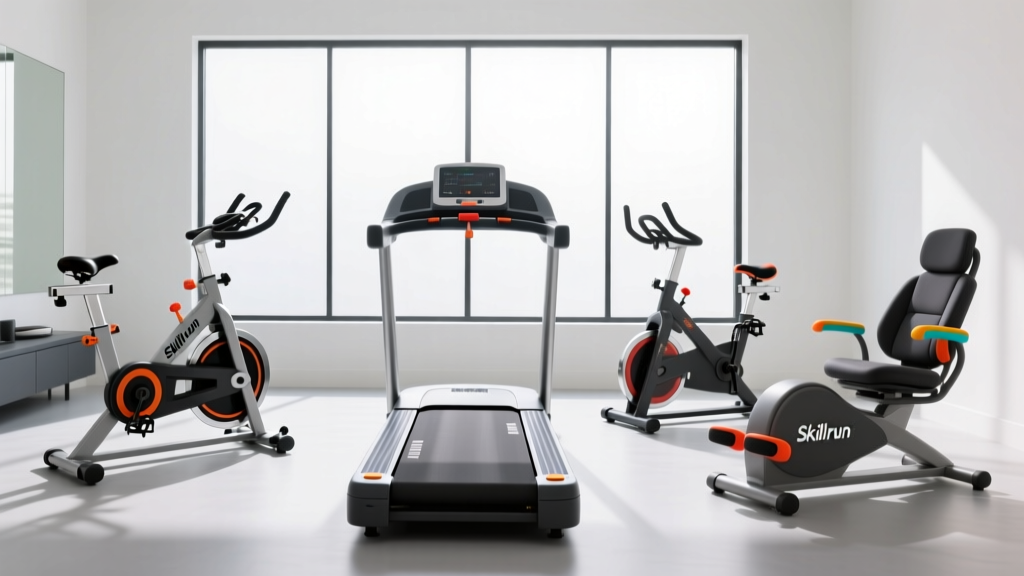
Skillrun Treadmill vs Spin, Upright & Recumbent Bike Budget
Compare the premium Skillrun treadmill against spin, upright, and recumbent bikes. Discover the ultimate 2026 budget breakdown and value analysis.

Allocating a premium home gym budget in 2026 requires ruthless financial pragmatism. When buyers evaluate high-end cardiovascular equipment, the Technogym Skillrun treadmill frequently emerges as the ultimate benchmark for non-motorized, performance-grade engineering. However, dropping over $13,000 on a single piece of equipment forces a critical household question: Does the ROI of a flagship curved treadmill outweigh the versatility and cost-efficiency of building a multi-modal stationary bike fleet?
💡 The 2026 Cardio Budget Dilemma: Are you optimizing for peak athletic performance (Skillrun), or are you prioritizing household utility, rehabilitation, and varied biomechanical engagement (Spin, Upright, and Recumbent bikes)? This guide breaks down the exact costs, hidden fees, and long-term value of each modality.The Premium Benchmark: Skillrun Treadmill Pricing Context
To understand the value of stationary bikes, we must first establish the ceiling of the home cardio market. The Technogym Skillrun is a non-motorized, dual-function treadmill that utilizes a slatted belt and magnetic resistance to simulate sled pushes and parachute sprints. In 2026, the Skillrun retails between $13,500 and $14,500, depending on the integrated screen package and commercial-grade warranty add-ons.
The Value Proposition: You are paying for zero-electricity motor requirements, a 300kg (661 lbs) weight capacity, and biomechanical feedback that reduces joint shear forces compared to traditional motorized treadmills. Yet, for the price of one Skillrun, a consumer could purchase a commercial-grade spin bike, a premium upright bike, and a therapeutic recumbent bike, while still having $8,000 left over for strength equipment.
Stationary Bike Types: A Budget & Value Breakdown
Stationary bikes are not a monolith. The market is strictly segmented into three distinct categories, each serving a unique physiological purpose and price tier. Here is how spin, upright, and recumbent bikes stack up in a value analysis.
1. Spin Bikes (Indoor Cycles)
Spin bikes mimic the aggressive, forward-leaning geometry of outdoor road bikes. They are the undisputed kings of high-intensity interval training (HIIT) and calorie expenditure.
- Budget Tier ($800 - $1,200): The Schwinn IC4 ($999) remains the value champion in 2026. It features a magnetic resistance system, a Poly-V belt drive for silent operation, and dual-sided pedals (SPD and toe cages). It lacks a proprietary screen, relying instead on BYOD (Bring Your Own Device) connectivity to apps like Zwift.
- Premium Tier ($2,000 - $2,800): The Peloton Bike+ ($2,495) includes a rotating 23.8-inch HD touchscreen and auto-follow resistance. The value here is heavily tied to the ecosystem rather than the raw hardware.
- ROI Analysis: Spin bikes offer the highest calorie burn per square foot. However, the aggressive saddle position requires adequate core strength and hip mobility, making them less suitable for multi-generational households with elderly users.
2. Upright Stationary Bikes
Upright bikes feature a more relaxed geometry, a wider plush saddle, and a step-through frame. They engage the core and upper body more than recumbents but lack the aggressive posture of spin bikes.
- The Gold Standard: The Keiser M3i ($2,295) utilizes eddy current magnetic resistance, meaning there are zero friction pads to replace. Its 2-inch V-belt drive and aluminum frame make it virtually maintenance-free for a decade.
- Mid-Range Workhorse: The Sole B94 ($1,299) offers a heavy 48-pound flywheel and a built-in tablet holder, providing a stable, no-nonsense cardio experience without mandatory subscription fees.
- ROI Analysis: Upright bikes are the best "middle ground" for general cardiovascular health. According to the CDC's Physical Activity Guidelines, achieving 150 minutes of moderate-intensity aerobic activity weekly is easily sustained on an upright bike due to the comfortable seating position, leading to higher long-term adherence rates.
3. Recumbent Bikes
Recumbent bikes place the user in a reclined position with a backrest, shifting the workload almost entirely to the lower body while completely offloading the lumbar spine and wrists.
- Rehabilitation & Comfort: The Sole R92 ($1,599) features a 40-pound flywheel and a mesh lumbar-support seat. The step-through design requires minimal hip flexion to mount.
- Budget Option: The Schwinn 270 Recumbent ($899) offers 25 resistance levels and Bluetooth connectivity, making it an exceptional entry-level therapeutic tool.
- ROI Analysis: As noted by the Mayo Clinic's guidelines on aerobic exercise, low-impact modalities are crucial for individuals managing osteoarthritis or recovering from lower-back injuries. A recumbent bike is not just fitness equipment; it is a preventative healthcare investment that extends the active lifespan of aging household members.
Cost-Per-Use & Longevity Matrix
To truly evaluate value, we must look past the MSRP and analyze the 5-year total cost of ownership (TCO), factoring in maintenance, space economics, and subscription fatigue.
| Modality | Benchmark Model | 2026 MSRP | 5-Yr Maintenance | Footprint |
|---|---|---|---|---|
| Non-Motorized Treadmill | Technogym Skillrun | $13,500 | $400 (Belt lube, tensioning) | ~28 sq ft |
| Spin Bike | Schwinn IC4 | $999 | $50 (Pedal straps, sweat wipe-down) | ~8 sq ft |
| Upright Bike | Keiser M3i | $2,295 | $0 (Eddy current magnetic) | ~10 sq ft |
| Recumbent Bike | Sole R92 | $1,599 | $100 (Seat rail grease, belt check) | ~18 sq ft |
Hidden Costs: Subscriptions, Electricity, and Space
When conducting a budget breakdown, the initial purchase price is only the entry fee. The Technogym Skillrun requires a massive physical footprint and, while the belt itself is self-generating, the interactive console requires a Technogym Live subscription (approx. $39/month) to unlock guided sled and parachute simulations. Without it, you are left with a manual push-treadmill.
"The most common failure mode in premium home cardio isn't mechanical; it's financial abandonment. Buyers invest $14,000 in a treadmill, realize the monthly content ecosystem costs another $500 a year, and eventually reduce the machine to a $14,000 clothes rack."
— Home Fitness Industry Analyst Report, 2025
Conversely, bikes like the Keiser M3i or Schwinn IC4 operate on open Bluetooth FTMS protocols. This means you can use free or low-cost third-party apps (like Zwift at $19.99/mo or completely free YouTube cycling tours) without being locked into a proprietary hardware ecosystem. Furthermore, recumbent and upright bikes draw negligible electricity compared to the motorized consoles and cooling fans of high-end treadmills.
The "Split-Budget" Strategy: Maximizing Household ROI
If your total 2026 cardio budget is $14,000 (the price of a single Skillrun), the most mathematically and physiologically sound strategy for a multi-user household is the Barbell Allocation:
- The High-Intensity Node ($1,000): Purchase a Schwinn IC4 for the primary athlete seeking HIIT, sweat-drenching intervals, and Zwift integration.
- The Longevity & Rehab Node ($1,600): Purchase a Sole R92 Recumbent for aging parents, post-partum recovery, or days when the primary athlete needs active recovery without spinal compression.
- The Capital Reallocation ($11,400 Remaining): Reinvest the remaining budget into a commercial-grade functional trainer, a full rack of adjustable dumbbells, and premium shock-absorbing gym flooring.
Final Verdict: Where Should Your Money Go?
The Skillrun treadmill is an unparalleled piece of engineering for elite athletes, sprinters, and sports-performance facilities where budget is secondary to biomechanical data. However, for 95% of home gym owners, the value analysis heavily favors stationary bikes.
By diversifying your budget across spin, upright, and recumbent bikes, you accommodate different joint-health requirements, eliminate single-point-of-failure subscription lock-ins, and free up thousands of dollars to build a more holistic, well-rounded home fitness environment. In 2026, true value isn't about buying the most expensive machine on the market; it's about buying the right tool for your body's daily reality.
More gear to consider
All reviews
Echelon Stride Sport Treadmill: 2026 Compact Cardio Market Trends

Walking Pad Treadmill Costco Guide & Office Layout Design 2026

Rowing Machine Guide & Technique: Beyond Lubricating Horizon Treadmill
True ES900 Treadmill vs Under Desk Treadmills: Office Use Review
Stair Treadmill & Cardio Machine Noise: 2026 Buyer Guide
